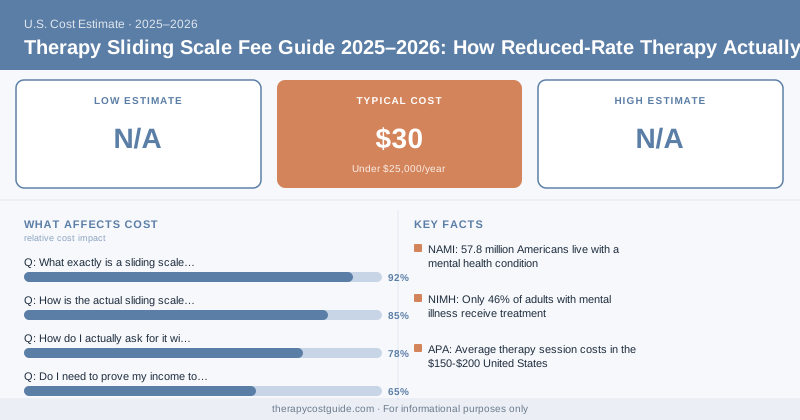
Therapy Sliding Scale Fee Guide 2025–2026: How Reduced-Rate Therapy Actually Works
{ if eq .Lang "zh" }{ else }{ end }Q: What exactly is a sliding scale fee?
A: It’s a reduced session rate a therapist offers at their own discretion, based on your reported income or financial situation, rather than a fixed rate for everyone. Instead of charging every client $150 per session, a therapist offering a sliding scale might charge anywhere from $40 to $150 depending on where you fall on their income chart.
Q: How is the actual sliding scale rate calculated?
A: There’s no universal formula — it varies by therapist. Some use a simple chart tied to income brackets (for example, under $30,000/year pays $50, $30,000–$60,000 pays $80, above that pays full rate). Others ask you to self-report what you can genuinely afford without a formal chart. A few structure it around household size combined with income, similar to how federal poverty guidelines work.
| Income Bracket (individual) | Typical Sliding Scale Rate |
|---|---|
| Under $25,000/year | $30 – $60/session |
| $25,000 – $50,000/year | $60 – $100/session |
| $50,000 – $75,000/year | $90 – $130/session |
| Above $75,000/year | Full rate, typically $120 – $250/session |
These brackets vary significantly by therapist and region — treat them as a general pattern, not a fixed standard.
Q: How do I actually ask for it without feeling awkward?
A: Simply ask directly during a consultation call: “Do you offer a sliding scale, and how does it work?” This is a completely normal question therapists expect and field regularly — you’re not asking for a special favor, you’re asking about an existing part of many practices’ pricing structure.
Why Sliding Scale Slots Are Often Limited
Most private-practice therapists operate as small businesses with real overhead — rent, insurance, continuing education requirements. A therapist can typically only sustain a handful of significantly reduced-rate clients (often just 1–3) while keeping the rest of their caseload at standard rates, because sliding scale slots directly reduce their practice’s revenue. This is why sliding scale slots frequently have waitlists. Asking several therapists, rather than waiting on just one, meaningfully improves your odds of finding an open slot.Q: Where can I find therapists who explicitly offer sliding scale rates?
A: Directories like Open Path Collective specialize specifically in connecting clients to therapists offering reduced rates ($40–$70/session, verified across their whole network), Psychology Today’s directory has a filter for sliding scale, and community mental health centers often use formal, larger-scale sliding fee schedules tied to federal poverty guidelines rather than individual therapist discretion.
Q: Is sliding scale therapy lower quality than full-rate therapy?
A: No — sliding scale is a pricing accommodation, not a reflection of a therapist’s training or skill level. Many highly experienced, fully licensed therapists offer sliding scale slots as part of their practice’s values around access, alongside full-rate clients who fund the rest of the practice.
Q: Do I need to prove my income to qualify?
A: Practices vary. Some ask for informal self-report with no documentation; others, particularly larger sliding-fee clinics, may ask for a pay stub or tax return, similar to how federally qualified health centers verify income for their fee schedules.
Bottom Line
Sliding scale fees typically range from $30–$130 per session based on income, compared to $120–$250 full rate. Slots are often limited, so ask multiple therapists directly and check dedicated directories like Open Path Collective, which specialize in connecting clients specifically to reduced-rate care.
{ if eq .Lang "zh" }Disclaimer: TherapyCostGuide provides cost information for educational purposes only. We are not a mental health provider and do not offer clinical advice or treatment. Cost ranges are based on national survey data and vary significantly by location, provider credentials, practice setting, and insurance plan. Always consult a licensed mental health professional for treatment decisions. If you are in crisis, call or text 988 (Suicide & Crisis Lifeline) or go to your nearest emergency room.