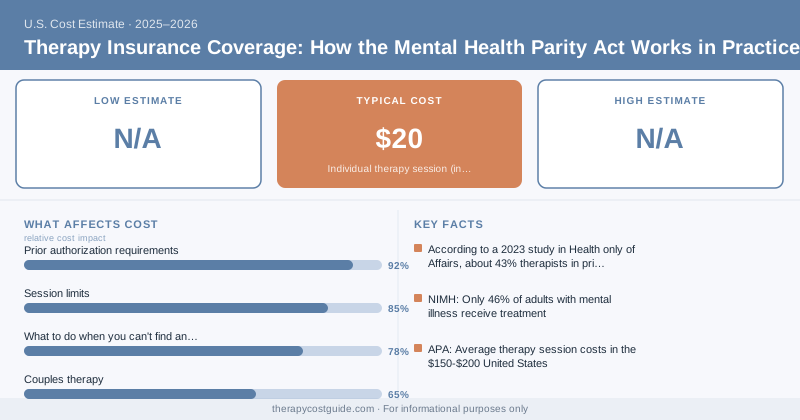
Therapy Insurance Coverage: How the Mental Health Parity Act Works in Practice
{ if eq .Lang "zh" }{ else }{ end }In 2008, Congress passed the Mental Health Parity and Addiction Equity Act. The idea was simple: insurance plans that cover mental health couldn’t treat it worse than physical health. In 2024, the Biden administration strengthened those rules significantly.
And yet: millions of Americans still can’t access in-network mental health care, still get denied claims, and still pay far more out of pocket for therapy than for a specialist visit. Here’s why — and what you can actually do about it.
What the Mental Health Parity Act Requires
The Mental Health Parity and Addiction Equity Act (MHPAEA) requires that health insurance plans that cover mental health and substance use disorder benefits apply the same cost-sharing rules to those benefits as to medical/surgical benefits.
In plain terms:
- Your mental health copay must be comparable to your specialist copay
- Your deductibles for mental health can’t be higher than for medical
- Prior authorization requirements can’t be stricter for mental health than for comparable medical services
- Session limits can’t be applied to mental health if no similar limits apply to medical conditions
How to Use Parity Law to Challenge Denials
If your insurer charges a higher copay for therapy than for specialist visits, or imposes a session cap that doesn’t apply to other specialty care, this may violate federal parity law. To file a complaint:
- Request a Parity Compliance Review from your state insurance commissioner
- File a complaint with the Department of Labor (for employer-sponsored plans) at dol.gov
- Contact your state attorney general’s consumer protection division
You can also request a “non-quantitative treatment limitation (NQTL) comparison” from your insurer — they’re legally required to provide documentation showing their mental health restrictions are no more stringent than medical/surgical equivalents. Many insurers struggle to comply with this requirement.
What Insurance Typically Covers for Therapy
Most employer-sponsored health plans and ACA marketplace plans include mental health benefits. Here’s what coverage typically looks like:
| Service | Typical In-Network Cost | Notes |
|---|---|---|
| Individual therapy session (in-network) | $20 – $60 copay | After deductible, per session |
| Group therapy | $15 – $40 copay | Per group session |
| Initial psychiatric evaluation | $40 – $80 copay | Higher copay for initial |
| Medication management (psychiatry) | $20 – $60 copay | Like specialist visit |
| Intensive outpatient program (IOP) | 20–40% coinsurance | After deductible |
| Inpatient psychiatric | 20% coinsurance, daily copay | Varies widely by plan |
The In-Network Access Problem
Here’s the practical issue: the law requires insurance to cover mental health, but it doesn’t require therapists to accept insurance. And increasingly, they don’t.
According to a 2023 study in Health Affairs, only about 43% of therapists in private practice were accepting new patients who had insurance. The therapist shortage combined with low reimbursement rates means that having insurance coverage doesn’t guarantee you can find an in-network provider with availability.
What to do when you can’t find an in-network therapist:
Call your insurance’s member services and ask them to find an in-network therapist with openings in your area. If they can’t find one within a reasonable distance, this may trigger a “network adequacy” requirement to cover out-of-network care at in-network rates.
Request an “out-of-network exception” or “continuity of care” authorization — especially if you’re mid-treatment with an out-of-network provider.
Use your out-of-network benefits if you have them. Many PPO plans reimburse 50–70% of the “allowed amount” for OON mental health services.
Prior Authorization for Mental Health
Many insurers require prior authorization for:
- Initial psychiatric hospitalization
- Intensive outpatient programs (IOPs)
- Residential treatment
- Extended individual therapy (beyond a certain number of sessions per year)
Prior authorization for ongoing outpatient therapy is supposed to be no more burdensome than prior auth for comparable medical services under MHPAEA. In practice, mental health prior auth is often more complex.
If your therapist’s office says prior auth is required, ask your insurer: “What is the equivalent medical/surgical service that also requires prior authorization?” This is the parity comparison question. If mental health requires prior auth but comparable physical health services don’t, that’s a potential parity violation.
What Insurance Almost Never Covers
Despite parity requirements, some things are routinely excluded:
- Couples therapy (usually not covered unless treating one partner’s diagnosis)
- Marriage counseling
- Life coaching (not a clinical service)
- Online-only platforms (BetterHelp, some Talkspace plans)
- Out-of-network therapy without OON benefits on your plan
Disclaimer: TherapyCostGuide provides cost information for educational purposes only. We are not a mental health provider and do not offer clinical advice or treatment. Cost ranges are based on national survey data and vary significantly by location, provider credentials, practice setting, and insurance plan. Always consult a licensed mental health professional for treatment decisions. If you are in crisis, call or text 988 (Suicide & Crisis Lifeline) or go to your nearest emergency room.