Therapy HSA/FSA Eligible 2025–2026: What Qualifies and How to Use Your Account
{ if eq .Lang "zh" }{ else }{ end }The IRS allows you to pay for therapy with pre-tax dollars through an HSA or FSA — which means the effective cost of your therapy sessions drops by whatever your marginal tax rate is. At a 22% marginal rate, a $150 therapy session effectively costs you $117. That’s real savings. Here’s exactly how to use these accounts for mental health care.
2025 HSA and FSA Contribution Limits
| Account Type | 2025 Contribution Limit | Who Can Contribute |
|---|---|---|
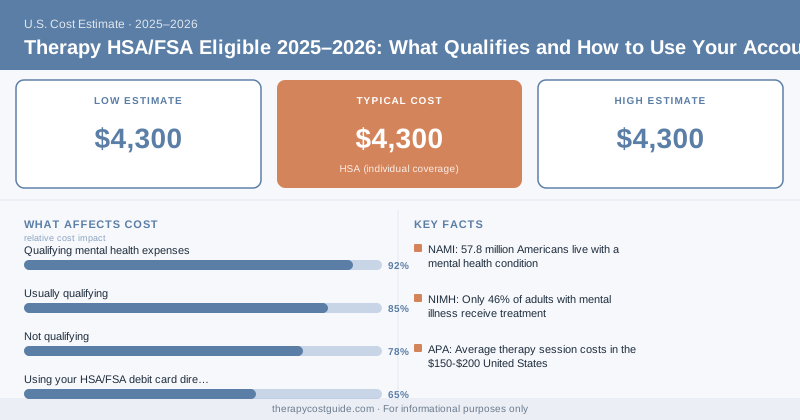
| HSA (individual coverage) | $4,300 | Employee + employer |
| HSA (family coverage) | $8,550 | Employee + employer |
| FSA (general purpose) | $3,300 | Employee (employer may add) |
| FSA Dependent Care | $5,000 (or $2,500 if married filing separately) | Employee |
| HSA catch-up (age 55+) | +$1,000 | Employee |
These limits are set by the IRS and adjusted annually for inflation. The 2025 limits reflect a modest increase from 2024.
What Mental Health Services Qualify for HSA/FSA
The IRS’s general rule: expenses qualify if they’re for the “diagnosis, cure, mitigation, treatment, or prevention of disease, or for the purpose of affecting any structure or function of the body.” For mental health, this covers a wide range.
Qualifying mental health expenses:
- Individual therapy sessions with a licensed therapist (LCSW, LPC, psychologist, LMFT)
- Psychiatric evaluation and psychiatric follow-up visits
- Medication management appointments
- Prescription psychiatric medications (antidepressants, anxiolytics, mood stabilizers, ADHD medications)
- Inpatient psychiatric hospitalization
- Partial hospitalization and intensive outpatient programs
- TMS (transcranial magnetic stimulation) treatments
- ECT (electroconvulsive therapy)
- Spravato (esketamine) treatments
- Substance use disorder treatment programs
Usually qualifying:
- Telehealth therapy sessions (same rules apply as in-person)
- Couples therapy IF the primary purpose is treating a diagnosed mental health condition
- EMDR, CBT, DBT — any evidence-based therapeutic modality
Not qualifying:
- General counseling without a mental health diagnosis (life coaching, career counseling)
- Couples therapy purely for relationship improvement with no diagnosed condition
- Online therapy for general wellness (without medical necessity documentation)
- Marriage retreats, wellness apps (in most cases)
Marriage/Couples Therapy and HSA/FSA
Couples therapy is a gray area. If the purpose is treating a diagnosed mental health condition (one partner’s anxiety disorder, PTSD, depression), it qualifies. If it’s purely for relationship enhancement without a medical diagnosis, it typically doesn’t. Your therapist can provide documentation of the medical necessity for tax purposes. When in doubt, request a Letter of Medical Necessity (LMN) from your provider.How to Pay for Therapy with HSA or FSA
Using your HSA/FSA debit card directly: Most HSA and FSA providers issue debit cards. Many therapy practices, psychiatry offices, and telehealth platforms accept these as direct payment. You can pay directly at the time of service, same as any debit card.
Pay out of pocket and reimburse yourself: If you prefer to pay by other means (check, credit card), you can pay out of pocket and then submit a reimbursement claim to your HSA/FSA administrator. You’ll need documentation: an itemized receipt showing the date, provider name, service provided, and amount. Most therapist offices can provide this on request.
Important: For HSA accounts, keep receipts. The IRS can audit HSA withdrawals; you need to be able to document that each distribution was for a qualifying medical expense.
Online Therapy Platforms and HSA/FSA
Most major online therapy platforms are not eligible for direct HSA/FSA payment through the platform itself — this has been a source of confusion for patients.
- BetterHelp: Does NOT accept HSA/FSA cards directly. The subscription is positioned as general “wellbeing” rather than medical care. However, if your therapist provides an itemized receipt or letter of medical necessity for a diagnosed condition, you may be able to self-submit for reimbursement.
- Talkspace: Accepts FSA/HSA for therapy when prescribed for a medical condition. Can provide documentation.
- Brightside: The medication management component is HSA/FSA eligible. Therapy sessions through Brightside may be as well with documentation.
- Cerebral: Varies. The medication management component qualifies; care counseling (non-licensed support) may not.
The Tax Savings Math
For context on what this actually saves:
At 22% marginal federal tax rate + 6% state:
- $200 therapy session: saves $56 (effective cost $144)
- $150/month Brightside subscription: saves $42/month ($504/year)
- $6,000 TMS course: saves $1,680
These aren’t trivial. If you’re paying cash for therapy, using HSA or FSA dollars is one of the simplest ways to reduce your effective cost.
For HSA specifically: contributions are pre-tax going in, grow tax-free, and withdrawals are tax-free for qualified expenses. If you contribute to the 2025 maximum ($4,300 individual) and use it entirely for mental health care, the tax savings at a 24% combined marginal rate is approximately $1,032.
FSA vs. HSA: Key Differences
| Feature | HSA | FSA |
|---|---|---|
| Eligibility requirement | Must have qualifying high-deductible health plan (HDHP) | Most employer health plans qualify |
| Funds roll over | Yes (no use-it-or-lose-it) | Use-it-or-lose-it (most plans) |
| Contribution control | Can contribute throughout year | Elected at enrollment; fixed |
| Investment option | Yes (once balance exceeds threshold) | No |
| Ownership | Yours, even if you change jobs | Employer’s account |
HSA is often the better long-term option if you qualify (HDHP enrollment required). FSA is a “spend it down” annual benefit useful for predictable mental health expenses.
Bottom Line
Therapy, psychiatric care, medications, TMS, ECT, and most mental health services are HSA and FSA eligible when medically necessary. The 2025 HSA limit is $4,300 individual/$8,550 family. Using these accounts for mental health care reduces your effective cost by your marginal tax rate — typically 22–32%. Keep documentation, use your debit card when accepted, or submit itemized receipts for reimbursement. Online therapy platform HSA eligibility varies — check with your specific platform and FSA/HSA administrator.
{ if eq .Lang "zh" }Disclaimer: TherapyCostGuide provides cost information for educational purposes only. We are not a mental health provider and do not offer clinical advice or treatment. Cost ranges are based on national survey data and vary significantly by location, provider credentials, practice setting, and insurance plan. Always consult a licensed mental health professional for treatment decisions. If you are in crisis, call or text 988 (Suicide & Crisis Lifeline) or go to your nearest emergency room.