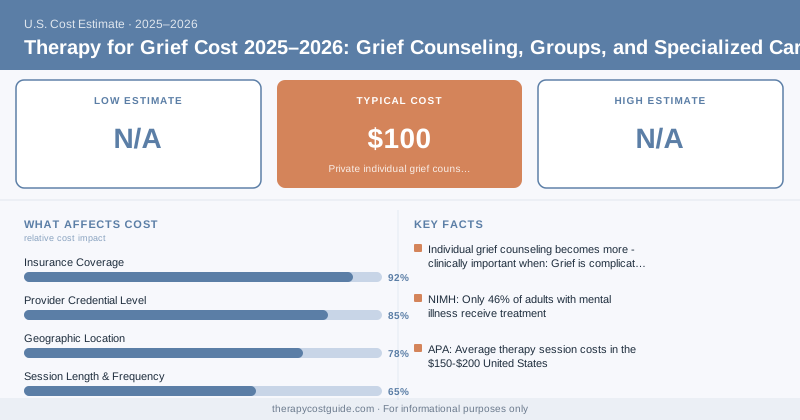
Therapy for Grief Cost 2025–2026: Grief Counseling, Groups, and Specialized Care
{ if eq .Lang "zh" }{ else }{ end }Most people assume grief “just needs time” — that seeing a therapist for it means something has gone wrong. That assumption is outdated. In 2022, the American Psychiatric Association formally added prolonged grief disorder to the DSM-5-TR, recognizing that for a meaningful subset of people, grief doesn’t resolve with time alone and benefits from structured clinical treatment.
Here’s what that treatment actually costs.
Grief Therapy Costs by Format
| Format | Typical Cost |
|---|---|
| Private individual grief counseling | $100 – $200/session |
| In-network insurance (with billable diagnosis) | $20 – $50 copay |
| Hospice bereavement services (post-loss) | Free, typically 13 months |
| Hospital-affiliated grief support group | Free – $20/session |
| Community grief nonprofit (e.g., local grief center) | Free – $60/session, sliding scale |
| Specialized prolonged grief disorder treatment (12-week protocol) | $1,200 – $2,400 total |
Why Hospice Grief Support Is Often Free — And Often Overlooked
If your loved one was under hospice care before passing, Medicare-certified hospice programs are required to offer bereavement support to surviving family members for at least 13 months after the death, at no cost. This is a federally mandated benefit tied to the hospice program itself, not to your personal insurance — meaning it’s available regardless of your own coverage status. Many families never use this benefit because no one tells them it exists once the immediate paperwork of a death is behind them.
When Grief Becomes Prolonged Grief Disorder
Typical grief, even when intensely painful, tends to gradually ease within the first year. Prolonged grief disorder is diagnosed when intense yearning, preoccupation with the loss, and functional impairment persist beyond 12 months for adults (6 months for children) and significantly disrupt daily life. Structured protocols like Prolonged Grief Disorder Therapy (a 16-session evidence-based treatment) have strong outcomes data and typically run $1,200–$2,400 for the full course, often insurance-billable now that the condition has a formal diagnostic code.Free and Low-Cost Grief Resources
- Hospice bereavement programs — free for 13 months following a hospice-supported death, regardless of your insurance
- The Dinner Party and similar peer grief communities — free, peer-facilitated grief groups, often for younger adults
- Local funeral homes — many offer free short-term grief support groups as a community service
- GriefShare and faith-based grief programs — low-cost or donation-based, widely available through community organizations
When to Pay for Individual Therapy Instead of a Free Group
Free grief groups work well for many people experiencing typical bereavement — they offer community, normalization, and low cost. Individual grief counseling becomes more clinically important when:
- Grief is complicated by trauma (a sudden, violent, or traumatic death)
- Symptoms meet criteria for prolonged grief disorder (persisting intensely beyond a year)
- Depression, suicidal ideation, or substance use has developed alongside the grief
- The loss involves complicated relational dynamics that a group format can’t adequately address
Research on prolonged grief disorder suggests it affects roughly 7–10% of bereaved individuals — a minority, but a large enough group in absolute numbers that specialized treatment access matters.
Bottom Line
Free grief support — through hospice programs, community groups, and nonprofits — is genuinely sufficient for many people navigating typical bereavement. Paid individual therapy, at $100–$200/session or $1,200–$2,400 for a structured prolonged grief disorder protocol, becomes important when grief is complicated, prolonged beyond a year, or accompanied by other mental health symptoms.
{ if eq .Lang "zh" }Disclaimer: TherapyCostGuide provides cost information for educational purposes only. We are not a mental health provider and do not offer clinical advice or treatment. Cost ranges are based on national survey data and vary significantly by location, provider credentials, practice setting, and insurance plan. Always consult a licensed mental health professional for treatment decisions. If you are in crisis, call or text 988 (Suicide & Crisis Lifeline) or go to your nearest emergency room.