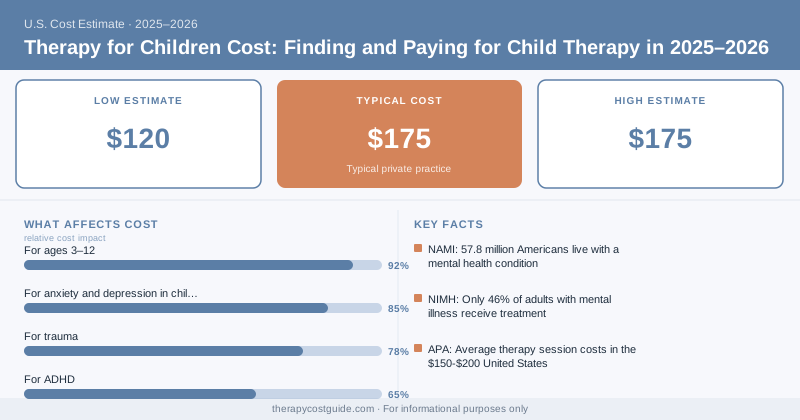
Therapy for Children Cost: Finding and Paying for Child Therapy in 2025–2026
{ if eq .Lang "zh" }{ else }{ end }One in 6 U.S. children between the ages of 2 and 8 has a diagnosed mental, behavioral, or developmental disorder — according to CDC surveillance data. Yet fewer than half of children who need mental health services receive them, with cost and access as the primary barriers.
Here’s the full picture: what child therapy costs, what options exist at every price point, and how to navigate a system that’s genuinely difficult to access.
Child Therapy Session Costs
| Setting | Cost Per Session | Notes |
|---|---|---|
| Private practice child therapist | $100 – $250 | Licensed clinician specializing in children |
| Group practice child therapist | $90 – $200 | Often more insurance contracts |
| Community mental health center | $10 – $80 | Sliding scale, income-based |
| School-based therapist | Often free | During school hours, school district funded |
| Hospital outpatient clinic | $80 – $200 | Often covered by insurance |
| University training clinic | $20 – $70 | Supervised doctoral students |
| Telehealth child therapist | $70 – $180 | Ages 6+ generally; platform or private |
| Typical private practice | $120 – $175 | Most U.S. markets |
Parent consultation sessions — which most child therapists schedule every 3–6 sessions — run the same per-session rate as child sessions and add 15–25% to the overall cost.
What Credentials Should a Child Therapist Have?
There’s no specific “child therapist” license. Child therapy is a specialization within existing mental health credentials. Look for:
For ages 3–12: Therapists with play therapy training — ideally the RPT (Registered Play Therapist) credential from the Association for Play Therapy. Behavioral therapy training for conduct and oppositional problems.
For anxiety and depression in children: Training in Child/Adolescent CBT, which has the strongest evidence base. The Child Anxiety Network and ABCT maintain directories of CBT-trained child therapists.
For trauma: TF-CBT (Trauma-Focused CBT) trained therapists — verify at tfcbt.org/practitioner-search. TF-CBT is the most evidence-supported trauma treatment for children and adolescents.
For ADHD: PCIT (Parent-Child Interaction Therapy) for ages 2–7 has excellent evidence for behavioral management. Behavioral parent training programs for older children.
For autism spectrum: Providers trained in ABA (Applied Behavior Analysis), DIR/Floortime, or PEERS (social skills) depending on the child’s age and goals.
How Parents Fit Into Child Therapy
For younger children, parents are not just present — they’re often central to treatment. Models like PCIT put parents in the room. TF-CBT has specific caregiver components. CBT for child anxiety involves parenting modules. Most evidence-based child treatments recognize that changing the child’s environment (which largely means supporting the parents) is as important as changing the child’s behavior or cognition. Expect to be an active participant, not just a driver who drops off the child. Therapists who never involve parents in child treatment for elementary-age children should give you pause.Free and Low-Cost Options Most Parents Don’t Know About
School-based mental health services: Public schools provide counseling and therapy through school counselors and school psychologists. For children with qualifying diagnoses, mental health services can be included in an IEP (Individualized Education Program) or 504 Plan — provided at no cost to the family.
For children with significant mental health needs affecting school functioning, you can request an evaluation and potentially have school-based therapy written into the IEP as a related service.
Community mental health centers: Every county in the United States has some form of publicly funded mental health services. Services are income-based sliding scale and may be free for families below certain income thresholds. Quality varies, but these centers often specialize in the most serious presentations (psychosis, severe depression, crisis stabilization).
CHIP (Children’s Health Insurance Program): For families who earn too much for Medicaid but can’t afford private insurance, CHIP provides low-cost or free health insurance for children — and must cover mental health services under mental health parity law. Check coverage at healthcare.gov or your state CHIP website.
Medicaid: If your child qualifies for Medicaid, mental health services including therapy are covered. Medicaid-participating child therapists exist in most areas, though access can be more limited than commercial insurance.
APA reports that access to child mental health services is one of the most significant equity gaps in the U.S. healthcare system, with children in low-income households and rural areas disproportionately underserved despite having equal or greater rates of mental health needs.
Insurance Coverage for Child Therapy
Child therapy is covered by insurance when:
- The therapist is in-network and licensed
- There is a qualifying diagnosis (e.g., anxiety disorder, ADHD, adjustment disorder, depression)
- The treatment is deemed medically necessary
Typical in-network copay for child therapy: $20–$60/session after deductible.
Key insurance considerations for children:
- Mental Health Parity Act applies to children’s services
- Essential Health Benefits under the ACA require mental health coverage in most plans sold through the marketplace
- CHIP provides mental health coverage; specific benefits vary by state
- EPSDT (Early and Periodic Screening, Diagnostic and Treatment): Medicaid’s child benefit requires coverage of all medically necessary services, including mental health — with potentially stronger coverage than adult Medicaid
If a claim is denied, appeal. “Medical necessity” denials for child therapy are often successfully appealed with supporting documentation from the treating therapist and referring pediatrician.
Waitlists: The Real Access Barrier
The practical reality in many U.S. markets is not cost — it’s availability. NAMI documents that the shortage of child mental health providers has created waitlists of 3–12 months for child therapists in many communities.
Strategies while waiting:
- Ask to be on multiple therapists’ waitlists simultaneously
- Request school-based mental health support as a bridge
- Talk to your pediatrician — many pediatricians can provide interim support for anxiety or depression, and some practices have embedded behavioral health counselors
- Explore telehealth: wait times are often shorter for virtual appointments, and telehealth is appropriate for most common child mental health presentations (ages 6+ generally)
Finding a Child Therapist
- Psychology Today: Filter by age range (children), condition, and insurance
- TF-CBT Practitioner Search: tfcbt.org/practitioner-search (for trauma-specialized child therapists)
- APT therapist directory: a4pt.org (for play therapy trained providers)
- Your pediatrician: Most pediatric practices maintain referral lists and can point to vetted local providers
- Your school counselor: Often knows community child therapists and their waitlist status
- SAMHSA’s treatment locator: findtreatment.samhsa.gov — includes community mental health centers
Disclaimer: TherapyCostGuide provides cost information for educational purposes only. We are not a mental health provider and do not offer clinical advice or treatment. Cost ranges are based on national survey data and vary significantly by location, provider credentials, practice setting, and insurance plan. Always consult a licensed mental health professional for treatment decisions. If you are in crisis, call or text 988 (Suicide & Crisis Lifeline) or go to your nearest emergency room.