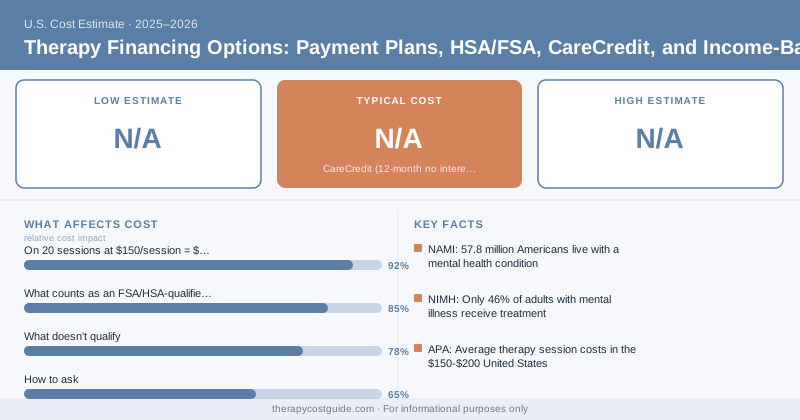
Therapy Financing Options: Payment Plans, HSA/FSA, CareCredit, and Income-Based Programs
{ if eq .Lang "zh" }{ else }{ end }You need therapy. You can’t pay $175/session out of pocket, your deductible resets in January, and you don’t qualify for sliding scale because your income is “too high” — but nowhere near enough to absorb $700/month in therapy costs. You’re not alone. Here are the concrete financing options that actually work, what each one costs, and how to use them.
Therapy Financing Options Compared
| Option | Effective Cost | Best For | Catch |
|---|---|---|---|
| HSA/FSA pre-tax dollars | 22–37% savings | Employed with HSA/FSA access | Must have qualifying account |
| Payment plans with therapist | Full rate, spread out | Cash flow management | Requires therapist agreement |
| CareCredit (12-month no interest) | Full rate, deferred interest | Large one-time bills | Deferred interest if not paid in full |
| Employer EAP advance | $0 for initial sessions | Any employee | Only 3–12 sessions |
| Income-based FQHC sliding scale | $0 – $50/session | Low-to-moderate income | Service limitations |
| Flexible payment apps (Splitit, etc.) | Full rate, installments | Spreading out session costs | Requires credit card |
HSA and FSA: The Most Powerful Underused Tool
Health Savings Accounts (HSA) and Flexible Spending Accounts (FSA) let you pay for therapy with pre-tax dollars. If you’re in the 22% federal tax bracket, every dollar you spend on therapy through an HSA/FSA effectively costs you 78 cents. In the 32% bracket, it costs 68 cents.
On 20 sessions at $150/session = $3,000 in therapy:
- 22% bracket + 5% state tax: Effective cost = $2,190 (save $810)
- 32% bracket + 8% state tax: Effective cost = $1,800 (save $1,200)
HSA: Available if you have a High-Deductible Health Plan (HDHP). 2025 contribution limits: $4,300 individual / $8,550 family. Money rolls over indefinitely. Therapy from a licensed provider is an HSA-qualified expense.
FSA: Available through most employer benefit plans regardless of plan type. 2025 contribution limits: $3,200. Use-it-or-lose-it (with limited rollover provisions). Therapy is FSA-qualified.
What counts as an FSA/HSA-qualified therapy expense:
- Sessions with licensed therapists (LCSW, LPC, psychologist, MFT, MD)
- Psychiatric medication copays
- Telehealth therapy sessions
What doesn’t qualify:
- Life coaching (not a licensed medical service)
- Wellness apps without a letter of medical necessity
- Non-licensed counseling services
Getting a Letter of Medical Necessity for Therapy
Some FSA/HSA purchases that aren’t automatically qualified become qualified with a “Letter of Medical Necessity” from your treating provider. For example, certain mental health apps or tools prescribed by your therapist as part of treatment can become FSA-eligible with an LMN.
Ask your therapist or psychiatrist to write an LMN if you’re using mental health tools that aren’t automatically FSA-qualified. The letter needs to state that the item is being used as part of treatment for a diagnosed condition.
Payment Plans: How to Negotiate With Your Therapist
Most therapists don’t advertise payment plans, but many will agree to them. This works especially well for:
- Getting through a high-deductible period before insurance kicks in
- Managing the cost of intensive treatment (weekly + medication)
- Covering a gap between losing insurance and getting new coverage
How to ask: “I’d like to work with you, but I’m struggling with the upfront cost right now. Would you be willing to set up a payment plan where I pay [X amount] per session now and make up the difference over [X months]?”
Most therapists would rather keep a client on a payment plan than lose them entirely. The key is asking directly and proposing specific terms rather than vague requests.
Common plan structures:
- Pay 50% per session, pay remainder at end of each month
- Pay reduced rate now, true up quarterly
- Pay reduced rate indefinitely (this becomes a de facto sliding scale)
Get any payment plan in writing — even a brief email confirmation — to avoid confusion later.
CareCredit for Mental Health
CareCredit is a healthcare credit card accepted by many therapists, psychiatric practices, and treatment facilities. It offers promotional financing periods:
12-month no-interest: If you pay the full balance within 12 months, no interest accrues. A $3,000 therapy course would cost $3,000 total if paid off within a year.
24-60 month reduced APR: For larger balances, longer terms at 14.9% APR (reduced from standard credit card rates).
The crucial warning: CareCredit uses deferred interest, not true 0% interest. If you don’t pay the full balance within the promotional period, interest accrues retroactively from the purchase date at the standard rate (26.99% APR). This can turn a $3,000 bill into a $3,500+ bill if you miss the deadline.
CareCredit works well when you: Have a specific, defined cost (a 12-session therapy course, a PHP program) that you can calculate and budget to pay within the promotional period.
CareCredit works poorly when you: Have ongoing indefinite therapy costs that may extend beyond the promotional period, or when you’re not confident you can pay the balance in time.
SAMHSA and Federal Income-Based Programs
SAMHSA’s Substance Abuse Prevention and Treatment Block Grants: Fund treatment for income-qualifying individuals at community mental health centers and FQHCs. Services may be free or on a sliding scale. Find options at findtreatment.gov.
National Health Service Corps Loan Repayment: Mental health providers working in underserved areas receive loan repayment assistance in exchange for working in federally designated shortage areas. These providers often charge sliding-scale rates because they’re placed in underserved communities.
330-funded FQHCs: Any FQHC receiving Section 330 funding must provide services regardless of ability to pay. The sliding scale is set by federal law using family income relative to federal poverty guidelines.
What the sliding scale typically looks like at an FQHC:
| Income Level (as % FPL) | Fee |
|---|---|
| 100% or below | $0 – nominal |
| 101–150% | Very low nominal fee |
| 151–200% | Moderate sliding-scale |
| 200%+ | Nominal to standard rate |
For 2025, 100% of the federal poverty level is approximately $15,060 for a single individual.
Using Your Benefits During the Deductible Period
If you have a $2,000 deductible and it’s January, you’re paying full session costs until you meet it. Strategies:
Front-load high-cost services: If you know you’ll need intensive treatment (PHP, IOP), consider accessing it early in the year to meet your deductible faster. All remaining services that year benefit from post-deductible cost-sharing.
Coordinate with medical care: Every medical expense counts toward your deductible. If you have other healthcare needs early in the year (dental, vision if integrated, medical procedures), these contribute to meeting your mental health deductible too.
HSA/FSA to bridge: Use HSA/FSA to cover the deductible period cost with pre-tax dollars, reducing the effective cost as described above.
Employer-Based Financing Resources
Beyond EAP, some employers offer additional mental health support:
Behavioral health carve-outs: Some employer health plans contract separately with behavioral health companies (Lyra Health, Spring Health, Modern Health) that provide covered therapy sessions with no or low copay, outside the standard insurance structure. Check your benefits portal for these.
Employee hardship funds: Larger employers sometimes have employee assistance funds for non-reimbursed healthcare costs. HR can tell you if this exists and whether mental health costs qualify.
COBRA and grace periods: If you’ve lost insurance, COBRA allows continuation of coverage for up to 18 months (at full premium cost). The first month of COBRA is often expensive — but if you have significant mental health needs, it may be more cost-effective than a gap in coverage leading to postponed care.
The bottom line: therapy financing is not one-size-fits-all. Most people who successfully manage therapy costs use a combination of 2–3 of these approaches simultaneously — HSA dollars for the session copay, payment plan for a deductible gap, and EAP sessions to bridge a coverage transition.
{ if eq .Lang "zh" }Disclaimer: TherapyCostGuide provides cost information for educational purposes only. We are not a mental health provider and do not offer clinical advice or treatment. Cost ranges are based on national survey data and vary significantly by location, provider credentials, practice setting, and insurance plan. Always consult a licensed mental health professional for treatment decisions. If you are in crisis, call or text 988 (Suicide & Crisis Lifeline) or go to your nearest emergency room.