Student Therapy Cost: Campus Counseling vs. Graduate Clinics vs. Insurance
{ if eq .Lang "zh" }{ else }{ end }If you’re a college student, your therapy options are better than almost anyone else’s — and most students don’t know it. Campus counseling centers are often free. Your student health insurance usually covers mental health. And if you need more than a campus counseling center can provide, graduate training clinics charge $20–$60 per session.
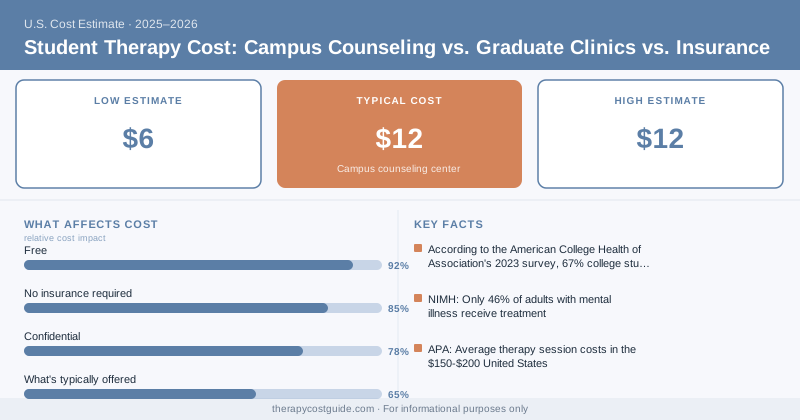
According to the American College Health Association’s 2023 survey, 67% of college students reported experiencing overwhelming anxiety in the past year, and 44% reported depression. Mental health is the defining student health issue of this generation — and campuses have responded with expanded resources.
Campus Counseling Centers: The Free First Option
Most four-year colleges and universities include a counseling center as part of tuition and fees. Access is typically:
- Free: Included in student fees you’ve already paid
- No insurance required: Your parent’s plan isn’t needed and doesn’t need to cover it
- Confidential: Not reported to parents, financial aid offices, or academic records
What’s typically offered:
- Individual counseling sessions (often 6–12 per academic year)
- Group therapy (often unlimited)
- Crisis intervention (often walk-in)
- Psychiatric consultations (often limited — for medication evaluation, not ongoing management)
The limitation: Session limits. Most campus counseling centers limit individual sessions because demand far exceeds capacity. According to APA’s Center for Workforce Studies, student-to-counselor ratios at many institutions are 1,000:1 or worse.
| Student Therapy Option | Cost | Availability |
|---|---|---|
| Campus counseling center | Often free | Limited (6–12 sessions/year typically) |
| Student health insurance (in-network) | $0–$40 copay | Wide, if plan is good |
| Graduate psychology training clinic | $20–$60/session | Moderate; check your university |
| Open Path Collective | $30–$80/session | $65 membership fee |
| Community mental health center | $0–$40/session | Varies by city |
| BetterHelp/Talkspace (student discounts) | $40–$70/week | Good for mild concerns |
Student Health Insurance: Better Than You Think
Most colleges offer student health insurance plans, and many require students to enroll (though you can often waive with proof of comparable coverage). Student health plans must comply with ACA requirements, including mental health parity.
What student health insurance typically covers:
- Individual outpatient therapy: $15–$40 copay in-network
- Psychiatric evaluation and medication management
- Inpatient psychiatric care (important for crisis situations)
- Prescription psychiatric medications
The challenge: student health plans often have narrow networks, and off-campus therapists may be out-of-network.
Graduate Psychology Training Clinics on Campus
Many universities with psychology graduate programs run training clinics that offer therapy at reduced rates to the general community — including other students. These are distinct from the student counseling center:
Graduate training clinic (psychology department):
- Services delivered by advanced graduate students under close faculty supervision
- Licensed faculty review cases and supervise all clinical work
- Evidence-based therapies including CBT, DBT-informed, and trauma-focused approaches
- Cost: $20–$60/session on sliding scale
- Access: Usually open to students from other departments, community members, and university staff
This is an excellent option for students who’ve used up their campus counseling sessions or need more specialized care.
When to Go Beyond the Campus Counseling Center
Campus counseling centers are excellent for: adjustment issues, relationship problems, academic stress, mild-to-moderate anxiety and depression.
You should seek off-campus care when:
- You’ve used the session limit and still need ongoing support
- You have a more complex condition (OCD, bipolar disorder, eating disorder, trauma) that requires specialized treatment
- Your symptoms are severe or you’re in crisis frequently
- You need medication management beyond what campus psychiatry can provide
Your campus counseling center can typically refer you to appropriate community resources and, in some cases, coordinate with community providers.
Online Therapy Options for Students
Several platforms offer student discounts or student-specific features:
- BetterHelp: Offers financial aid to students; $60–$90/week for unlimited messaging plus live sessions
- Talkspace: Has university partnership programs at some schools
- Calm App / Headspace: Not therapy, but free subscriptions available through many universities for mindfulness tools
Caution: Online messaging therapy (as distinct from video sessions) is not clinical therapy in the traditional sense. It can be supportive but isn’t equivalent to structured individual therapy for significant mental health conditions.
Mental Health Crisis Resources for Students
If you’re in crisis on campus:
- Campus counseling center crisis line: Most run 24/7 crisis phone access even outside hours
- 988 Suicide and Crisis Lifeline: Call or text 988, 24/7, free
- Campus safety/emergency services: For immediate safety concerns
- Student health services: Can facilitate emergency psychiatric evaluation
Many campuses also have mental health first aid-trained residential advisors (RAs) who can be your first point of contact.
Disclaimer: TherapyCostGuide provides cost information for educational purposes only. We are not a mental health provider and do not offer clinical advice or treatment. Cost ranges are based on national survey data and vary significantly by location, provider credentials, practice setting, and insurance plan. Always consult a licensed mental health professional for treatment decisions. If you are in crisis, call or text 988 (Suicide & Crisis Lifeline) or go to your nearest emergency room.