Stellate Ganglion Block for PTSD: Cost, Coverage, and What the Research Shows
{ if eq .Lang "zh" }{ else }{ end }PTSD affects 6% of Americans at some point in their lifetime, according to the National Center for PTSD — about 12 million people in any given year. For combat veterans, the rate is significantly higher: 11–30% depending on the conflict.
Most PTSD treatments are psychological: prolonged exposure, cognitive processing therapy, EMDR. They work. But they take time, require verbal engagement with trauma, and don’t reach everyone. Stellate ganglion block is different. It’s a neck injection. And the results from military research centers have been striking enough that it’s now being used at Walter Reed and other military facilities.
Here’s what it costs, how it works, and what you need to know before pursuing it.
What SGB Costs
| Protocol / Setting | Cost Per Injection | Notes |
|---|---|---|
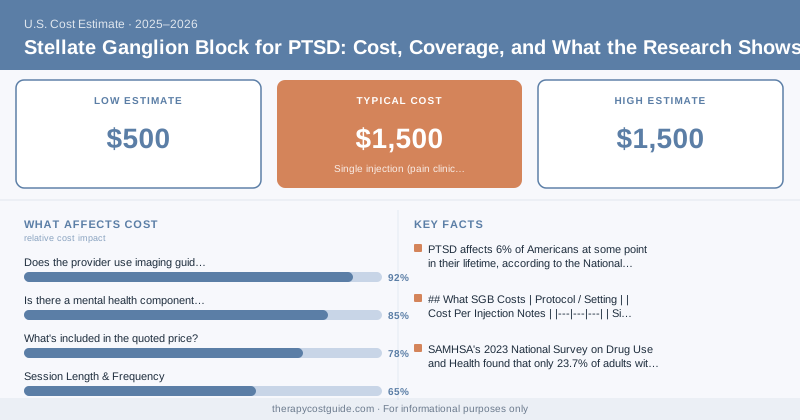
| Single injection (pain clinic / anesthesiology) | $500 – $1,500 | Standard pain management setting |
| Single injection (specialty PTSD clinic) | $1,000 – $2,500 | Psychological screening + imaging included |
| Two-injection protocol (both sides) | $1,000 – $5,000 | Full bilateral course; 1–4 weeks between injections |
| VA or military facility (when available) | $0 – co-pay | Limited availability; requires referral and approval |
| Re-treatment (after 12–24 months) | Same as initial | Some patients need repeat treatment |
The variation within those ranges is real. A pain management anesthesiologist who does SGB routinely for neck pain may charge $600 per injection. A specialized PTSD clinic with a full intake evaluation, psychiatric screening, and imaging-guided injection may charge $2,000–$2,500 per injection but include more clinical infrastructure.
Imaging guidance (ultrasound or fluoroscopy) matters for safety — the stellate ganglion sits near major blood vessels and nerves in the neck. Providers who use real-time imaging cost more but carry less procedural risk.
How SGB Works
The stellate ganglion is a cluster of sympathetic nerve cells in the neck, roughly at the level of the C6 vertebra. It’s part of the sympathetic nervous system — the system that governs fight-or-flight responses.
In PTSD, the theory (supported by neuroimaging evidence from researchers at Walter Reed) is that nerve growth factor (NGF) signaling causes the sprouting of excess sympathetic nerve fibers, essentially wiring the brain for a heightened alarm state. The result is hyperarousal that doesn’t regulate down even when the threat is gone.
Injecting local anesthetic into the stellate ganglion temporarily blocks sympathetic signaling in that region. The hypothesis, supported by growing trial data, is that this “reset” allows the brain’s alarm system to recalibrate. The local anesthetic wears off in hours — but the therapeutic effect appears to last months to years in many patients.
The Walter Reed Research
The most rigorous trial to date (published in JAMA Psychiatry in 2019 and followed by a Phase 3 trial) was led by researchers at Walter Reed National Military Medical Center. The Phase 3 randomized controlled trial found that active-duty service members with PTSD showed significantly greater symptom reduction from SGB compared to sham injection. The researchers used the PTSD Checklist (PCL-5) as the primary measure. Effect sizes were clinically meaningful — not just statistically significant.FDA Status: Cleared but Off-Label for PTSD
SGB is FDA-cleared as a procedure — the technique is established and widely used in pain medicine for conditions like hot flashes, complex regional pain syndrome, and arrhythmias. However, it is not FDA-approved specifically for PTSD. That designation requires a new drug application or device approval pathway, which doesn’t apply to injection procedures.
“Off-label” in this context means the evidence base is serious (multiple RCTs, including military-funded Phase 3 data) but formal regulatory approval for this specific indication hasn’t been obtained. Physicians can legally offer it; insurance often won’t cover it.
VA and TRICARE Coverage: Where Things Stand in 2026
| Coverage Source | Status | Notes |
|---|---|---|
| VA (Veterans Affairs) | Limited, facility-dependent | Some VAMCs offer under clinical access; no system-wide policy |
| TRICARE (active duty) | Possible with prior auth | SGB is covered for approved indications; PTSD requires appeal |
| Private insurance | Rarely covered | Off-label use; prior authorization typically denied |
| Medicare / Medicaid | Not routinely covered | May be covered if billed for primary pain indication |
| HSA / FSA | Eligible | Qualified medical expense; no insurance required |
Veterans seeking SGB through the VA should ask their primary care team for a referral to pain management or anesthesiology and specifically mention the PTSD indication. The VA has been publishing internal guidance following the Phase 3 trial results, but rollout is uneven across facilities.
Some veterans pursue SGB at civilian clinics and then appeal to the VA for reimbursement — this is a longer process with inconsistent outcomes but has worked for some.
Comparing SGB to TMS and Ketamine for PTSD
All three represent newer, intervention-based approaches to PTSD that go beyond talk therapy:
| Treatment | Total Cost | Sessions | Mechanism | Evidence Level |
|---|---|---|---|---|
| Stellate Ganglion Block | $1,000 – $5,000 | 1–2 injections | Sympathetic nervous system reset | RCTs including Phase 3 military data |
| TMS (transcranial magnetic stimulation) | $6,000 – $12,000 | 30–36 sessions over 6–8 weeks | Prefrontal cortex stimulation | FDA-cleared for depression; off-label for PTSD |
| Ketamine (IV infusions) | $2,400 – $4,800 | 6 infusions over 2–3 weeks | NMDA receptor modulation | Strong evidence for depression; off-label for PTSD |
TMS has FDA clearance for major depression and OCD, and is increasingly used off-label for PTSD. Ketamine therapy has the fastest onset for mood symptoms but may require maintenance sessions. SGB is the most targeted and has the most direct PTSD-specific trial data, but its insurance coverage situation is the least favorable of the three.
What to Look For in a Provider
Not all providers offering SGB have specific PTSD expertise. When evaluating:
- Does the provider use imaging guidance? (Ultrasound or fluoroscopy — not landmark-based blind injection)
- Do they have experience with PTSD patients specifically, or primarily chronic pain patients?
- Is there a mental health component to the intake? Some clinics pair SGB with follow-up therapy; some do not
- What’s included in the quoted price? (Imaging, follow-up, the second injection if using bilateral protocol)
SAMHSA’s 2023 National Survey on Drug Use and Health found that only 23.7% of adults with PTSD received any mental health treatment in the past year. Cost and access are real barriers. SGB doesn’t fix that equation, but for the right candidate — particularly treatment-resistant PTSD or PTSD with prominent hyperarousal symptoms — it’s one of the more evidence-backed options available outside traditional psychotherapy.
{ if eq .Lang "zh" }Disclaimer: TherapyCostGuide provides cost information for educational purposes only. We are not a mental health provider and do not offer clinical advice or treatment. Cost ranges are based on national survey data and vary significantly by location, provider credentials, practice setting, and insurance plan. Always consult a licensed mental health professional for treatment decisions. If you are in crisis, call or text 988 (Suicide & Crisis Lifeline) or go to your nearest emergency room.