Spravato (Esketamine) Cost 2025–2026: What Each Treatment Actually Costs
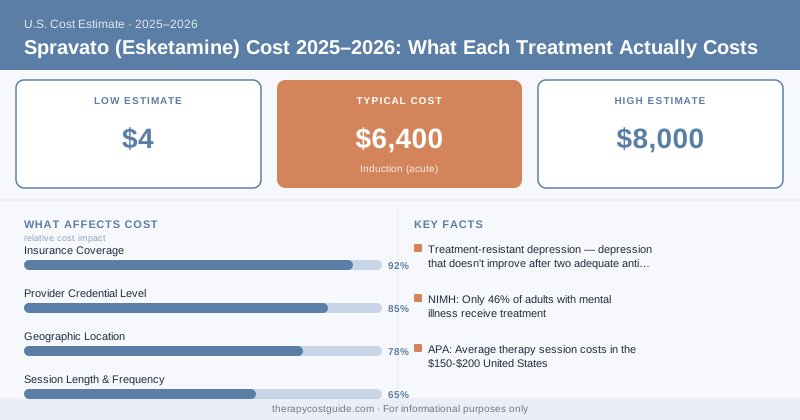
{ if eq .Lang "zh" }{ else }{ end }Treatment-resistant depression — depression that doesn’t improve after two adequate antidepressant trials — affects an estimated 30% of the roughly 21 million Americans with major depressive disorder, according to NIMH. For that population, Spravato (esketamine) is the first genuinely new treatment mechanism approved by the FDA in decades. It also costs $800–$1,000 per session.
Here’s exactly what you’re paying for and how to navigate the coverage landscape.
What Spravato Costs Per Session and Per Course
| Treatment Phase | Sessions | Frequency | Total Cost (Cash) |
|---|---|---|---|
| Induction (acute) | 8 sessions | Twice weekly x 4 weeks | $6,400 – $8,000 |
| Continuation | 4 sessions | Weekly x 4 weeks | $3,200 – $4,000 |
| Maintenance | Ongoing | Every 1–2 weeks | $800–$1,000/session |
| Administration fee (per session) | — | — | $100 – $300 additional |
The $800–$1,000 is the drug cost alone. Treatment centers typically add an administration and monitoring fee — usually $100–$300/session — since you must stay on-site for at least 2 hours after each treatment. The total per-session cost at a comprehensive treatment center often runs $1,000–$1,300.
A complete induction course of 8 sessions costs $8,000–$10,400 with administration fees. Most patients require ongoing maintenance treatment to sustain the response.
The REMS Program: Why Spravato Can’t Be Taken at Home
Spravato is administered as a nasal spray that you use yourself — but you do it at a certified healthcare facility. The FDA required a REMS (Risk Evaluation and Mitigation Strategy) program for esketamine due to its dissociative effects and abuse potential.
Under REMS requirements:
- Spravato can only be dispensed to certified healthcare settings (not retail pharmacies)
- Patients must be observed at the facility for at least 2 hours after each dose
- You cannot drive yourself home — you need a driver for every session
- The facility must be enrolled in the REMS program and follow specific monitoring protocols
This makes each session a multi-hour time commitment in addition to the cost. Budget 3–4 hours per session: travel, dosing, 2-hour monitoring, recovery.
Insurance Coverage
Spravato has FDA approval for two indications:
- Treatment-resistant depression (TRD) — failed at least two adequate antidepressant trials
- Major depressive disorder with acute suicidal ideation or behavior (MDSI)
For both indications, most major commercial insurers now cover Spravato, but with strict prior authorization requirements. Typical requirements:
- Documentation of 2–3 adequate antidepressant failures
- Current concurrent antidepressant therapy
- Psychiatric diagnosis confirmation
- Sometimes: requirement for inpatient or partial hospitalization evaluation first
With insurance coverage, out-of-pocket costs are typically the facility’s copay or coinsurance for the procedure, plus the drug copay — often $50–$150/session total for patients with decent commercial coverage.
Medicare Part B covers Spravato when administered in a clinical setting. Prior authorization applies.
What the Evidence Shows
The FDA approval of Spravato was based on two pivotal trials showing significant reduction in depression symptoms compared to placebo at 4 weeks for TRD patients. A key aspect of the trial results: Spravato worked faster than traditional antidepressants — most patients see some response within 24–48 hours rather than the 4–8 weeks required for SSRIs.
The response rate in pivotal trials was approximately 50–55% for meaningful improvement, with about 25–30% achieving remission. These are modest numbers — it’s not a cure — but for patients with TRD who’ve failed multiple other treatments, even a 50% response rate represents a significant therapeutic option.
The duration of benefit varies. Some patients maintain improvement with periodic maintenance sessions. Others lose benefit over time. Response is unpredictable, which complicates the cost-benefit calculation for any individual patient.
Spravato vs. Ketamine Infusions: What’s Different
Spravato (esketamine) is the nasal spray form of ketamine’s S-enantiomer, FDA-approved specifically for depression. IV ketamine infusions use racemic ketamine (both R and S forms) and are widely used off-label for depression — but aren’t FDA-approved for that indication.
| Treatment | FDA Approved for Depression | Typical Session Cost | Insurance Coverage |
|---|---|---|---|
| Spravato (esketamine nasal spray) | Yes (TRD, MDSI) | $800–$1,300/session | Yes (with prior auth) |
| IV ketamine infusion | No (off-label) | $400–$800/session | Rarely covered |
Ketamine infusions are cheaper per session but typically not covered by insurance. Spravato is more expensive but increasingly covered. For patients with insurance, Spravato is often the more cost-effective choice despite the higher sticker price.
Is Spravato Worth the Cost?
For treatment-resistant depression where multiple antidepressants have failed, Spravato represents one of the few evidence-backed options with a novel mechanism. The cost of $8,000–$10,000 for an induction course is significant, but must be compared against the cost of untreated TRD — lost productivity, hospitalizations, and ongoing suffering. With insurance coverage (which most commercial plans now provide), the patient cost is manageable for many. Without insurance, it’s financially prohibitive for most people.Bottom Line
Spravato costs $800–$1,000 per treatment session (drug cost) plus $100–$300 in administration fees, totaling $8,000–$10,400 for a standard 8-session induction course. Insurance coverage is available for FDA-approved indications but requires documentation of treatment resistance and prior authorization. The REMS program requires every session to occur at a certified facility with a 2-hour observation period. For true treatment-resistant depression, it’s the most accessible novel treatment option currently available.
{ if eq .Lang "zh" }Disclaimer: TherapyCostGuide provides cost information for educational purposes only. We are not a mental health provider and do not offer clinical advice or treatment. Cost ranges are based on national survey data and vary significantly by location, provider credentials, practice setting, and insurance plan. Always consult a licensed mental health professional for treatment decisions. If you are in crisis, call or text 988 (Suicide & Crisis Lifeline) or go to your nearest emergency room.