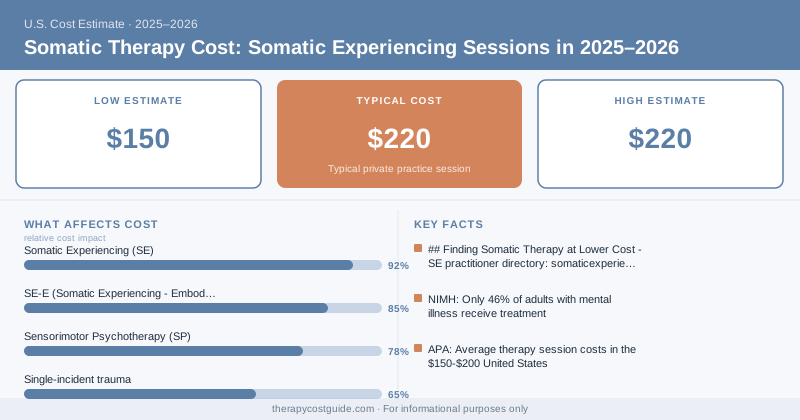
Somatic Therapy Cost 2026: $100–$250 per Session (Body-Based Trauma Therapy)
{ if eq .Lang "zh" }{ else }{ end }The body keeps the score. That phrase — from Bessel van der Kolk’s landmark 2014 book — captured something that trauma survivors had known for decades: talk therapy doesn’t always touch what’s stored in the nervous system. Somatic therapy was built specifically for that gap.
Here’s what it costs, what the different models are, and who it’s actually for.
Somatic Therapy Costs by Provider Type
| Provider Type | Cost Per Session | Notes |
|---|---|---|
| Somatic Experiencing Practitioner (SEP) | $100 – $250 | SE-certified, any base license |
| Licensed therapist with SE training | $120 – $230 | LCSW, LPC, or PhD with SE cert |
| Sensorimotor Psychotherapy practitioner | $120 – $240 | Pat Ogden’s parallel model |
| Community mental health clinic | $40 – $100 | Sliding scale, limited access |
| Typical private practice session | $140 – $200 | Most U.S. markets |
Sessions are typically 50–60 minutes. Some practitioners offer extended 75–90 minute sessions for deep trauma work, often at 1.5x the standard rate.
Somatic Experiencing vs. Sensorimotor Psychotherapy
These are the two dominant somatic trauma models in U.S. practice, and they’re frequently confused.
Somatic Experiencing (SE) is Peter Levine’s model, derived from his observation that prey animals complete the physiological threat-response cycle without developing lasting trauma. SE works by tracking bodily sensations, “titrating” (working in small doses) exposure to trauma activation, and helping the nervous system complete interrupted defensive responses. Full SEP certification requires approximately 216 hours of training across three modules, personal SE sessions, supervision, and peer consultation — a process that typically spans three years and costs the practitioner $6,000–$10,000.
Sensorimotor Psychotherapy (SP) is Pat Ogden’s parallel model, integrating attachment theory and body-centered techniques with cognitive and emotional processing. SE and SP are both well-developed approaches. Neither is definitively superior; the choice often depends on practitioner availability in your area.
SE-E (Somatic Experiencing - Embodiment) is a newer SE variant that more explicitly addresses relational and attachment trauma — particularly useful when developmental wounds (early childhood, caregiver relationships) are central.
Why Titration Matters in Somatic Work
SE practitioners don’t run 8-session protocols on purpose. Moving through trauma too quickly overwhelms the nervous system and can worsen symptoms rather than help. “Titration” — working in small, carefully paced doses — is built into the model because physiological regulation changes at the speed of biology, not cognition. This is the main reason somatic therapy takes longer and costs more in total than protocol-based treatments like EMDR or CPT.Does Insurance Cover Somatic Therapy?
The short answer: sometimes. The determining factor isn’t whether the therapy is “somatic” — it’s your therapist’s licensure.
A licensed LCSW, LPC, MFT, or psychologist who also holds SE or SP certification can bill insurance using standard outpatient psychotherapy codes (90834, 90837). The specific somatic techniques don’t change the billing. The insurer sees a licensed clinician providing outpatient therapy for a covered diagnosis — it goes through.
If your somatic practitioner’s primary credential is in a body-based field without clinical mental health licensure (massage therapy, physical therapy, movement therapy), insurance coverage for psychotherapy services generally isn’t available.
NIMH research has increasingly validated body-based trauma approaches. A 2021 pilot published in Frontiers in Psychology showed significant PTSD symptom reduction with SE in a veteran population. The VA has also started funding SE training for some providers treating combat veterans — a meaningful signal from a major payer.
How Many Sessions Will You Need?
Somatic therapy doesn’t have a fixed session count. Broadly:
- Single-incident adult trauma (accident, assault, medical event): 15–30 sessions
- Complex/developmental trauma: 40–80+ sessions over 2–4 years
- Concurrent somatic work alongside talk therapy: Some people do monthly or bimonthly SE sessions rather than weekly, extending the timeline but reducing monthly cost
At $160/session weekly for 24 sessions, you’re looking at $3,840 total. For a 60-session complex-trauma course: $9,600. That long-term cost is the main financial reality check for somatic approaches.
According to the American Psychological Association, PTSD affects approximately 3.5% of U.S. adults each year — roughly 9 million people — with higher rates in trauma-exposed populations. Many of these individuals don’t respond fully to first-line treatments, which is exactly where somatic approaches find their clinical niche.
Who Is Somatic Therapy For?
Somatic therapy is particularly well-suited for:
- Trauma and PTSD where standard talk therapy hasn’t been sufficient
- Complex/developmental trauma with significant physical symptoms (chronic pain, dysregulation, dissociation)
- Chronic pain with trauma history — SE addresses the nervous system contributions to pain maintenance
- Anxiety with strong physical symptoms — racing heart, gut reactivity, muscular tension that doesn’t respond to cognitive approaches
It’s less indicated for acute situational problems that respond well to CBT, or for conditions where the evidence base clearly favors a specific protocol (OCD, specific phobias, panic disorder).
Finding Lower-Cost Somatic Therapy
- SE practitioner directory at somaticexperiencing.com — filter by location, ask about sliding scale
- Open Path Collective: Some SE-trained clinicians offer $30–$80 sessions for qualifying incomes
- Hakomi Institute: Another somatic model with its own practitioner network, sometimes at lower rates
- Research participants: Academic medical centers studying SE sometimes recruit participants for free or reduced-cost treatment
- Group somatic skills programs: Not clinical therapy, but some practitioners run group nervous-system regulation workshops for $30–$60/session as a lower-cost entry point
Disclaimer: TherapyCostGuide provides cost information for educational purposes only. We are not a mental health provider and do not offer clinical advice or treatment. Cost ranges are based on national survey data and vary significantly by location, provider credentials, practice setting, and insurance plan. Always consult a licensed mental health professional for treatment decisions. If you are in crisis, call or text 988 (Suicide & Crisis Lifeline) or go to your nearest emergency room.