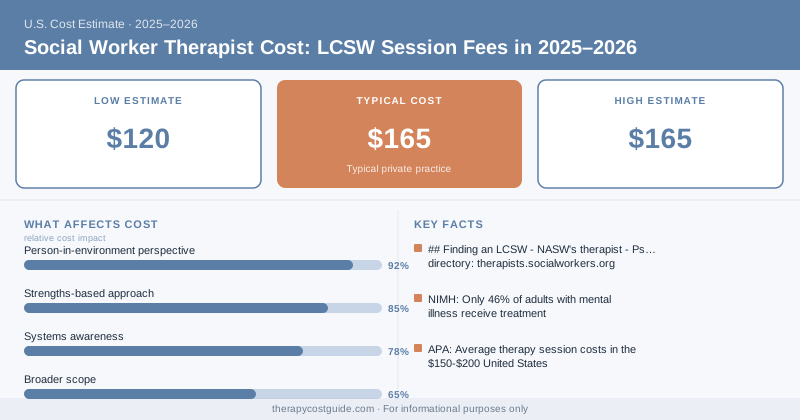
Social Worker Therapist Cost: LCSW Session Fees in 2025–2026
{ if eq .Lang "zh" }{ else }{ end }Clinical social workers are the largest single group of licensed mental health providers in the United States — with over 300,000 LCSWs in practice according to the Bureau of Labor Statistics. They’re also among the most likely to work in community, hospital, and underserved settings where access to mental health care is otherwise limited.
Here’s what LCSW therapy costs and what distinguishes the social work model.
LCSW Session Costs
| Setting | Cost Per Session | Notes |
|---|---|---|
| Private practice LCSW | $100 – $200 | Most common private pay range |
| Hospital-based LCSW (outpatient) | $80 – $160 | Often has broader insurance contracts |
| Community mental health LCSW | $10 – $80 | Sliding scale or government-funded |
| School/university counseling LCSW | Often free or low-cost | Student or school-employee benefit |
| Online LCSW (telehealth) | $60 – $140 | Platform or independent telehealth |
| EAP (employer assistance) | $0 (employer-paid) | 6–12 free sessions |
| Typical private practice | $120 – $165 | Most U.S. markets |
LCSW fees are nearly identical to LPC/LMHC fees at the same practice level. The credential type doesn’t predictably drive fee differences within the master’s-level provider tier.
What Is an LCSW and What Does the Credential Require?
LCSW stands for Licensed Clinical Social Worker. The credential requires:
- MSW (Master of Social Work) from an accredited program — typically 2 years, 60 credit hours
- Supervised clinical hours: 2,000–3,000 hours of post-degree supervised clinical practice (varies by state)
- Licensing exam: The ASWB (Association of Social Work Boards) Clinical Examination
- Continuing education: Required for license renewal, typically 30–40 hours per renewal cycle
The path to LCSW typically takes 3–5 years post-MSW. Before full LCSW licensure, candidates may hold an LMSW (Licensed Master Social Worker) and practice under supervision.
How Social Workers Approach Therapy Differently
The social work model has a distinct philosophical orientation that shapes clinical practice — even when LCSWs use the same techniques as LPCs or psychologists.
Person-in-environment perspective: Social work training emphasizes understanding people within their social, cultural, and environmental context. An LCSW treating depression will think about housing stability, family system, economic pressures, and community resources alongside psychological factors — not just cognitive patterns or neurobiology.
Strengths-based approach: Social work training explicitly focuses on client strengths and resilience rather than pathology-centered models.
Systems awareness: Social workers are trained to work across systems — healthcare, housing, legal, educational — and often help clients navigate these systems as part of treatment.
Broader scope: LCSWs are trained to connect clients to community resources, social services, and supports beyond the therapy room.
APA’s Division on Social Issues and the National Association of Social Workers (NASW) frame these distinctions consistently in professional literature. For clients whose mental health is intertwined with housing instability, poverty, racism, immigration status, or complex family systems, the social work lens can add real clinical value.
Why So Many Therapists Are LCSWs
Social work programs have historically been more accessible than clinical psychology doctoral programs — lower tuition, more part-time options, broader geographic distribution. This has produced a large, diverse workforce of clinicians who are disproportionately represented in community mental health, hospital settings, school counseling, and underserved communities. If you’re looking for a therapist who combines clinical training with social systems awareness, LCSWs are worth specifically seeking.What Conditions Do LCSWs Treat?
LCSWs treat the same range of conditions as LPCs: depression, anxiety, trauma, relationship issues, grief, and more. They’re particularly well-represented in:
- Child welfare and family systems: Many child protective services and foster care systems employ clinical social workers
- Medical social work: Hospital LCSWs provide counseling for patients with chronic illness, terminal diagnosis, or medical trauma
- Geriatric care: End-of-life issues, caregiver support, dementia-related family counseling
- Addiction: Many LCSWs have additional CADC or LCAS certification for substance use treatment
- Poverty and disadvantaged populations: Community mental health and safety-net settings
NASW reports that LCSWs provide about 60% of all mental health services in the United States — a striking figure that reflects both their numbers and their presence in settings that serve high volumes of patients.
Insurance Coverage with LCSWs
LCSWs are widely covered by insurance. Their billing credentials are recognized by Medicare, Medicaid, and most commercial insurers. LCSWs are particularly important in Medicaid coverage because they’re often the primary or only licensed mental health provider in community health settings serving Medicaid populations.
Typical in-network copay: $20–$60/session after deductible.
One notable coverage point: Medicare directly covers LCSW services at 80% of the approved amount after deductible — LCSWs are one of only a few non-physician provider types with direct Medicare billing rights. This makes them particularly important for elderly and disabled patients.
Finding an LCSW
- NASW’s therapist directory: therapists.socialworkers.org
- Psychology Today: Filter by “Licensed Clinical Social Worker” credential
- SAMHSA’s treatment locator: Includes community-based LCSWs in mental health settings
- Medicare’s provider directory: If you have Medicare, search for LCSW providers who accept Medicare assignment
- Open Path Collective: $30–$80 sessions from licensed providers including LCSWs for those with financial need
The LCSW is often the most accessible licensed therapist in rural, low-income, and medically underserved areas — precisely because social work training programs have historically prioritized placing graduates in these settings.
{ if eq .Lang "zh" }Disclaimer: TherapyCostGuide provides cost information for educational purposes only. We are not a mental health provider and do not offer clinical advice or treatment. Cost ranges are based on national survey data and vary significantly by location, provider credentials, practice setting, and insurance plan. Always consult a licensed mental health professional for treatment decisions. If you are in crisis, call or text 988 (Suicide & Crisis Lifeline) or go to your nearest emergency room.