Residential Mental Health Treatment Cost: $10,000–$60,000/Month Explained
{ if eq .Lang "zh" }{ else }{ end }In 2023, the average 30-day stay at a privately funded residential mental health facility cost between $20,000 and $40,000 — and that’s for a mid-range program. At the luxury end, monthly fees top $60,000. Why such a massive range? The difference between a $12,000/month and a $60,000/month residential program isn’t always the quality of therapy. Here’s what you’re actually paying for, and where the money goes.
Cost by Facility Type
| Facility Type | Monthly Cost | Daily Rate | What’s Included |
|---|---|---|---|
| State/county funded residential | $0 – $2,000 | $0 – $67 | Basic therapy, meals, housing |
| Non-profit community residential | $5,000 – $15,000 | $167 – $500 | Therapy, meals, basic amenities |
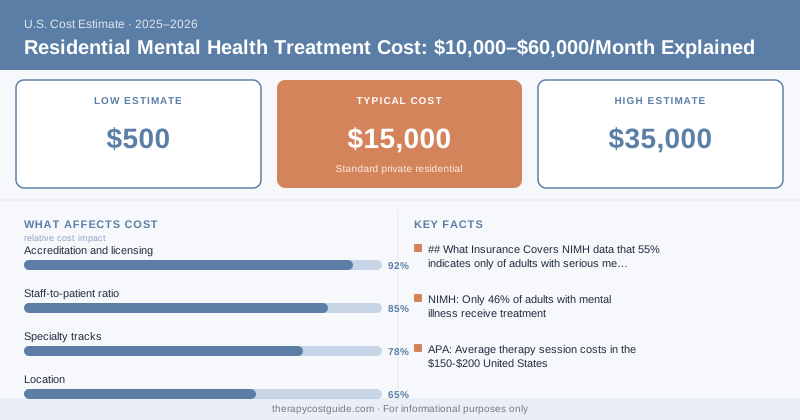
| Standard private residential | $15,000 – $35,000 | $500 – $1,167 | Full clinical programming, private rooms |
| Luxury / executive residential | $35,000 – $60,000+ | $1,167 – $2,000+ | Spa, chef, private suites, concierge |
The “standard private residential” tier is where most insurance-covered residential care lands when facilities are in-network. Out-of-network facilities frequently fall in the $25,000–$50,000/month range.
What Insurance Covers
NIMH data indicates that only 55% of adults with serious mental illness received mental health services in the past year — and insurance barriers are a leading reason. Residential care faces some of the toughest coverage battles.
What commercial insurance typically covers (in-network):
- Medically necessary residential care: 7–30 days initially authorized
- Concurrent review every 3–7 days; authorization must be renewed continuously
- Your cost-share: deductible + 20–30% coinsurance or flat copay per day ($100–$300/day)
What to expect with out-of-network benefits:
- Reimbursement at 50–70% of “usual and customary” rates (which may be much lower than the facility charges)
- You pay the full amount upfront, submit claims, and receive partial reimbursement
- Out-of-pocket costs for out-of-network residential can reach $20,000–$50,000+ after insurance contributions
Medicare: Covers psychiatric residential treatment only if it’s a Medicare-certified psychiatric inpatient facility. Free-standing residential programs are often not certified and thus not covered.
Medicaid: Covers residential treatment at state-funded and certified non-profit programs. Private luxury residentials typically don’t accept Medicaid.
The Insurance Prior Authorization Battle for Residential
Most insurers want to authorize the least intensive level of care. A request for residential authorization may initially be met with a recommendation for PHP or IOP. If your treatment team believes residential is medically necessary, the clinical staff should write a letter of medical necessity that specifically documents:
- Failed response to outpatient or PHP treatment
- Safety risk that requires 24-hour supervision
- Environmental factors that make outpatient unsafe (domestic violence, active substance use in the home, etc.)
Appeals succeed roughly 40–60% of the time when well-documented clinical rationale is submitted. Don’t accept the first denial as final.
Luxury vs. Standard: What You’re Actually Paying For
The clinical programming — individual therapy, group therapy, psychiatric medication management — is often comparable between a $15,000/month and a $50,000/month facility. What differs:
Luxury add-ons at high-end residentials:
- Private suite (vs. shared room at standard)
- Chef-prepared meals with dietary customization
- Equine therapy, art therapy, yoga, massage
- Concierge intake and discharge coordination
- Hotel-like campus in scenic locations (Malibu, Scottsdale, Vermont)
- Smaller client-to-therapist ratios (3:1 vs. 8:1)
- Amenities: pools, gym, outdoor activities
What’s genuinely clinically superior at higher-end programs:
- Lower client-to-therapist ratios mean more individual therapy hours per week
- More specialized staff (neuropsychologists, addiction medicine specialists, trauma specialists)
- Longer average stays (45–90 days vs. 21–30 days)
- Aftercare coordination and alumni programming
If you’re choosing strictly for clinical outcomes and cost matters, a non-profit or mid-range residential with strong accreditation (Joint Commission, CARF) often provides equivalent therapy quality to a luxury facility at half the cost.
What Affects the Price
Accreditation and licensing: Joint Commission and CARF-accredited programs cost more — but the oversight also provides quality assurance. Unaccredited programs should be approached cautiously.
Staff-to-patient ratio: A 3:1 ratio requires significantly more payroll than a 10:1 ratio. Individual therapy frequency scales with staffing.
Specialty tracks: Programs specializing in co-occurring disorders, complex trauma, eating disorders, or TBI require more specialized staff and cost more per day.
Location: California and East Coast facilities command a geographic premium. Mid-country facilities in states like Tennessee, Texas, and Colorado often offer the same clinical quality at 20–30% lower cost.
Length of stay: Most programs charge a consistent daily rate. A 30-day stay at $600/day = $18,000; 60 days = $36,000.
Finding Affordable Residential Care
SAMHSA’s National Helpline (1-800-662-4357): Free, confidential referrals to local treatment facilities, many with sliding-scale fees. Available 24/7.
State mental health authority: Each state funds residential mental health treatment for eligible residents. Wait times exist, but costs are often $0–$500/month on a sliding scale.
Non-profit facilities: Facilities like The Menninger Clinic, Sheppard Pratt, and McLean Hospital are non-profits with strong clinical reputations. They typically cost less than private luxury facilities and often have more robust financial assistance programs.
Verify in-network status first: Before choosing a facility, call your insurer and ask for a list of in-network residential mental health providers in your state and neighboring states. The in-network discount can mean paying $3,000–$8,000/month instead of $20,000–$40,000.
{ if eq .Lang "zh" }Disclaimer: TherapyCostGuide provides cost information for educational purposes only. We are not a mental health provider and do not offer clinical advice or treatment. Cost ranges are based on national survey data and vary significantly by location, provider credentials, practice setting, and insurance plan. Always consult a licensed mental health professional for treatment decisions. If you are in crisis, call or text 988 (Suicide & Crisis Lifeline) or go to your nearest emergency room.