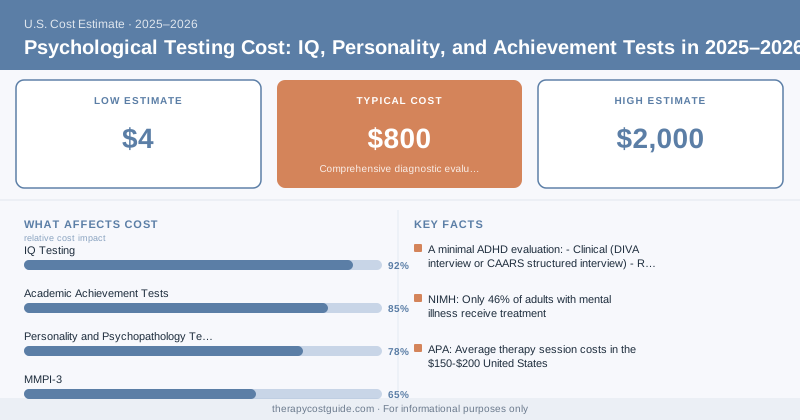
Psychological Testing Cost: IQ, Personality, and Achievement Tests in 2025–2026
{ if eq .Lang "zh" }{ else }{ end }Psychological testing and neuropsychological testing are often confused. Here’s the quick distinction: psychological testing is broader, includes personality and emotional assessments, and doesn’t require the medical-focused neuropsychology specialization. Neuropsychological testing is a subset focused specifically on brain-behavior relationships and cognitive functions.
A psychological evaluation covering IQ, academic achievement, and personality functioning runs $500–$2,500. Here’s what drives the variation.
Psychological Testing Costs by Type
| Test Type | Cost Range | Time Required | Common Use |
|---|---|---|---|
| IQ testing (WAIS-IV or WISC-V) | $400 – $900 | 2–3 hours | Intellectual disability eval, gifted assessment |
| Academic achievement battery | $300 – $700 | 2–3 hours | Learning disability diagnosis |
| Personality testing (MMPI-3, PAI) | $300 – $600 | 1–2 hours + interpretation | Diagnostic clarification, therapy planning |
| ADHD evaluation battery | $700 – $1,800 | 3–5 hours | Comprehensive ADHD diagnosis, adult or child |
| Psychoeducational evaluation (full) | $1,500 – $3,500 | 6–8 hours | Learning disability + IQ for school accommodations |
| Forensic psychological evaluation | $2,000 – $10,000+ | Variable | Legal contexts, custody, criminal |
| Comprehensive diagnostic evaluation | $800 – $2,000 | 4–6 hours | Most clinical referrals |
What the Major Test Types Measure
IQ Testing
The most commonly used adult IQ test is the WAIS-IV (Wechsler Adult Intelligence Scale, 4th ed.); for children it’s the WISC-V (Wechsler Intelligence Scale for Children, 5th ed.). These tests assess:
- Verbal comprehension (vocabulary, verbal reasoning)
- Perceptual reasoning (visual-spatial reasoning, matrices)
- Working memory (holding and manipulating information)
- Processing speed (visual scanning, clerical speed)
Plus a Full Scale IQ (FSIQ) composite. Testing takes 2–3 hours and produces a standardized score with a mean of 100 and standard deviation of 15.
Academic Achievement Tests
The WIAT-III (Wechsler Individual Achievement Test) or Woodcock-Johnson IV assess reading, written language, math, and oral language relative to age and grade norms. Used primarily to diagnose specific learning disabilities.
Personality and Psychopathology Testing
- MMPI-3 (Minnesota Multiphasic Personality Inventory): The most validated personality/psychopathology instrument. Hundreds of published validity studies. Used for diagnostic clarification, treatment planning, and forensic assessments.
- PAI (Personality Assessment Inventory): Shorter than MMPI, clinical scales covering major psychiatric conditions
- Rorschach (R-PAS system): Projective technique with contested validity; used in some specialty settings
- MCMI-IV (Millon Clinical Multiaxial Inventory): Specifically assesses personality disorders and clinical syndromes
APA’s Division 5 (quantitative and qualitative methods) and major assessment textbooks emphasize that personality test validity depends heavily on the examiner’s interpretive training and the appropriateness of the test for the referral question.
Why Psychological Testing Costs What It Does
Most of the cost is not the 2–3 hours of testing you’re present for. A psychological examiner typically spends 3–5 additional hours scoring tests, reviewing records, integrating data, writing a report, and conducting the feedback session. A full psychoeducational evaluation involves 6–8 hours of client contact plus another 6–8 hours of professional work behind the scenes. When you pay $2,000 for an evaluation, you’re paying for roughly 14–16 total professional hours — which at a $125–$145/hour professional rate isn’t particularly excessive.ADHD Testing in Adults: The Most Common Referral
Adult ADHD evaluation is one of the most frequently requested psychological evaluations — and one of the most debated in terms of what it should cost and what it should include.
A minimal ADHD evaluation:
- Clinical interview (DIVA or CAARS structured interview)
- Rating scales (CAARS, Conners 3, or equivalent)
- Collateral information (school records, partner/family ratings)
- Rule out other conditions
- Cost: $700–$1,200
A comprehensive ADHD evaluation:
- All of the above
- Cognitive testing (IQ assessment, working memory assessment)
- Academic achievement screen
- Executive function testing
- Cost: $1,200–$2,500
NIMH data indicates ADHD affects approximately 4.4% of U.S. adults, with significant diagnostic variation across practitioners. Comprehensive testing is particularly valuable when the diagnosis is uncertain or when ruling out learning disabilities alongside ADHD is clinically important.
The note on telehealth ADHD platforms: services that diagnose and prescribe ADHD medication based solely on self-report questionnaires — without clinical interview or cognitive testing — are not providing comprehensive evaluations by clinical standards. This became controversial during the COVID-era stimulant prescription surge.
School Psychological Evaluations: The Free Option Many Parents Miss
For children with suspected learning disabilities or ADHD, public schools are legally required under IDEA (Individuals with Disabilities Education Act) to provide free psychoeducational evaluations if there’s reason to suspect a disability affecting education.
You can request this in writing from your child’s principal or special education coordinator. The school must respond within 60 days. The evaluation must be comprehensive and conducted by a qualified school psychologist.
School evaluations are genuinely free and legally mandated. The main limitations: they focus on educational eligibility rather than clinical diagnosis, they may not use the most current test versions, and the school may be motivated to narrow the finding to avoid service obligations — though legal protections exist against this.
Private psychological evaluation through a licensed psychologist gives you a clinical diagnosis, more comprehensive testing, and a report useful for non-school contexts (physician, therapist, accommodations for college/workplace). If you need accommodations for the SAT, ACT, college boards, or professional licensing exams, these organizations typically require evaluations from licensed psychologists, not just school psychologists.
Insurance Coverage for Psychological Testing
Insurance coverage for psychological testing depends heavily on the referral diagnosis and insurance plan.
Generally covered:
- Testing for intellectual disability, developmental delays
- Evaluation for significant psychiatric conditions (personality disorders, severe anxiety, psychosis)
- ADHD evaluation when there’s documented educational or occupational impairment
Frequently disputed or denied:
- Adult ADHD testing without compelling medical necessity documentation
- Gifted assessments (not medically necessary)
- Forensic evaluations (for legal purposes, not clinical)
- Testing primarily for school accommodations
NCHS data shows significant disparities in access to psychological testing by income and insurance status — a comprehensive psychoeducational evaluation is unaffordable for many families without insurance coverage, which is part of why IDEA’s free school evaluation mandate exists.
Finding Psychological Testing Services
- Your insurance’s provider directory: Search for “psychologist” specializing in “testing and assessment”
- University psychology training clinics: Reduced-cost evaluations under doctoral supervision
- Your child’s school: Request IDEA evaluation in writing for educational eligibility
- Community mental health centers: Some offer sliding-scale testing for diagnostic purposes
- APA’s psychologist locator: locator.apa.org — filter for assessment specialty
Disclaimer: TherapyCostGuide provides cost information for educational purposes only. We are not a mental health provider and do not offer clinical advice or treatment. Cost ranges are based on national survey data and vary significantly by location, provider credentials, practice setting, and insurance plan. Always consult a licensed mental health professional for treatment decisions. If you are in crisis, call or text 988 (Suicide & Crisis Lifeline) or go to your nearest emergency room.