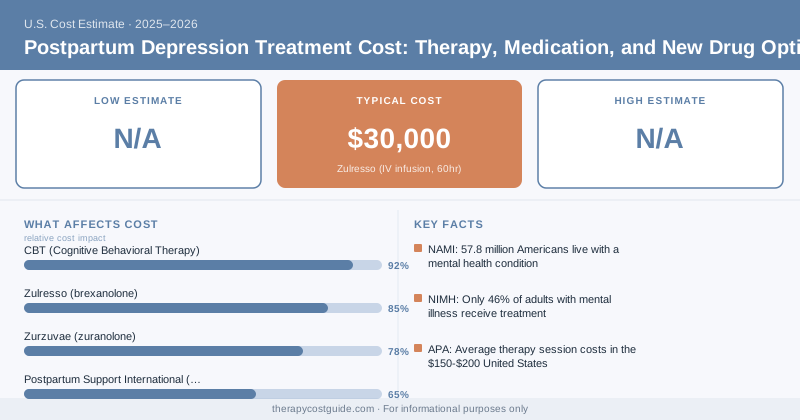
Postpartum Depression Treatment Cost: Therapy, Medication, and New Drug Options
{ if eq .Lang "zh" }{ else }{ end }Postpartum depression affects 1 in 7 new mothers — about 500,000 women per year in the United States. Yet only about 15% receive any treatment. Cost is one barrier. Stigma is another. And the new medications that work fastest cost tens of thousands of dollars.
According to ACOG (American College of Obstetricians and Gynecologists), postpartum depression affects approximately 1 in 8 to 1 in 7 women after childbirth, with symptoms that can emerge up to 12 months after delivery. PPD is distinct from “baby blues” — it’s more severe, lasts longer, and requires treatment.
Standard PPD Treatment Options
PPD is treated with the same tools as major depression: therapy, medication, or both. The difference is the clinical context — nursing considerations, rapid symptom onset, and the functional demands of new parenthood.
| PPD Treatment Option | Per Session/Unit | Typical Total | Notes |
|---|---|---|---|
| Individual therapy (16–20 sessions) | $150–$250 | $2,400–$5,000 | CBT or IPT most studied |
| SSRI medication (generic, monthly) | $10–$30 | $120–$360/year | Sertraline is first-line while nursing |
| Psychiatry evaluation + follow-ups | $300–$500 | $600–$1,200 | For medication management |
| Postpartum support groups | $0–$40/session | $0–$640 | Many free through hospitals |
| Zurzuvae (pill form, 14-day course) | — | $16,000–$20,000 | FDA-approved 2023, insurance coverage variable |
| Zulresso (IV infusion, 60hr) | — | $30,000–$34,000 | FDA-approved 2019, requires hospitalization |
Standard Therapy: What Works and What It Costs
CBT (Cognitive Behavioral Therapy) and IPT (Interpersonal Therapy) are the two psychotherapy modalities with the strongest evidence specifically for PPD. Both are time-limited — 12–20 sessions is the typical range.
A 16-session course of individual therapy at $150–$200/session costs $2,400–$3,200 out of pocket. With in-network insurance at a $40 copay, that’s $640 for the same course.
IPT — which focuses on relationships, role transitions (like becoming a parent), and interpersonal conflicts — is particularly well-suited for PPD because the transition to parenthood is a major life change with relational implications.
SSRIs for PPD: Costs and Nursing Considerations
SSRIs are first-line medication for PPD. For nursing mothers, sertraline (Zoloft) is typically preferred because of the lowest infant exposure through breast milk.
Generic sertraline costs $10–$25/month. With insurance, it’s typically $0–$10/month. This is not a cost barrier for most families.
Other commonly used SSRIs:
- Generic paroxetine: $15–$35/month (not preferred while nursing due to infant exposure data)
- Generic escitalopram: $15–$30/month (low infant exposure, sometimes used)
The New PPD Medications: Cost Reality
Two drugs are now FDA-approved specifically for PPD — the first treatments ever specifically developed for this indication.
Zulresso (brexanolone), approved 2019: A neuroactive steroid given as a 60-hour continuous IV infusion in a hospital or infusion center. Cost: $30,000–$34,000 for the infusion. Works rapidly (within 2–3 days). Required 24/7 monitoring due to sedation risk.
Zurzuvae (zuranolone), approved 2023: An oral pill taken once daily for 14 days. Cost: approximately $16,000–$20,000 for the 14-day course. Works rapidly (2–3 weeks to full effect).
Insurance coverage for both is growing but inconsistent. Some plans cover Zurzuvae after failed SSRI trial. Sage Biosciences (manufacturer) offers patient assistance programs.
Is Zurzuvae Worth the Cost vs. Standard SSRIs?
Zurzuvae has one major advantage over SSRIs: speed. SSRIs typically take 4–8 weeks to produce full antidepressant effect. Zurzuvae can produce significant improvement in 2–3 weeks.
For women with severe PPD who can’t wait 6–8 weeks for medication to work — especially if there are safety concerns — faster response has real value. For mild-to-moderate PPD, standard SSRIs plus therapy produce equivalent outcomes at a fraction of the cost.
ACOG guidance indicates that for most women with PPD, standard SSRIs and psychotherapy are appropriate first-line treatment. Zurzuvae is a meaningful option for severe PPD or cases where rapid response is clinically important.
Support Groups and Community Resources
Postpartum Support International (PSI) — postpartum.net — offers free online support groups, a helpline (1-800-944-4773), and provider referrals. Many in-person hospital-based PPD support groups are free or low-cost.
Hospital-based perinatal mental health programs often offer integrated care with sliding-scale fees. Check with your OB or midwife about what’s available at your delivering hospital.
Insurance Coverage for PPD Treatment
Under the Affordable Care Act, mental health benefits (including PPD treatment) must be covered with parity to medical benefits. Mothers on Medicaid are covered for therapy and medication.
States have expanded postpartum Medicaid coverage under various provisions — check with your state Medicaid program for specific coverage periods.
Disclaimer: TherapyCostGuide provides cost information for educational purposes only. We are not a mental health provider and do not offer clinical advice or treatment. Cost ranges are based on national survey data and vary significantly by location, provider credentials, practice setting, and insurance plan. Always consult a licensed mental health professional for treatment decisions. If you are in crisis, call or text 988 (Suicide & Crisis Lifeline) or go to your nearest emergency room.