Play Therapy Cost 2026: $100–$200 per Session for Children
{ if eq .Lang "zh" }{ else }{ end }42% of parents who seek mental health help for their child are told the wait is 3–6 months. When you finally get an appointment, you want to know it’s the right fit — not just any therapist who ‘works with kids.’ Play therapy is a specific clinical modality, not a room with toys. Here’s the real cost breakdown.
Play Therapy Session Costs in 2026
| Setting | Cost Per Session | Notes |
|---|---|---|
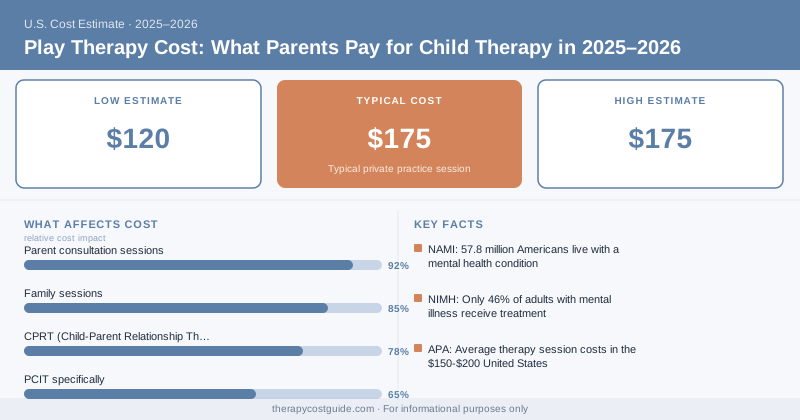
| Private practice RPT | $100 – $200 | Registered Play Therapist credential |
| Licensed therapist with play therapy training | $90 – $175 | Trained but not RPT-credentialed |
| Community mental health center | $20 – $80 | Income-based sliding scale |
| School-based play therapy | Often free | District-funded, limited availability |
| Hospital child life program | Often free or included | Inpatient/outpatient hospital settings |
| Parent-Child Interaction Therapy (PCIT) | $120 – $200 | Specialized, coach-in-session format |
| Typical private practice session | $120 – $165 | Most U.S. markets |
Sessions are usually 45–50 minutes. Some therapists offer shorter sessions (30–40 minutes) for children ages 3–5 who can’t sustain longer engagement, at a proportionally lower fee.
The RPT Credential: Why It Matters
RPT stands for Registered Play Therapist, issued by the Association for Play Therapy (APT). Requirements:
- Master’s or doctoral degree in a mental health field
- Current clinical mental health license
- 150+ hours of APT-approved play therapy coursework
- 500+ hours of supervised play therapy with an RPT-Supervisor
- Passing the APT examination
The RPT-S designation (Supervisor level) indicates additional qualification to train other play therapists.
Not every excellent child therapist holds RPT credentials. Many licensed clinicians use play-based approaches without the formal credential, and some do fine work. But for specific presentations — childhood trauma, sexual abuse, selective mutism — the structured play therapy models that RPTs are trained in have the clearest evidence. Verify at a4pt.org before your child’s first appointment.
Directive vs. Non-Directive Play Therapy
These are the two philosophical camps, and they’re genuinely different:
Child-Centered Play Therapy (CCPT) is non-directive, rooted in Carl Rogers’ person-centered approach. The child leads the play completely — chooses materials, themes, stories. The therapist follows, reflects, and tracks without directing outcomes. The theory is that children have an innate drive toward healing when given a safe, accepting therapeutic relationship.
Directive play therapy uses structured activities, assigned scenarios, and specific therapeutic interventions designed by the therapist. More common in trauma-focused approaches where specific processing of events is the clinical goal.
Most experienced play therapists integrate both, shifting based on where the child is in treatment. Neither is universally better.
Parent Consultation Sessions: A Hidden Cost to Budget For
Play therapy almost always involves regular parent check-ins — typically every 3–6 child sessions — to share observations and provide parenting guidance. These sessions run the same $100–$200 as child sessions and are billed separately. Over a 20-session treatment course, that could add 4–6 parent consultations: $400–$1,200 in additional cost. Factor it into your budget from the start.What Conditions Respond Best to Play Therapy
Play therapy’s strongest evidence applies to children ages 3–12. The clearest indications:
Trauma and abuse: Child sexual abuse, physical abuse, neglect, family violence. Play therapy allows trauma processing through symbolic play without requiring verbal disclosure from children who can’t or won’t narrate directly. This is where the model was originally developed.
Childhood anxiety disorders: Separation anxiety, generalized anxiety, selective mutism. The APA’s Division 53 (Society of Clinical Child and Adolescent Psychology) classifies play therapy as “probably efficacious” for childhood anxiety.
ADHD and oppositional behavior: Parent-Child Interaction Therapy (PCIT) — a structured directive approach with parents in the room — has some of the strongest RCT evidence in all of child mental health for oppositional defiant disorder and early conduct problems.
Adjustment to loss, illness, or major transitions: Divorce, death, serious illness, and hospitalization all have solid play therapy evidence, particularly in hospital child life programs.
Autism spectrum disorder: Developmental play-based models like DIR/Floortime are used as intervention approaches for ASD, though the evidence base varies.
NAMI reports that 1 in 6 U.S. children ages 6–17 experiences a mental health disorder each year. Fewer than half receive any treatment — and access to credentialed child specialists is the most consistent barrier cited by families.
School-Based vs. Private Practice Play Therapy
These are different in important ways:
School-based: Free to families, available during school hours, delivered by school counselors or district-employed therapists. The catch: school counselors typically have caseloads of 200–400 students and can’t provide intensive individual therapy. School-based play therapy is best for mild to moderate adjustment issues, not complex trauma.
Private practice: More expensive, requires scheduling outside school hours, but offers significantly more intensive individualized treatment. Ideal for moderate to severe presentations where the child needs 30–60+ sessions of focused work.
Insurance Coverage for Play Therapy
Play therapy with a licensed therapist bills under standard outpatient child psychotherapy codes. Common covered diagnoses:
- F93.0 — Separation anxiety disorder of childhood
- F41.1 — Generalized anxiety disorder
- F43.x — Adjustment disorders
- F43.10–F43.12 — PTSD
- F91.x — Conduct disorders
- F94.0 — Selective mutism
With insurance, you’re typically looking at a $20–$50 copay per session for in-network providers. Prior authorization is increasingly common for child behavioral health — don’t assume approval without checking with your plan first.
{ if eq .Lang "zh" }Disclaimer: TherapyCostGuide provides cost information for educational purposes only. We are not a mental health provider and do not offer clinical advice or treatment. Cost ranges are based on national survey data and vary significantly by location, provider credentials, practice setting, and insurance plan. Always consult a licensed mental health professional for treatment decisions. If you are in crisis, call or text 988 (Suicide & Crisis Lifeline) or go to your nearest emergency room.