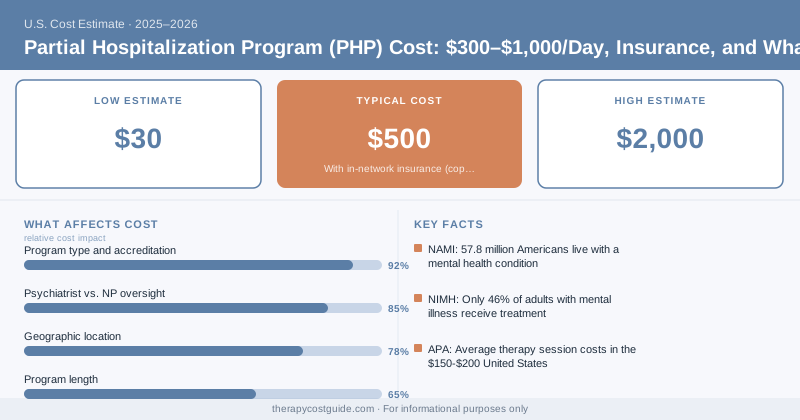
Partial Hospitalization Program (PHP) Cost: $300–$1,000/Day, Insurance, and What to Expect
{ if eq .Lang "zh" }{ else }{ end }A PHP slot opened up. The treatment coordinator told you it’s $650 a day. You do the math — that’s $3,250 for one week — and your stomach drops. Here’s what that number actually means, what insurance will cover, and whether PHP is the right level of care for your situation.
What PHP Actually Costs
Partial hospitalization programs run five days a week, typically six to eight hours per day. You go home at night — that’s the key difference from inpatient. SAMHSA data shows PHP is one of the most cost-effective bridges between 24-hour inpatient care and standard outpatient therapy.
| Setting | Daily Rate | Weekly Cost (5 days) | Monthly Estimate |
|---|---|---|---|
| Community hospital-affiliated PHP | $300 – $500 | $1,500 – $2,500 | $6,000 – $10,000 |
| Free-standing behavioral health PHP | $450 – $700 | $2,250 – $3,500 | $9,000 – $14,000 |
| Academic medical center PHP | $600 – $1,000 | $3,000 – $5,000 | $12,000 – $20,000 |
| With in-network insurance (copay) | $30 – $100 | $150 – $500 | $600 – $2,000 |
Most people in PHP don’t stay a full month. The average PHP stay runs two to four weeks, then steps down to intensive outpatient.
What Insurance Pays
The Mental Health Parity and Addiction Equity Act (MHPAEA) requires that PHP benefits be comparable to medical/surgical day hospital benefits. In practice this means most commercial plans cover PHP when it’s medically necessary — but “medically necessary” is defined narrowly, and insurers frequently deny or limit coverage.
What you’ll typically pay with in-network coverage:
- Copay model: $30–$100 per day after deductible
- Coinsurance model: 20–30% of the daily rate after deductible
- Out-of-pocket maximum: Once you hit it, PHP costs $0 for the rest of the year
Medicare: Part A covers PHP under the hospital outpatient benefit at 20% after Part B deductible. Medicare Advantage plans vary — check your plan’s behavioral health benefits specifically.
Medicaid: Covers PHP in most states, often with minimal or no cost-sharing.
How to Get PHP Authorized by Insurance
Call your insurer before the program starts. Get a pre-authorization number. Ask specifically: “What is the daily rate you reimburse for PHP, what is my cost-share, and how many days are approved?” Get all of this in writing (an email confirmation or fax from your insurer).
If they deny PHP as “not medically necessary,” the program’s utilization review department can usually appeal on your behalf within 24–48 hours. Most denials are reversed when the clinical team documents severity clearly.
What PHP Is — and Who It’s For
PHP is not a halfway measure. It’s intensive psychiatric treatment — group therapy, individual therapy, medication management, and psychoeducation — condensed into a structured daily schedule. Most PHPs run 9 a.m. to 3 or 4 p.m., Monday through Friday.
PHP is typically appropriate when:
- You’ve been discharged from inpatient hospitalization and need continued structure
- You’re having active symptoms (suicidal ideation without intent or plan, significant mood episodes, panic attacks multiple times daily) but don’t need 24-hour supervision
- Your home environment can support you safely overnight
- You need more support than weekly outpatient therapy provides
PHP is not appropriate when you need 24-hour supervision, have active medical complications, or pose an imminent risk to yourself or others. In those cases, inpatient hospitalization is the right level of care.
The Step-Down Model
Most people enter PHP from one of two directions:
Step-down from inpatient: You were hospitalized for psychiatric stabilization. After 3–10 days, you’re medically stable but not ready for outpatient. PHP provides the next layer of structure while you transition back to daily life.
Step-up from outpatient: Your weekly therapy isn’t containing a worsening episode. PHP provides intensive daily support to prevent hospitalization.
After PHP, most patients step down to Intensive Outpatient Programs (IOP) — 9 hours per week instead of 30–40 — and then to standard weekly outpatient therapy.
What a PHP Day Looks Like
A typical PHP day includes:
- Morning check-in group (30–45 minutes)
- Process therapy group (60–90 minutes)
- Skills group (DBT, CBT, or disorder-specific, 60 minutes)
- Medication review with psychiatrist (15–30 minutes, 2–3x/week)
- Individual therapy session (50 minutes, 1–2x/week)
- Psychoeducation group (45 minutes)
- Wrap-up group (30 minutes)
This is substantially more therapeutic contact than any outpatient setting. For many people, it’s the most treatment they’ve ever received — and it’s why PHP can produce noticeable stabilization within one to two weeks.
Factors That Affect PHP Cost
Program type and accreditation: Joint Commission- or CARF-accredited programs typically cost more but often have better clinical staff ratios and more specialized tracks (trauma, co-occurring disorders, etc.).
Psychiatrist vs. NP oversight: Programs with psychiatrist-led medication management cost more than those using nurse practitioners or physician assistants.
Geographic location: PHP in Manhattan or San Francisco costs more than PHP in rural Tennessee. Urban programs often charge 40–60% more than rural equivalents.
Program length: Some insurers approve 10–14 days of PHP; others approve up to 30. Daily costs are fixed; total costs scale directly with length.
PHP Without Insurance
Without insurance, PHP at $500–$700/day quickly becomes prohibitive. Options:
Federally Qualified Health Centers (FQHCs): Some FQHCs run PHPs at sliding-scale fees based on income. Search at findahealthcenter.hrsa.gov.
State-funded behavioral health programs: Every state has a public mental health authority. Search “[your state] mental health authority PHP” to find publicly funded programs.
Hospital charity care: Hospital-affiliated PHPs often have financial assistance programs. Ask the financial counselor — not the intake coordinator — specifically about charity care or sliding-scale options.
Negotiate a payment plan: Many programs will agree to payment plans over 12–24 months if you ask. The total amount is the same, but the monthly payment becomes manageable.
The average PHP stay runs two to three weeks. Even at full private-pay rates, $10,000–$21,000 for a course of PHP that prevents a $30,000+ inpatient hospitalization can be a reasonable exchange — assuming you can access financing.
{ if eq .Lang "zh" }Disclaimer: TherapyCostGuide provides cost information for educational purposes only. We are not a mental health provider and do not offer clinical advice or treatment. Cost ranges are based on national survey data and vary significantly by location, provider credentials, practice setting, and insurance plan. Always consult a licensed mental health professional for treatment decisions. If you are in crisis, call or text 988 (Suicide & Crisis Lifeline) or go to your nearest emergency room.