Out-of-Network Therapy Reimbursement: What You'll Actually Get Back
{ if eq .Lang "zh" }{ else }{ end }You pay your therapist $200 up front. Then your insurance mails you a check for $120 a few weeks later. That’s out-of-network reimbursement in a nutshell, and once you understand it, the sticker price of a great therapist who doesn’t take insurance stops looking so terrifying.
Plenty of skilled therapists don’t join networks. If yours is one of them and your plan has out-of-network (OON) benefits, you’re not stuck paying full freight forever. You front the cash, file paperwork, and get a chunk back.
How OON Reimbursement Actually Works
The process has three moving parts: your OON deductible, your coinsurance percentage, and your insurer’s “allowed amount.”
That last one trips people up. Your insurer doesn’t reimburse a percentage of what you paid — they reimburse a percentage of what they decide the service is worth. That number is sometimes lower than your therapist’s fee.
So if your therapist charges $200, your insurer might set the allowed amount at $160 and reimburse 70% of that ($112), not 70% of $200 ($140). Always ask member services: “What’s your allowed amount for CPT code 90837?” That’s the code for a 60-minute therapy session.
Key Takeaway
You pay the therapist in full at each visit. Once you’ve met your separate out-of-network deductible, your plan reimburses a percentage (the coinsurance) of its allowed amount — not necessarily your therapist’s full fee. Typical net reimbursement lands at 50–80% of what you spent.What You’ll Pay and Get Back
| Scenario | You Pay Per Session | Reimbursed | Net Cost |
|---|---|---|---|
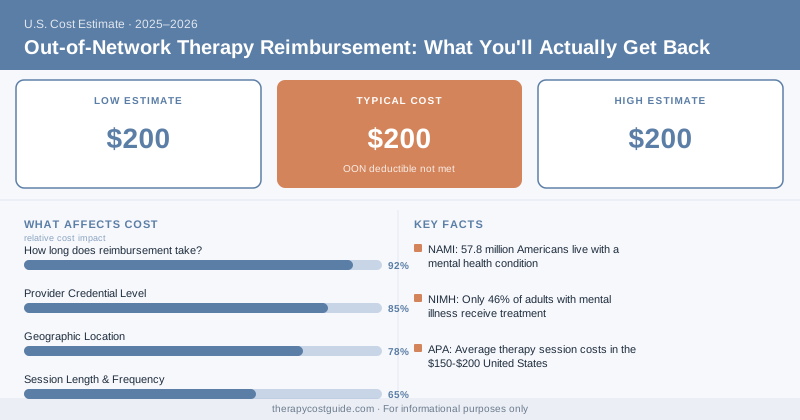
| OON deductible not met | $200 | $0 (counts toward deductible) | $200 |
| Deductible met, 80% coinsurance | $200 | ~$128 (80% of $160 allowed) | ~$72 |
| Deductible met, 60% coinsurance | $200 | ~$96 (60% of $160 allowed) | ~$104 |
| No OON benefits (HMO/EPO) | $200 | $0 | $200 |
Most HMO and EPO plans have no OON benefits at all. PPO and POS plans usually do. Check your card — if it says PPO, you likely have something to work with.
The Superbill Is Your Ticket
To get reimbursed, you need a superbill — an itemized receipt your therapist provides. It lists the date, the CPT code, the fee, your diagnosis code, and the therapist’s credentials and tax ID. You submit it to your insurer, not your therapist.
Some people use apps like Reimbursify or Thrizer that file the claims for you. They take a small cut but save the headache of mailing forms.
Is It Worth the Hassle?
A 2024 KFF analysis found that mental health providers were far more likely to be out-of-network than other specialists, and that out-of-network use for behavioral health was several times higher than for medical or surgical care. Translation: if your dream therapist isn’t in-network, you’ve got plenty of company, and the reimbursement route is well-worn.
According to APA survey data, demand for therapists has outpaced in-network supply for years running, which is exactly why so many clinicians can fill their calendars without joining a single network.
If you can float the up-front cost and you have real OON benefits, the net price often beats hunting for an available in-network provider. If cash flow is tight, the front-loading can sting — see sliding scale therapy or how to find affordable therapy for lower-out-of-pocket paths.
For the broader picture of how plans handle therapy, our guide to therapy insurance coverage walks through every benefit type. And if you’re weighing it against straight cash pay, compare with therapy without insurance.
Frequently Asked Questions
How long does reimbursement take? Usually two to six weeks after you submit a clean superbill. Electronic submission through your insurer’s portal or an app is faster than mailing paper. Keep copies of everything.
Does my OON deductible count separately from my regular deductible? Often, yes. Many plans have a distinct out-of-network deductible that’s higher than the in-network one, and the two don’t always cross-credit. Ask member services to confirm both numbers.
What if my insurer’s allowed amount is way below my therapist’s fee? That gap is on you — it’s called balance billing, and for OON care it’s legal. This is why asking for the allowed amount on CPT 90837 before committing matters. A big gap can wipe out the value of reimbursement.
{ if eq .Lang "zh" }Disclaimer: TherapyCostGuide provides cost information for educational purposes only. We are not a mental health provider and do not offer clinical advice or treatment. Cost ranges are based on national survey data and vary significantly by location, provider credentials, practice setting, and insurance plan. Always consult a licensed mental health professional for treatment decisions. If you are in crisis, call or text 988 (Suicide & Crisis Lifeline) or go to your nearest emergency room.