Open Path Therapy Cost: What You Pay and How to Find a Provider
{ if eq .Lang "zh" }{ else }{ end }$30 a session for a licensed therapist. Not a trainee. Not an AI chatbot. A fully licensed LCSW, LPC, or psychologist. That’s what Open Path Collective makes possible — and for the roughly 100 million Americans who earn too much for Medicaid but can’t afford $175/session private practice rates, it fills a real gap.
Open Path launched in 2012 and has grown to over 20,000 therapists as of 2024. It’s not perfect — provider availability varies by city, specialty coverage is uneven — but it’s one of the most effective affordable therapy options available for uninsured and underinsured people.
How Open Path Works
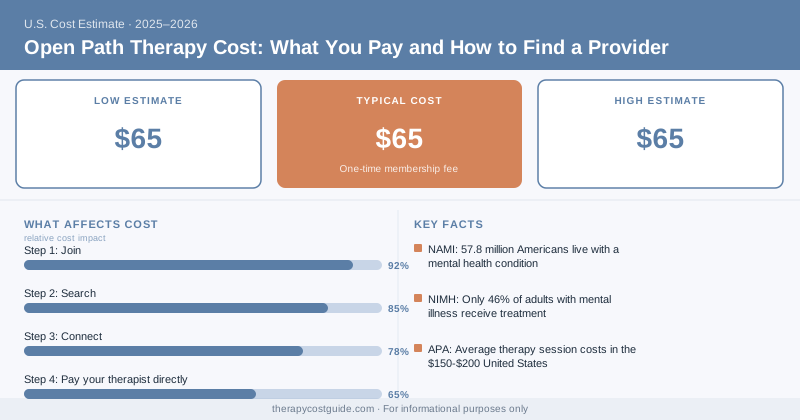
Step 1: Join — Pay a one-time $65 membership fee at openpathcollective.org. No recurring fees. This covers you indefinitely.
Step 2: Search — Browse the directory of therapists by location, specialty, insurance (some therapists on Open Path also accept insurance), and modality.
Step 3: Connect — Contact a therapist directly through the platform to inquire about availability and schedule a consultation.
Step 4: Pay your therapist directly — Sessions are billed at $30–$80 (agreed upon with the therapist). You pay the therapist directly, not through Open Path.
| Open Path Cost Component | Amount | Notes |
|---|---|---|
| One-time membership fee | $65 | Covers you indefinitely, no expiration |
| Individual therapy session | $30–$80 | Per session, paid to therapist |
| Couples therapy session | $30–$80 | Same range, with couples-trained therapists |
| Group therapy session | $30–$50 | Less common, check availability |
| First session (typical) | $30–$80 | No separate intake fee through Open Path |
Who Qualifies for Open Path?
Open Path is designed for people with household incomes under $100,000 (or under $150,000 for couples). The membership fee is on the honor system — they don’t verify income.
If your income is higher but you’re facing financial hardship (high medical expenses, recent job loss, other financial strain), Open Path is still appropriate. The goal is making therapy accessible to people who genuinely can’t afford standard market rates.
What Types of Therapists Are on Open Path?
Open Path members are licensed, credentialed therapists who choose to accept reduced fees as a way to serve people who couldn’t otherwise afford therapy. You’ll find:
- Licensed Clinical Social Workers (LCSWs) — most common on the platform
- Licensed Professional Counselors (LPCs) and equivalent (LMFT, LPCC)
- Psychologists (PhD, PsyD) — less common but available
All therapists on Open Path have verified licenses. You can see their credentials, specialties, and approach in their profile.
Finding a Therapist on Open Path: Practical Tips
Availability varies significantly by location. In major cities (NYC, LA, Chicago, Austin), there are hundreds of therapists to choose from. In smaller cities and rural areas, options may be much more limited — or only telehealth.
Filter by specialty. If you need a therapist who specializes in a specific condition (trauma, OCD, eating disorders), search by specialty. Not all therapists specialize in every area, and for conditions like OCD, you’ll want an ERP-trained therapist specifically.
Don’t expect immediate availability. Open Path therapists often have wait lists — sometimes 2–6 weeks. Message several therapists at once to compare availability.
Telehealth is widely available. Most Open Path therapists offer video sessions. If you’re in a state with limited in-person availability, telehealth opens up the full national network.
Is $65 Worth It Compared to Other Low-Cost Options?
Community mental health centers (CMHCs) are technically cheaper — they’ll see you for $0–$40 on sliding scale without an upfront fee. But CMHCs have wait lists that can run 1–3 months, limited appointment availability, and sometimes less continuity (you may see different providers).
Open Path gives you access to private-practice therapists willing to see you for $30–$80. If you find a therapist you click with and see them for 10+ sessions, the $65 fee represents $6.50 amortized per session — trivial compared to the $70–$120 per session you’re saving.
For people who can’t get into a CMHC quickly and can’t afford standard private-practice rates, the $65 upfront is almost always worth it.
Does Open Path Accept Insurance?
Open Path sessions are not billed to insurance. The reduced fee is in lieu of insurance billing. Some therapists on the platform do accept insurance for standard-rate clients — but Open Path sessions are specifically the reduced-fee arrangement.
If you have insurance with mental health benefits, check if your insurer’s in-network therapists charge manageable copays first. Open Path is most valuable for people without insurance or with insurance that doesn’t cover therapy well.
Couples Therapy on Open Path
Open Path includes couples therapists at the same $30–$80 rate. Couples therapy at Open Path rates ($30–$80) is substantially more affordable than standard couples therapy ($175–$300/session). Filter for “couples therapy” in your Open Path search to see therapists with that specialty.
Disclaimer: TherapyCostGuide provides cost information for educational purposes only. We are not a mental health provider and do not offer clinical advice or treatment. Cost ranges are based on national survey data and vary significantly by location, provider credentials, practice setting, and insurance plan. Always consult a licensed mental health professional for treatment decisions. If you are in crisis, call or text 988 (Suicide & Crisis Lifeline) or go to your nearest emergency room.