Open Path Collective and Insurance: How the $65 Membership Actually Works
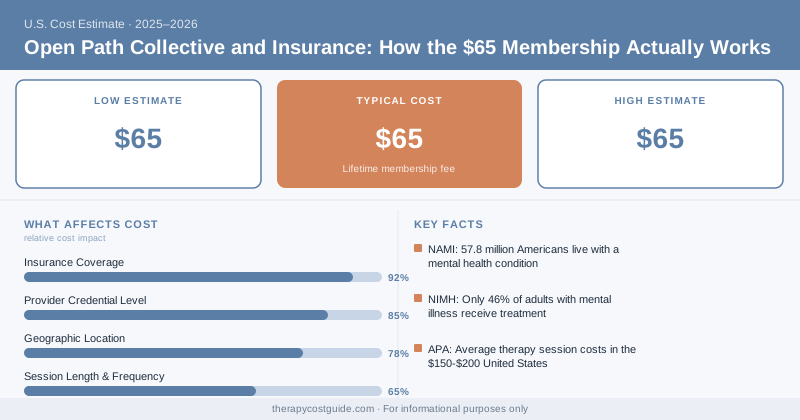
{ if eq .Lang "zh" }{ else }{ end }Most affordable-therapy directories ask you to prove you’re poor enough to qualify. Open Path Collective flips that script: pay $65 once, ever, and you get lifetime access to a national network of therapists charging $40–$80 per session — no insurance required, no income documentation, no annual renewal.
Open Path Collective is a nonprofit founded in 2013 specifically to address the affordability gap in mental health care for people who are either uninsured, underinsured, or simply can’t justify a $150–$250 private-pay session. It works by recruiting therapists willing to reserve a portion of their caseload for reduced-fee clients in exchange for the referral pipeline the network provides.
How the Cost Structure Works
| Component | Cost |
|---|---|
| Lifetime membership fee | $65 (one-time) |
| Individual therapy session (member rate) | $40 – $80 |
| Couples/family therapy session (member rate) | $50 – $110 |
| Group therapy session (where available) | $30 – $50 |
| Membership fee hardship waiver | $0 (for qualifying applicants) |
Unlike sliding-scale clinics that require pay stubs or tax returns to set your specific rate, Open Path therapists typically set their own fee within the network’s approved range, and you and the therapist agree on the specific rate during your first contact — a lighter-touch process than most income-verification sliding-scale programs.
Why It Doesn’t Bill Insurance
Open Path’s entire cost model depends on therapists being willing to accept a lower rate in exchange for reduced administrative overhead and a steady referral stream — billing insurance adds claims processing, coding requirements, and the risk of denied or delayed payment, all of which would undercut the “predictable low fee” value proposition for both therapist and client. That’s a deliberate tradeoff, not an oversight: the SAMHSA-documented treatment gap (roughly half of adults with a diagnosed mental illness receive no treatment in a given year, largely for cost and access reasons) is exactly the population this model targets.
Ask About Superbills If You Have Out-of-Network Benefits
If your insurance plan includes out-of-network reimbursement, ask your Open Path therapist directly whether they’ll provide a superbill — an itemized statement with your diagnosis code and session details that you submit to your insurer for partial reimbursement. Not every Open Path therapist offers this, since it adds paperwork relative to their already-reduced fee, so ask before your first session if this matters to your financial planning.Comparing Open Path to Other Low-Cost Options
Open Path’s $40–$80 range sits between free community mental health center care and typical $130–$220 private-pay rates. It’s generally faster to access than public community mental health centers, which can have significant waitlists, but it does require the one-time $65 fee and depends on therapist availability in your specific state, since not all states have deep Open Path networks.
If your insurance already provides low copays through mental health parity protections, Open Path may not save you money — it’s most valuable for people who are uninsured, have a high deductible they haven’t met, or whose insurance network has thin mental health coverage in their area.
Who Should Consider It
Open Path makes the most sense for people who are uninsured, on a high-deductible plan they haven’t met, facing a long wait for an in-network therapist, or simply priced out of typical private-pay rates in their city. It’s less useful if you already have solid mental health coverage with a low copay, since your existing insurance would likely cost about the same or less.
Bottom Line
The $65 membership fee is a one-time cost, not a subscription, and it unlocks $40–$80 sessions without any insurance billing involved. It won’t count toward your deductible unless your therapist provides a superbill you can submit yourself, so weigh that against your existing insurance situation before deciding which route saves you more.
{ if eq .Lang "zh" }Disclaimer: TherapyCostGuide provides cost information for educational purposes only. We are not a mental health provider and do not offer clinical advice or treatment. Cost ranges are based on national survey data and vary significantly by location, provider credentials, practice setting, and insurance plan. Always consult a licensed mental health professional for treatment decisions. If you are in crisis, call or text 988 (Suicide & Crisis Lifeline) or go to your nearest emergency room.