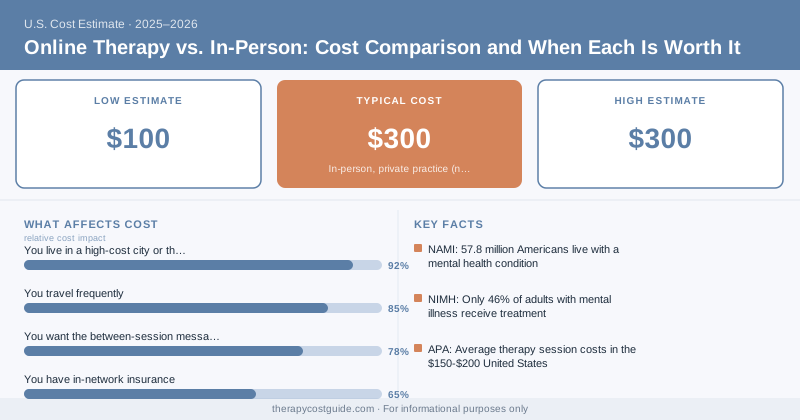
Online Therapy vs. In-Person: Cost Comparison and When Each Is Worth It
{ if eq .Lang "zh" }{ else }{ end }Online therapy was supposed to be cheaper. For some people, it is. For others — especially those with good insurance — it isn’t. The comparison depends on four things: what you’re treating, whether you have insurance, where you live, and how you use the service.
Here’s an honest cost-by-cost breakdown.
The Price Side by Side
| Format | Cost Range | Notes |
|---|---|---|
| In-person, private practice (no insurance) | $100 – $300/session | Varies by location, credential |
| In-person, in-network insurance | $20 – $60/session copay | After deductible |
| BetterHelp (self-pay) | $60 – $100/week | Unlimited messaging + 1 live session |
| Talkspace (self-pay) | $69 – $109/week | Depends on plan tier |
| Talkspace (with insurance) | $20 – $60/session copay | If your plan covers it |
| Online private practice via video (OON) | $80 – $200/session | Therapist’s standard rate, billed via Zoom/video |
The key number: in-person therapy with in-network insurance often costs the same or less than online platforms at self-pay rates. If you have good mental health coverage, in-person with a network provider may actually be cheaper than BetterHelp.
Where Online Therapy Wins on Cost
You don’t have insurance (or your plan has a high deductible): BetterHelp and Talkspace at $60–$100/week are significantly cheaper than paying $150–$250/session out of pocket for in-person care.
You live in a high-cost city or therapist-scarce area: In rural areas, the only therapists available may be 60+ miles away. Online removes the access barrier entirely, and may be the only realistic option.
You travel frequently: Consistent in-person therapy requires consistent geography. Online works around your schedule.
You want the between-session messaging: Platforms like BetterHelp offer asynchronous messaging with your therapist between sessions. For some people, this daily check-in is genuinely useful — and you don’t get it with in-person therapy.
Where In-Person Wins on Cost (and Effectiveness)
You have in-network insurance: Your $40 copay for in-person beats $85/week for self-pay online therapy, with more flexibility in provider selection and specialization.
You need a specialized modality: EMDR, full DBT, trauma-focused therapies, and eating disorder treatment are most reliably delivered in-person by specialists. Online platforms do not have reliable access to certified specialists.
You have a complex presentation: The evidence for telehealth therapy is strong for mild-to-moderate anxiety and depression. For complex PTSD, severe depression, personality disorders, and acute presentations, in-person treatment with a skilled clinician produces better outcomes.
The Hidden Cost of Online Therapy: What 'Unlimited Messaging' Actually Delivers
Asynchronous messaging sounds like constant access to your therapist. In practice, a BetterHelp therapist might have 30–40 clients. Your message might be answered the same day, or might wait 24–48 hours. During a difficult week, that lag can be frustrating.
If your primary need is crisis-adjacent support with quick responses, online messaging therapy will disappoint you. It’s better suited to processing between weekly sessions rather than providing on-demand support.
The Effectiveness Question
A 2021 meta-analysis in Lancet Psychiatry reviewed 17 trials of internet-delivered CBT vs. face-to-face CBT and found comparable effect sizes for depression and anxiety — with similar dropout rates. Subsequent studies during the COVID expansion of telehealth have broadly confirmed this for video-based therapy.
The caveat: these studies mostly examine structured CBT for specific conditions, not open-ended supportive therapy or complex presentations. The evidence for unstructured text messaging as primary therapy (without video sessions) is much weaker.
NIMH now recommends telehealth as a legitimate first-line option for people with mild-to-moderate presentations, geographic access barriers, or scheduling constraints — with in-person care remaining the standard for complex, severe, or treatment-resistant conditions.
The Practical Decision Framework
Choose online therapy (platform) if:
- You’re uninsured or have high out-of-pocket costs
- You want to start quickly without waiting for an in-network therapist
- You’re managing mild anxiety or depression
- You benefit from asynchronous between-session contact
Choose in-person therapy if:
- You have insurance with good mental health coverage
- You’re dealing with trauma, severe depression, OCD, or complex presentations
- You’ve tried online therapy and found the format limiting
- You specifically need a therapist trained in EMDR, DBT, or another specialized modality
Choose online private practice (video with a private therapist) if:
- You want a real therapeutic relationship without a platform middleman
- You’re out of network and willing to submit superbills
- Your therapist moved to video-only practice (very common post-2020)
Disclaimer: TherapyCostGuide provides cost information for educational purposes only. We are not a mental health provider and do not offer clinical advice or treatment. Cost ranges are based on national survey data and vary significantly by location, provider credentials, practice setting, and insurance plan. Always consult a licensed mental health professional for treatment decisions. If you are in crisis, call or text 988 (Suicide & Crisis Lifeline) or go to your nearest emergency room.