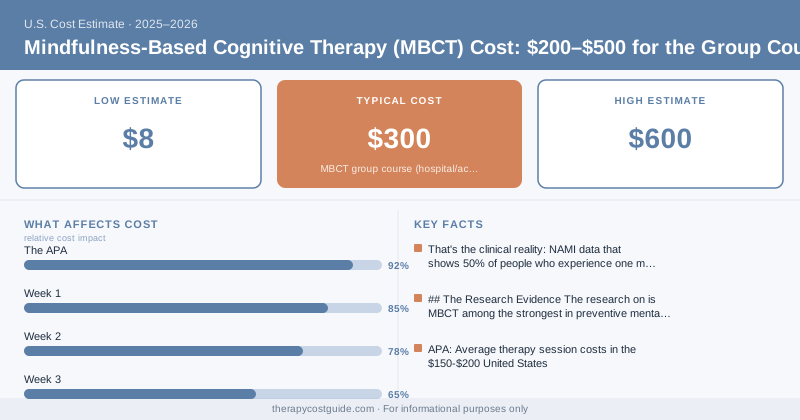
Mindfulness-Based Cognitive Therapy (MBCT) Cost: $200–$500 for the Group Course
{ if eq .Lang "zh" }{ else }{ end }Depression comes back. That’s the clinical reality: NAMI data shows that 50% of people who experience one major depressive episode will have another, and 80% of those who’ve had two will have a third. MBCT was specifically designed to interrupt this cycle — not while you’re depressed, but before the next episode starts. Here’s what it costs and whether it’s worth it.
MBCT Cost Overview
| Format | Cost | Duration | Best For |
|---|---|---|---|
| MBCT group course (community) | $200 – $400 | 8 weeks (2.5 hrs/week) | Prevention of depression relapse |
| MBCT group course (hospital/academic) | $300 – $600 | 8 weeks | Clinical populations with insurance |
| Individual MBCT with therapist | $100 – $200/session | 8 – 12 sessions | Customized, private |
| Online live MBCT group | $100 – $350 | 8 weeks | Remote access |
| Self-guided app (Headspace, Calm) | $5 – $15/month | Ongoing | General mindfulness; not clinical MBCT |
| NHS-equivalent / insurance-covered | $20 – $80 total | 8 weeks | In-network; copay only |
What Makes MBCT Different From Regular Mindfulness
Standard mindfulness practices — meditation apps, yoga, breathing exercises — teach present-moment awareness. MBCT is specifically designed by Zindel Segal, Mark Williams, and John Teasdale as a clinical intervention that combines mindfulness with CBT techniques to interrupt the cognitive patterns that precede depressive relapse.
The key insight: depression relapse doesn’t start with full-blown depression. It starts with low mood that triggers negative thought patterns (“things are never going to improve,” “I’m worthless”), which intensify the low mood, which triggers more negative thoughts — a downward spiral that can escalate to a full episode within days.
MBCT teaches you to:
- Recognize the early warning signs of this spiral
- Step back and observe thoughts as mental events rather than facts
- Break the automatic escalation through mindful awareness
- Respond skillfully rather than react automatically
This is cognitively sophisticated work, which is why MBCT requires a trained facilitator — not a mindfulness teacher, but a clinician with specific MBCT training.
The Research Evidence
The research on MBCT is among the strongest in preventive mental health:
- A 2016 meta-analysis in JAMA Psychiatry (Kuyken et al.) found MBCT reduced relapse rates by 23% compared to treatment as usual in patients with 3+ previous depressive episodes
- The APA classifies MBCT as “strongly recommended” for recurrent depression prevention
- The UK National Health Service (NHS) recommends MBCT as a first-line treatment for preventing recurrent depression — the NICE guidelines have included it since 2009
The evidence is most robust for people with three or more previous depressive episodes who are currently in remission. For active depression or first episodes, CBT or other treatments typically have stronger evidence. MBCT is primarily a prevention tool, not an acute depression treatment.
The 8-Week Protocol
MBCT follows a structured 8-week group program:
Week 1: Automatic pilot — recognizing how much we operate on autopilot Week 2: Living in our heads — seeing thought patterns more clearly Week 3: Gathering the scattered mind — breath awareness practices Week 4: Recognizing aversion — how we fight experience and make it worse Week 5: Allowing/letting be — turning toward difficult experiences Week 6: Thoughts are not facts — cognitive defusion from depressive thoughts Week 7: How can I best take care of myself? — building relapse prevention plans Week 8: Keeping this alive — sustaining practice beyond the course
Each session runs 2–2.5 hours, plus daily homework practices (45 minutes of formal mindfulness practice). There’s also a full-day mindfulness retreat between weeks 6 and 7.
This is not a casual course. The homework is substantial. Patients who benefit most are those who genuinely practice daily, not just attend weekly sessions.
Individual vs. Group MBCT: Which Is Right?
Group MBCT is the format in which all the research was conducted. The group dynamic itself is part of the therapeutic mechanism — learning that others have similar thought patterns reduces isolation and shame.
Individual MBCT is less studied but useful for people who can’t do groups due to social anxiety, scheduling, confidentiality concerns, or geographical limitations. A therapist delivering individual MBCT follows the same 8-session curriculum but adapts the group elements.
Cost difference: group MBCT ($25–$75/session in a group of 10–12) is significantly cheaper than individual MBCT ($100–$200/session). If you have the flexibility, group is both more evidence-based and more affordable.
Does Insurance Cover MBCT?
Commercial insurance typically covers MBCT in two ways:
Group psychotherapy (CPT code 90853): If the MBCT group is run by a licensed mental health provider in a clinical setting, it bills as group therapy. Your standard group therapy copay applies (usually lower than individual therapy copays).
Individual therapy (CPT codes 90834/90837): Individual MBCT sessions bill as standard individual therapy. Standard copays apply.
The availability problem: Finding insurance-covered MBCT can be difficult. Many MBCT programs are run in academic or research settings that may not be in your insurance network. The best approach is to:
- Call your insurer and ask for “mindfulness-based group therapy providers in network”
- Ask your current therapist if they’re MBCT-trained and would adapt treatment
- Check with local hospitals and academic medical centers for MBCT groups
Where to Find MBCT
Center for Mindfulness (UMass Memorial Medical Center): The center founded by Jon Kabat-Zinn (who developed MBSR, the precursor to MBCT). Offers training programs and can refer to certified instructors.
Oxford Mindfulness Centre: UK-based but lists international MBCT teachers.
Psychology Today: Filter by “Mindfulness-Based Cognitive Therapy” — many therapists now have MBCT training.
UCSD Center for Mindfulness: Another major training center; practitioner directory available.
Disclaimer: TherapyCostGuide provides cost information for educational purposes only. We are not a mental health provider and do not offer clinical advice or treatment. Cost ranges are based on national survey data and vary significantly by location, provider credentials, practice setting, and insurance plan. Always consult a licensed mental health professional for treatment decisions. If you are in crisis, call or text 988 (Suicide & Crisis Lifeline) or go to your nearest emergency room.