Mental Health Insurance Parity Law: What It Means for Your Therapy Coverage
{ if eq .Lang "zh" }{ else }{ end }Most people don’t know this law exists. Fewer know it was strengthened dramatically in 2024. And almost nobody knows how to actually use it to challenge their insurance company. That gap — between the law’s protections and how much they’re actually enforced — is the central problem with mental health parity in the United States.
The law is real, the protections are real, and insurance violations are common. Here’s what you need to know.
The Mental Health Parity and Addiction Equity Act (MHPAEA)
The MHPAEA, signed in 2008 and substantially strengthened by a 2024 Final Rule, requires that health insurance plans treat mental health and substance use disorder (MH/SUD) benefits at least as favorably as medical and surgical benefits.
In plain language: if your insurance covers unlimited doctor visits for physical conditions, it can’t impose session limits on mental health visits. If your plan doesn’t require prior authorization for most medical care, it can’t require it for mental health care without equivalent justification.
| Parity Requirement | What It Means | Common Violation |
|---|---|---|
| Quantitative limits | Can’t impose stricter visit limits for MH than medical | Capping therapy at 20 sessions/year while covering unlimited specialist visits |
| Non-quantitative limits | Same standards for prior auth, fail-first, step therapy | Requiring therapy fail before covering medication only for MH |
| Network adequacy | Must have enough MH providers (same standards as medical) | Narrow therapy networks while having broad medical networks |
| Reimbursement rates | Can’t pay MH providers dramatically less (2024 rule) | Paying therapists $60/session while paying physicians $150/visit |
| Out-of-network | Must cover OON MH if covers OON medical | Covering OON cardiologists but not OON psychiatrists |
The 2024 Final Rule: What Changed
In September 2024, the Biden administration issued a sweeping Final Rule implementing the most significant update to MHPAEA since its passage. Key changes:
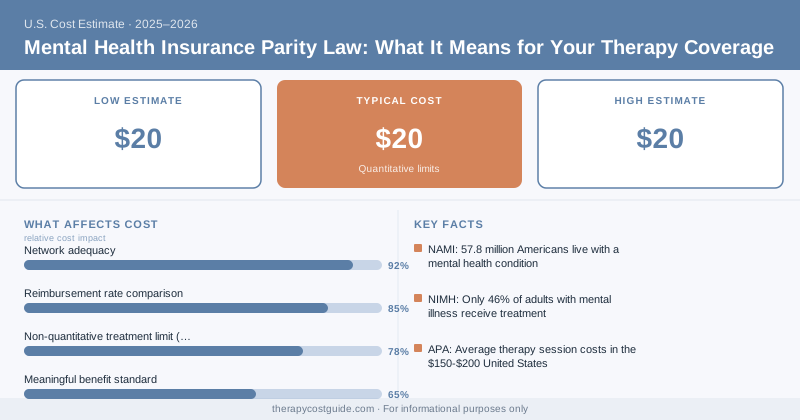
Network adequacy: Insurers must now demonstrate their mental health provider networks are sufficient — meeting the same quantitative standards as medical networks (time and distance standards, appointment wait times).
Reimbursement rate comparison: Insurers must compare payment rates for mental health providers to equivalent medical providers and justify disparities.
Non-quantitative treatment limit (NQTL) analysis: Insurers must conduct and document comparative analyses showing they apply NQTLs (like prior authorization, fail-first policies) with equal rigor to MH/SUD and medical/surgical benefits. Plans must provide these analyses on request.
Meaningful benefit standard: Plans can’t offer mental health benefits in such a limited way that they don’t provide meaningful coverage.
How to Use Parity Law When Your Claim Is Denied
Step 1: Request the NQTL analysis Under the 2024 rule, you can request your insurer’s comparative analysis for any NQTL (prior authorization requirement, step therapy, session limits). The insurer must provide it within 45 days. You don’t need a reason.
Step 2: File a complaint with state regulators Most states have an insurance commissioner’s office. Filing a parity complaint triggers a formal investigation. The National Alliance on Mental Illness (NAMI) reports that parity enforcement actions have increased significantly since 2022, with multiple states levying significant fines for violations.
Step 3: File a federal complaint The Department of Labor handles parity complaints for ERISA plans (most employer-sponsored insurance). CMS handles complaints for marketplace plans.
How to Spot a Parity Violation in Your Own Plan
Check your plan documents for these common parity violations:
- Annual visit limits for therapy (e.g., “30 sessions per year”) with no equivalent limit on physical specialist visits
- Prior authorization required for ongoing mental health care but not for comparable physical care
- Higher out-of-network rates for mental health than medical care
- “Fail-first” requirements only for mental health medications (must try a cheaper drug before the prescribed one) not applied equally to medical drugs
If you find any of these, you have grounds to file a parity complaint. The Bazelon Center for Mental Health Law (bazelon.org) provides free templates and guidance.
Which Plans Are Covered by MHPAEA?
The law applies to:
- Most employer-sponsored health plans (with 51+ employees)
- Individual and small group plans sold through ACA marketplace
- Medicaid managed care plans
- CHIP (Children’s Health Insurance Program)
Not covered: Self-insured small employer plans (fewer than 51 employees may be exempt), short-term health plans, grandfathered plans.
What Parity Doesn’t Guarantee
Parity law doesn’t guarantee that your insurance will actually cover the care you need — it requires that mental health coverage be no worse than physical health coverage. If your plan has high deductibles and limited benefits generally, parity doesn’t fix that. It ensures the playing field is level, but if the field is poor overall, parity doesn’t change it.
The law also doesn’t directly control what therapists charge or what your copays are — it governs the standards your plan must apply.
Disclaimer: TherapyCostGuide provides cost information for educational purposes only. We are not a mental health provider and do not offer clinical advice or treatment. Cost ranges are based on national survey data and vary significantly by location, provider credentials, practice setting, and insurance plan. Always consult a licensed mental health professional for treatment decisions. If you are in crisis, call or text 988 (Suicide & Crisis Lifeline) or go to your nearest emergency room.