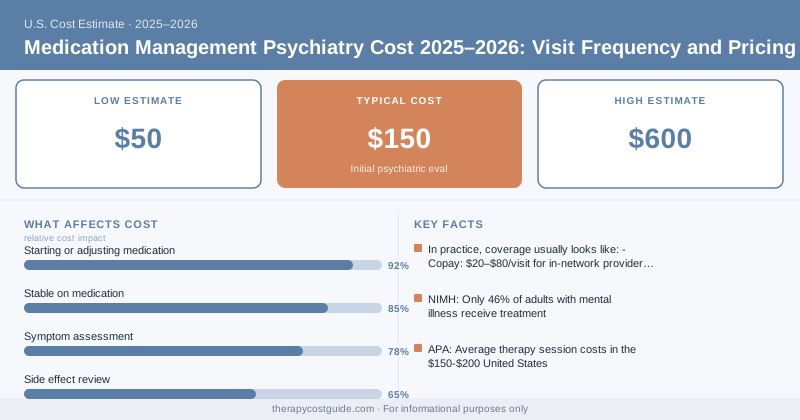
Medication Management Psychiatry Cost 2025–2026: Visit Frequency and Pricing
{ if eq .Lang "zh" }{ else }{ end }“Medication management” is the phrase psychiatry uses for what happens after the initial evaluation: the ongoing 20–30 minute appointments where your psychiatrist checks how your medication is working, adjusts doses, manages side effects, and decides whether to add, switch, or discontinue treatments. These visits are less expensive than an initial evaluation — but they’re recurring, and over a year they add up.
Here’s what medication management visits cost, how often you’ll need them, and how to think about combining them with therapy.
Medication Management Visit Costs
| Visit Type | Duration | Out-of-Pocket Cost | With Insurance |
|---|---|---|---|
| Initial psychiatric eval | 60–90 min | $300 – $600 | $50 – $150 |
| Medication follow-up (monthly) | 20–30 min | $100 – $200 | $30 – $80 |
| Brief medication check | 10–15 min | $75 – $125 | $20 – $50 |
| Complex medication visit | 30–45 min | $150 – $250 | $50 – $120 |
| Combined med mgmt + psychotherapy | 45–50 min | $200 – $350 | $75 – $150 |
Out-of-pocket rates vary by geography, provider type, and whether they’re in your insurance network. Urban markets trend toward the higher end; rural providers and telehealth platforms trend lower.
How Often You’ll Need Visits
Visit frequency depends on where you are in treatment and how stable your condition is. A rough framework:
Starting or adjusting medication:
- Month 1: 2–3 visits (initial evaluation + 1–2 follow-ups to assess early response and side effects)
- Months 2–3: monthly visits to assess full therapeutic effect and adjust if needed
Stable on medication:
- Every 2–3 months for most conditions
- Every 3–6 months for the most stable, long-term patients on well-tolerated regimens
Complex cases (multiple medications, treatment-resistant conditions, lithium/clozapine monitoring):
- Monthly or more frequently
| Patient Type | Annual Visit Count | Annual Out-of-Pocket (No Insurance) | With Insurance |
|---|---|---|---|
| New patient, titrating (year 1) | 6–8 visits | $700 – $1,600 | $200 – $640 |
| Stable patient (ongoing) | 4–6 visits | $500 – $1,200 | $120 – $480 |
| Complex/monitoring required | 8–12 visits | $900 – $2,400 | $240 – $960 |
These are medication management costs only — separate from therapy costs and separate from medication costs.
What Happens During a Medication Management Visit
A medication management appointment isn’t just “how are you feeling.” A thorough visit should cover:
- Symptom assessment: How are your target symptoms (depression, anxiety, mania, psychosis, inattention) responding? Are you using validated scales (PHQ-9, GAD-7, YMRS)?
- Side effect review: Weight, sleep, sexual function, GI tolerance, cardiovascular symptoms, blood pressure — depending on the medication
- Adherence: Are you taking medications consistently? At the right time? With or without food as instructed?
- Medication adjustments: Dose changes, timing changes, adding or switching medications
- Lab review: If you’re on lithium, valproate, or antipsychotics, reviewing recent lab results
- Safety check: Brief suicide risk and substance use check-in
- Coordination: Communication with your therapist if you have one
The 15-Minute Medication Visit Problem
Many patients report medication management appointments lasting 10–15 minutes — too short to cover all the above adequately. This is a widespread problem in U.S. psychiatry driven by reimbursement structures that reward volume. If your visits feel perfunctory, it’s reasonable to ask for longer appointment slots (often billed differently) or to seek a different provider. You’re paying for a medical service; you’re entitled to enough time to discuss your treatment properly.Medication Management vs. Therapy: Different Services
Medication management is not therapy. These are different billing codes, different clinical purposes, and often different providers.
Medication management (CPT codes 99212–99215, psychiatric-specific codes 90833, 90836, 90838): Focuses on diagnosis, prescribing, and medication monitoring. Typically done by a psychiatrist, psychiatric NP, or in some states a psychiatric PA.
Therapy (CPT codes 90832, 90834, 90837): Focused on psychological change through evidence-based techniques. Provided by a licensed therapist (LCSW, LPC, psychologist). No prescribing.
Combined med management + psychotherapy in the same visit (CPT codes 90833+, etc.): Some psychiatrists provide both in a longer appointment. This is often the most efficient use of time and has evidence for better outcomes than either alone.
NIMH research consistently shows that for depression and anxiety, combined pharmacotherapy plus psychotherapy produces better outcomes than either treatment alone. The question is how to practically access both:
Option 1: See a psychiatrist for medication management + separately see a therapist. Two providers, two billing streams, but specialized care from each.
Option 2: See a psychiatrist who provides integrated medication management + therapy in one longer appointment. More expensive per visit ($200–$350) but potentially more cost-effective than two separate providers.
Option 3: Use a telehealth platform (Brightside, Cerebral) that bundles both at a flat monthly rate.
Insurance and Billing
Most insurance plans cover medication management visits as “outpatient mental health” services. The Mental Health Parity and Addiction Equity Act requires these to be covered at parity with comparable medical services. In practice, coverage usually looks like:
- Copay: $20–$80/visit for in-network providers
- With deductible: up to $150–$300/visit until deductible met, then copay
- Out-of-network: reimbursed at a percentage (typically 60–80%) of “reasonable and customary”
NAMI estimates that 56% of counties in the U.S. have no in-network psychiatrist — which means out-of-network costs are unavoidable for many patients. If this applies to you, ask your insurance for a “gap exception” — a formal request to have an out-of-network provider treated as in-network when in-network options don’t exist in your area.
Community Mental Health Centers: The Low-Cost Option
For uninsured or underinsured patients, community mental health centers (CMHCs) offer psychiatric medication management on sliding scale fees based on income. Costs can range from $0–$50/visit for low-income patients.
CMHCs are often under-resourced and have longer wait times, but they provide real psychiatric care at accessible prices. SAMHSA’s treatment locator at findtreatment.gov can identify centers near you.
Bottom Line
Medication management visits cost $100–$200 per visit out of pocket ($30–$80 with insurance). Annual costs for a stable patient run $500–$1,200 without insurance; $120–$480 with coverage. Plan for more frequent visits when starting or adjusting medications. For best outcomes, combine medication management with regular psychotherapy — either through separate providers or a combined model.
{ if eq .Lang "zh" }Disclaimer: TherapyCostGuide provides cost information for educational purposes only. We are not a mental health provider and do not offer clinical advice or treatment. Cost ranges are based on national survey data and vary significantly by location, provider credentials, practice setting, and insurance plan. Always consult a licensed mental health professional for treatment decisions. If you are in crisis, call or text 988 (Suicide & Crisis Lifeline) or go to your nearest emergency room.