Medicaid Therapy Coverage: What Mental Health Benefits You Actually Get
{ if eq .Lang "zh" }{ else }{ end }“Does Medicaid cover therapy?” Short answer: yes. But the more important question is which therapists actually take it — and that’s where things get complicated.
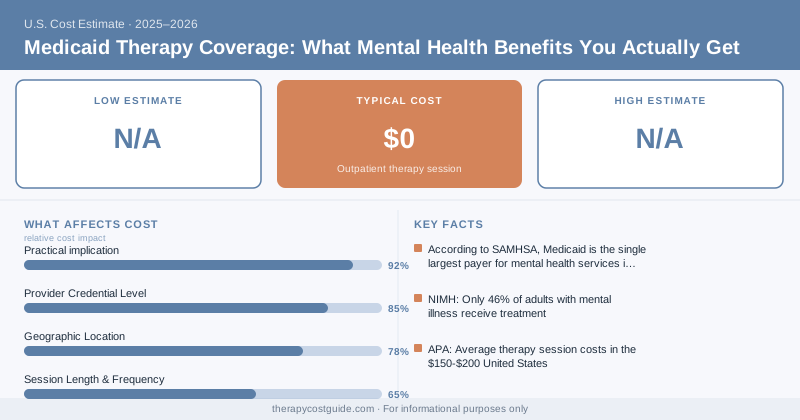
According to SAMHSA, Medicaid is the single largest payer for mental health services in the United States, financing approximately 26% of all mental health spending. If you’re enrolled in Medicaid, you have mental health coverage. The barriers to using it are more practical than coverage-related.
What Medicaid Covers for Mental Health
All 50 states must cover mandatory Medicaid mental health benefits for certain groups (children, pregnant women, low-income adults in expansion states). These mandatory benefits include:
- Individual outpatient therapy with licensed providers (LCSW, LPC, LMFT, PhD/PsyD, MD)
- Psychiatric evaluation and medication management
- Inpatient psychiatric hospitalization
- Crisis intervention services
- Medication (via Medicaid formulary)
Many states cover additional optional benefits, including:
- Group therapy
- Intensive outpatient programs (IOP)
- Partial hospitalization programs (PHP)
- Substance use disorder treatment
- Peer support services
| Medicaid Mental Health Service | Typical Copay | Notes |
|---|---|---|
| Outpatient therapy session | $0–$4 | Often $0 for income below 150% FPL |
| Psychiatry visit | $0–$4 | Same copay rules |
| Generic psychiatric medication | $0–$3 | Formulary varies by state |
| Inpatient psychiatric (per day) | $0–$75 | Varies by state plan |
| IOP program | $0–$20 | If covered by state |
| Crisis stabilization | $0 | Federal law: no copays for emergency |
Managed Care: Why Your Coverage Depends on Which Plan You’re In
Most states run Medicaid through managed care organizations (MCOs) — private companies that administer Medicaid benefits under contract with the state. This means your mental health coverage depends on:
- Which MCO you’re enrolled in — different MCOs in the same state may cover different services
- Which providers are in-network for your MCO — a therapist who accepts Medicaid might not be in your specific plan’s network
- Prior authorization requirements — some plans require prior auth for ongoing therapy beyond 8–12 sessions
- Carve-outs — some states “carve out” behavioral health to a separate managed care company from the physical health plan
Practical implication: When looking for a Medicaid therapist, you need to ask: “Do you accept [your specific MCO plan name]?” — not just “Do you accept Medicaid?”
How to Find a Therapist Who Takes Your Medicaid Plan
- Call your MCO’s member services line (number on your Medicaid card) and ask for a list of in-network behavioral health providers
- Use SAMHSA’s behavioral health treatment locator at findtreatment.gov
- Contact your local community mental health center — CMHCs accept all Medicaid plans in most states
- Ask your primary care provider for a referral to a behavioral health provider who accepts your specific plan
Why Medicaid Provider Networks Are Thin for Therapy
Medicaid reimbursement rates for therapy are typically 60–80% of Medicare rates — which are themselves below commercial insurance rates. Many private-practice therapists don’t accept Medicaid because the rates don’t cover their operating costs.
This is why community mental health centers matter so much. CMHCs are federally funded and take all Medicaid plans. For Medicaid beneficiaries, CMHCs are often the most accessible option, even though private-practice therapists with Medicaid are harder to find.
SAMHSA’s 2023 national survey found that 57.8 million Americans live with a mental illness, yet fewer than half received any treatment — and Medicaid coverage gaps and thin provider networks are a primary driver of that treatment gap.
State Variation in Medicaid Mental Health Coverage
Coverage differs significantly by state:
Expansion states (that accepted ACA Medicaid expansion): Cover adults up to 138% of the federal poverty level. More adults qualify for full Medicaid mental health benefits.
Non-expansion states: Only cover very low-income adults, pregnant women, children, and disabled individuals. Working-age childless adults often have no Medicaid coverage regardless of income.
State-specific enhancements — Some states fund mental health services beyond the federal minimum, including peer support, housing support, and intensive case management.
Telehealth coverage: As of 2025, all 50 states cover telehealth therapy under Medicaid — this substantially expands access to therapists who take Medicaid.
Prior Authorization and Session Limits
Some Medicaid plans limit outpatient therapy sessions to 20–30 per year without prior authorization. If you need more:
- Ask your therapist to submit a prior authorization request with clinical documentation
- Your treating provider can document medical necessity for additional sessions
- Appeal denials — mental health parity law applies to Medicaid managed care
Disclaimer: TherapyCostGuide provides cost information for educational purposes only. We are not a mental health provider and do not offer clinical advice or treatment. Cost ranges are based on national survey data and vary significantly by location, provider credentials, practice setting, and insurance plan. Always consult a licensed mental health professional for treatment decisions. If you are in crisis, call or text 988 (Suicide & Crisis Lifeline) or go to your nearest emergency room.