Licensed Counselor Cost: LPC and LMHC Fees in 2025–2026
{ if eq .Lang "zh" }{ else }{ end }Licensed counselors are the most common type of licensed mental health provider in the United States — and often the most accessible. They’re less expensive than psychologists, hold the same prescribing authority as social workers (which is to say none), and make up the majority of outpatient therapy providers in most states.
Here’s what they charge, what the credential means, and how to evaluate whether an LPC is the right provider for you.
Licensed Counselor Session Costs
| Setting | Typical Session Cost | Notes |
|---|---|---|
| Private practice LPC/LMHC | $100 – $200 | Most common private pay range |
| Group practice LPC | $90 – $175 | Often has more insurance contracts |
| Community mental health center | $20 – $80 | Sliding scale, income-based |
| Online/telehealth LPC | $60 – $140 | Platform-based or independent telehealth |
| University training clinic | $20 – $60 | Supervised interns |
| Employee Assistance Program (EAP) | Usually $0 (employer-paid) | 6–12 sessions typically |
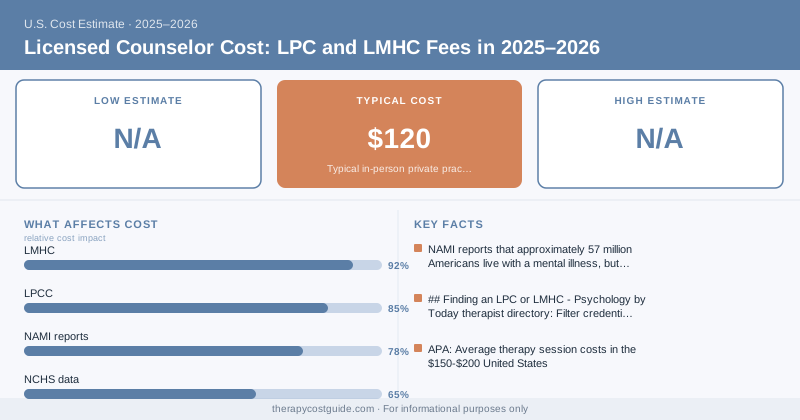
| Typical in-person private practice | $120 – $160 | Most U.S. markets |
What “Licensed Counselor” Actually Means
The title varies by state. Same credential, different names:
- LPC (Licensed Professional Counselor) — used in most states
- LMHC (Licensed Mental Health Counselor) — used in New York, Florida, Massachusetts, and several others
- LPCC (Licensed Professional Clinical Counselor) — California, Ohio, Minnesota
- LAC (Licensed Associate Counselor) — some states use this for pre-licensed counselors under supervision
All require a master’s degree in counseling, mental health, or a related field (typically 60 graduate credit hours), a 2–3 year supervised clinical internship (2,000–4,000 hours depending on state), and passing a national licensing exam — usually the National Counselor Examination (NCE) or the National Clinical Mental Health Counselor Examination (NCMHCE).
LPC vs. LCSW vs. Psychologist: What’s the Cost Difference?
| Credential | Education | Typical Session Cost | Can Prescribe? | Supervised Hours |
|---|---|---|---|---|
| LPC/LMHC | Master’s | $100 – $200 | No | 2,000 – 4,000 |
| LCSW | Master’s (social work) | $100 – $200 | No | 2,000 – 3,000 |
| MFT/LMFT | Master’s | $100 – $200 | No | 2,000 – 3,000 |
| PhD/PsyD | Doctoral | $150 – $300+ | No (except NM, LA, IL) | 2,000+ (postdoc) |
| Psychiatrist | MD/DO | $200 – $500 | Yes | Residency |
The key finding: at the master’s level, LPC/LCSW/MFT fees are nearly identical. The meaningful cost gap is between master’s-level providers ($100–$200) and doctoral-level providers ($150–$300+).
NAMI reports that approximately 57 million Americans live with a mental illness, but only about 50% receive any mental health treatment in a given year. Licensed counselors, as the most numerous licensed mental health providers in the country, are central to closing that treatment gap.
What Conditions Do Licensed Counselors Treat?
LPCs and LMHCs treat the full range of common mental health conditions:
- Depression and mood disorders
- Anxiety disorders (GAD, social anxiety, panic)
- Trauma and PTSD (with appropriate specialty training)
- Relationship and interpersonal issues
- Life transitions, grief, adjustment difficulties
- Substance use (often with additional CADC or LCAS certification)
- OCD, phobias, and other anxiety-spectrum conditions
Licensed counselors can diagnose mental health conditions. They cannot prescribe medication, order medical tests, or make medical diagnoses — that requires medical licensure.
When to Choose an LPC vs. a Psychologist
For most outpatient therapy — treating anxiety, depression, relationship issues, life transitions, trauma — an LPC with appropriate specialty training is clinically equivalent to a psychologist. The meaningful reasons to seek a psychologist (PhD/PsyD) specifically are: psychological testing and assessment (which requires doctoral training), complex diagnostic questions, research-driven settings, or treating conditions where doctoral-level specialized training is rare outside doctoral programs (severe OCD, complex personality disorders, some pediatric specialties). For standard outpatient therapy, the credential difference is mostly a fee difference, not a quality difference.Insurance Coverage with Licensed Counselors
LPCs and LMHCs are licensed to bill insurance in all states, but individual insurer networks vary. Some practical realities:
- LPCs in group practices are more likely to participate in insurance networks than solo private practitioners
- Solo LPCs in private practice increasingly operate out-of-network, citing low reimbursement rates
- Mental Health Parity Act (2008) requires equivalent coverage of mental health vs. physical health services
Typical in-network copay: $20–$60/session after deductible. Out-of-network reimbursement typically 60–80% of “usual and customary” rate.
NCHS data shows that among people who see an outpatient mental health professional, licensed counselors account for the plurality of visits — more than psychologists and social workers individually — which reflects both their numbers and their accessibility.
Finding an LPC or LMHC
- Psychology Today therapist directory: Filter by credential, insurance, specialty, and location
- SAMHSA’s Mental Health Treatment Locator: findtreatment.samhsa.gov
- American Counseling Association (ACA): counseling.org/find-a-counselor
- Your insurance company’s provider directory: Filter for mental health counselors or “licensed professional counselors”
- Open Path Collective: $30–$80/session for licensed counselors serving clients with financial need
The bottom line: if you need outpatient therapy for a common mental health condition and cost is a real factor, LPCs and LMHCs represent the most accessible mid-tier option between free community resources and higher-cost doctoral providers.
{ if eq .Lang "zh" }Disclaimer: TherapyCostGuide provides cost information for educational purposes only. We are not a mental health provider and do not offer clinical advice or treatment. Cost ranges are based on national survey data and vary significantly by location, provider credentials, practice setting, and insurance plan. Always consult a licensed mental health professional for treatment decisions. If you are in crisis, call or text 988 (Suicide & Crisis Lifeline) or go to your nearest emergency room.