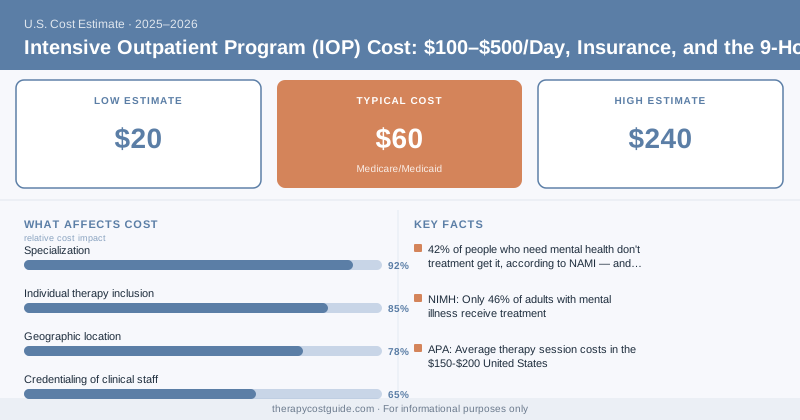
Intensive Outpatient Program (IOP) Cost: $100–$500/Day, Insurance, and the 9-Hour Model
{ if eq .Lang "zh" }{ else }{ end }42% of people who need mental health treatment don’t get it, according to NAMI — and cost is the most commonly cited reason. Intensive outpatient programs sit in a narrow sweet spot: more treatment than weekly therapy, less disruption (and cost) than residential care. Here’s exactly what IOP costs and how to make it work financially.
IOP Cost by Setting and Insurance Status
| Setting | Cost Per Day | Weekly Cost (3 days) | Monthly Estimate |
|---|---|---|---|
| Outpatient clinic IOP | $100 – $250 | $300 – $750 | $1,200 – $3,000 |
| Hospital-affiliated IOP | $200 – $400 | $600 – $1,200 | $2,400 – $4,800 |
| Specialty / dual-diagnosis IOP | $300 – $500 | $900 – $1,500 | $3,600 – $6,000 |
| In-network insurance (copay) | $30 – $80 | $90 – $240 | $360 – $960 |
| Medicare/Medicaid | $0 – $20 | $0 – $60 | $0 – $240 |
The standard IOP model is three days per week, three hours per session — nine hours of clinical programming weekly. Some programs run four or five days per week during the initial phase, stepping down to three days as stabilization occurs.
The Standard 9-Hour Model: What You Get
Nine hours sounds like a lot until you map it out:
- Monday, Wednesday, Friday, 10 a.m. – 1 p.m. (or evenings for working adults)
- Each session: process group (60–75 min), skills group (60 min), psychoeducation (30–45 min)
- Individual therapy: 1 session per week, often billed separately
- Psychiatry/medication management: 1 session every 2–4 weeks, billed separately
That individual therapy and psychiatry time matters — it’s often not included in the daily IOP rate and generates additional copays or charges. Ask the program coordinator to itemize every billable component before you start.
What Insurance Covers
The Mental Health Parity and Addiction Equity Act requires insurers to cover IOP comparably to medical day treatment. Most commercial plans cover IOP when medically necessary, but authorization requirements vary significantly.
Typical insurance process:
- Your therapist or the IOP program calls for pre-authorization
- Insurer approves an initial block (often 2–3 weeks)
- Program submits utilization review every 1–2 weeks for continued authorization
- Most adults complete IOP in 4–8 weeks of authorized sessions
Common out-of-pocket scenarios:
- High-deductible plan: First $1,500–$3,000 entirely self-pay until deductible is met, then 20–30% coinsurance
- Copay plan: $30–$80 per day, applied daily; individual therapy sessions have a separate copay
- Out-of-pocket maximum: Once reached, your IOP cost drops to $0
Evening IOPs: The Working Adult Option
Many IOP programs offer evening tracks specifically for people who can’t take daytime hours away from work. These typically run 5:30–8:30 p.m., three evenings per week. Insurance covers evening IOP at the same rate as daytime. If your employer provides EAP benefits, you may also get 3–8 free sessions with a therapist to bridge the gap between IOP discharge and weekly outpatient therapy.IOP vs. PHP: Which Level Do You Need?
Choosing the right level of care affects both clinical outcomes and cost. Undertreatment means you might cycle back to a higher level; overtreatment is unnecessarily expensive.
IOP is typically appropriate when:
- Symptoms are present but manageable; you can function overnight and on weekends without intensive support
- You’ve completed PHP and are ready to step down
- You need structured support but can maintain your work or school schedule with adjustments
- Medication is established; monitoring can be every 2–4 weeks rather than daily
PHP is typically appropriate when:
- You need daily psychiatric contact (new medication, significant safety concerns, acute mood instability)
- You can’t safely manage evenings and weekends without support but don’t need 24-hour supervision
What Affects IOP Cost
Specialization: General mental health IOP costs less than specialized tracks — eating disorder IOP, trauma-focused IOP, co-occurring disorders IOP all charge a premium because they require more specialized clinical staff.
Individual therapy inclusion: Some IOPs bundle individual therapy into the daily rate; others bill it separately. Ask specifically whether your individual sessions are part of the daily rate or billed as additional CPT codes.
Geographic location: Urban IOPs cost 30–60% more than rural equivalents. IOPs in California, New York, and Massachusetts are among the most expensive in the country.
Credentialing of clinical staff: Programs where groups are led by licensed psychologists or psychiatrists cost more than those using licensed counselors or social workers.
Duration: Most IOPs run 6–12 weeks. Each additional week adds $300–$750 out-of-pocket (with insurance) or $1,800–$4,500 self-pay.
Finding Lower-Cost IOP
Community mental health centers: Most states have publicly funded community mental health centers that offer IOP at sliding-scale fees, sometimes as low as $0 for qualifying income levels. These programs may have waitlists of 2–6 weeks.
University training clinics: Some university-affiliated psychiatric programs run IOPs at reduced rates as training environments under licensed supervision.
SAMHSA’s Treatment Locator: findtreatment.gov lets you filter by payment type (including free/sliding scale) and geographic area. It covers more than 14,000 treatment facilities.
Negotiating self-pay rates: If you’re paying out-of-pocket, ask for the program’s “self-pay rate” or “uninsured rate.” Programs often discount 20–40% from the standard daily charge for patients paying directly, because it eliminates billing overhead.
Total Cost of an IOP Episode
A typical IOP course runs 6–8 weeks at three sessions per week — about 18–24 treatment days total.
| Scenario | Total Cost |
|---|---|
| In-network, $50/day copay, 20 days | $1,000 |
| Self-pay, $200/day, 20 days | $4,000 |
| Self-pay, $350/day, 24 days | $8,400 |
| Medicaid, minimal copay | $0 – $200 |
For most commercially insured patients, IOP is genuinely affordable — especially compared to the cost of inpatient hospitalization, which averages $15,000–$40,000 for a one-week stay.
{ if eq .Lang "zh" }Disclaimer: TherapyCostGuide provides cost information for educational purposes only. We are not a mental health provider and do not offer clinical advice or treatment. Cost ranges are based on national survey data and vary significantly by location, provider credentials, practice setting, and insurance plan. Always consult a licensed mental health professional for treatment decisions. If you are in crisis, call or text 988 (Suicide & Crisis Lifeline) or go to your nearest emergency room.