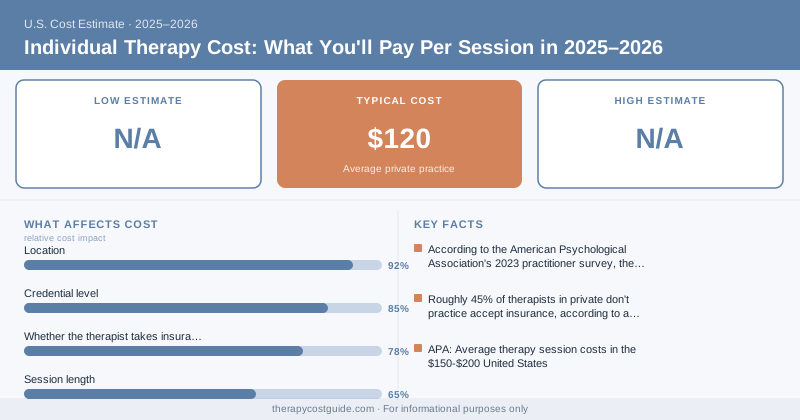
Individual Therapy Cost: What You'll Pay Per Session in 2025–2026
{ if eq .Lang "zh" }{ else }{ end }You called a few therapists. One charges $120. Another charges $275. A third has a “sliding scale” but won’t say what that means until you call. It’s maddening — and it’s one reason so many people give up before they even start.
Here’s what individual therapy actually costs, why prices vary so much, and what you can realistically expect to pay.
The Basic Price Range
Without insurance, a single 45–50 minute therapy session in the United States typically runs $100 to $300, with most therapists in mid-sized and large cities landing in the $150–$200 range.
According to the American Psychological Association’s 2023 practitioner survey, the median session fee for licensed psychologists in private practice is around $200. Licensed Professional Counselors (LPCs) and Licensed Clinical Social Workers (LCSWs) typically charge $100–$160 per session — lower overhead, similar quality of care for most presenting concerns.
| Provider Type | Typical Session Fee | Notes |
|---|---|---|
| Licensed Psychologist (PhD/PsyD) | $150 – $300 | Highest credential, often used for testing/assessment |
| Licensed Professional Counselor (LPC) | $100 – $180 | Master’s level, handles most therapy needs |
| Licensed Clinical Social Worker (LCSW) | $80 – $160 | Master’s level, often in agency or community settings |
| Marriage & Family Therapist (MFT) | $100 – $175 | Specialty in relationships and family systems |
| Psychiatrist (therapy-only) | $200 – $400 | Usually focuses on medication management, not talk therapy |
| Average private practice | $120 – $250 | Varies widely by city and provider |
What Makes Therapy Cost More or Less
A handful of factors explain most of the price variation you’ll see:
Location — A therapist in Manhattan or San Francisco charges more than one in Tulsa or Baton Rouge. It’s not just demand; it’s overhead. Office rent in major metros is genuinely 3–5x higher.
Credential level — A PhD or PsyD psychologist has 5–7 years of doctoral training. An LCSW has a 2-year master’s degree and a clinical residency. Both are licensed and qualified to provide therapy. For most anxiety and depression treatment, the outcomes research shows similar effectiveness.
Whether the therapist takes insurance — In-network therapists have agreed-upon rates with insurers, which are often 30–50% below their private-pay rate. Out-of-network therapists charge their full rate, though you may be able to submit claims for partial reimbursement.
Session length — Standard sessions are 45–53 minutes. Some therapists offer 60 or 90-minute sessions at a proportionally higher rate.
Specialty — Therapists who’ve completed intensive training in specific modalities (EMDR, intensive trauma treatment, eating disorder specialization) often charge a premium.
What You Pay With Insurance
With in-network insurance, you typically pay a copay of $20–$60 per session after your deductible is met. But there’s a catch — a big one.
Roughly 45% of therapists in private practice don’t accept insurance, according to a 2022 study published in Psychiatric Services. Some don’t want the administrative burden; others dropped insurance panels because reimbursement rates haven’t kept pace with costs.
If you have a deductible you haven’t met, you’ll likely pay close to the full session rate until you hit it — then copays kick in. Always call your insurance company before scheduling to ask:
- Is this specific provider in-network?
- What’s my deductible for mental health services?
- What will my copay be after my deductible is met?
- Is there a session limit per year?
The In-Network vs. Out-of-Network Math
Say your therapist charges $200 per session. In-network, your negotiated rate might be $130, and you pay a $40 copay after your deductible. Out-of-network, you pay $200 up front, then submit a claim and your insurance reimburses you maybe $80–$100 — leaving you $100–$120 out of pocket per session. Neither is free, but the difference adds up fast over months of weekly therapy.How Many Sessions Will You Need?
This is the question nobody wants to answer directly, because it genuinely depends. That said:
- Short-term CBT for a specific phobia, mild anxiety, or adjustment issues: typically 8–20 sessions
- Moderate depression or anxiety: 20–40 sessions over 6–12 months is common
- Complex trauma, personality disorders, or long-standing issues: often 1–3 years of weekly therapy
- Maintenance therapy (monthly check-ins once stable): indefinite, but at a lower frequency and cost
If your budget is tight, ask a potential therapist upfront: “Given what I’ve described, what’s a realistic timeline to feel meaningfully better?” A good therapist will give you a direct answer.
Finding Care at Lower Cost
You don’t have to pay $200 a session to get competent therapy. Legitimate lower-cost options include:
Community mental health centers — Federally funded, offer income-based sliding scale fees. Typical session cost: $5–$50. Wait lists can be long.
University training clinics — Graduate students in accredited programs, supervised by licensed clinicians. Fees are typically $20–$60 per session. Quality is often excellent.
Open Path Collective — A network of therapists who offer $30–$80 sessions to members who pay a one-time $65 enrollment fee. openpath.com.
Sliding scale private practice — Many therapists reserve a few spots at reduced rates. You have to ask. Most don’t advertise it prominently.
The Real Cost of Not Starting
NAMI reports that the average delay between first symptoms of a mental health condition and first treatment is 11 years. That’s not a financial statistic — it’s a quality-of-life one. The cost of untreated anxiety and depression includes lost productivity, strained relationships, and worsening symptoms that eventually require more intensive (and more expensive) care.
Getting into therapy at $150 a session is real money. It’s worth being strategic about how to pay for it. But it’s worth starting.
{ if eq .Lang "zh" }Disclaimer: TherapyCostGuide provides cost information for educational purposes only. We are not a mental health provider and do not offer clinical advice or treatment. Cost ranges are based on national survey data and vary significantly by location, provider credentials, practice setting, and insurance plan. Always consult a licensed mental health professional for treatment decisions. If you are in crisis, call or text 988 (Suicide & Crisis Lifeline) or go to your nearest emergency room.