How to Find Affordable Therapy: 10-Step Guide from EAP to Open Path to Sliding Scale
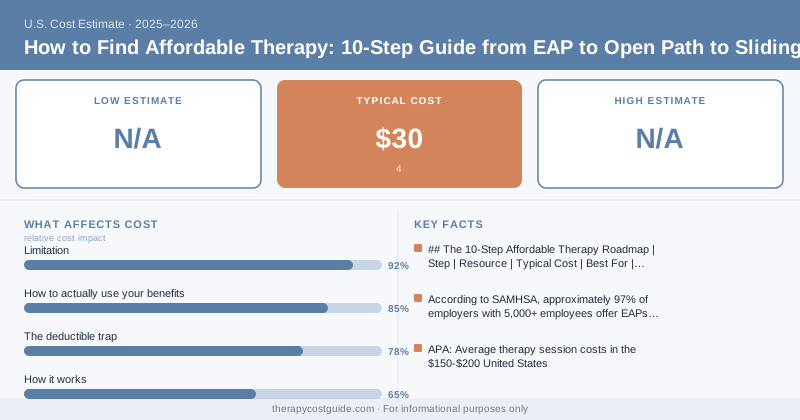
{ if eq .Lang "zh" }{ else }{ end }Therapy shouldn’t cost what a car payment does. Yet the average private-pay therapy session in the U.S. runs $150–$200 — and in major cities, $250–$400 isn’t unusual. NAMI data shows that nearly 9 in 10 people who need mental health treatment and don’t receive it cite cost as the primary reason. Here’s a 10-step roadmap from free to low-cost — in order of what to check first.
The 10-Step Affordable Therapy Roadmap
| Step | Resource | Typical Cost | Best For |
|---|---|---|---|
| 1 | Employer EAP | $0 (3–12 free sessions) | Anyone with a job |
| 2 | In-network insurance | $20 – $60 copay | People with commercial insurance |
| 3 | Open Path Collective | $30 – $80/session | Uninsured or high copay |
| 4 | Sliding-scale private therapists | $30 – $100/session | Income-based reduction |
| 5 | University training clinics | $20 – $60/session | Budget-flexible, not in crisis |
| 6 | Community mental health centers | $0 – $40/session | Low-income, Medicaid eligible |
| 7 | Federally Qualified Health Centers | $0 – $50/session | Uninsured, income-qualifying |
| 8 | Online platforms (BetterHelp, Talkspace) | $60 – $100/week | Convenience + affordability |
| 9 | National helplines (NAMI, 988) | Free | Crisis or information |
| 10 | Peer support groups | $0 | Supplemental support |
Step 1: Check Your Employer EAP (Most People Skip This)
Your employer’s Employee Assistance Program is the single most overlooked free mental health resource in America. According to SAMHSA, approximately 97% of employers with 5,000+ employees offer EAPs — yet utilization rates hover around 4–8%.
EAPs typically provide:
- 3–12 free therapy sessions per issue per year
- Confidential — your employer doesn’t know you’re using it
- Fast access — often within days, not months
- Licensed therapists
Call HR or check your pay stub/benefits portal for the EAP phone number. You don’t need a referral. You can call today and have an appointment within a week in most cases.
Limitation: EAP therapy is typically short-term (3–12 sessions). It’s excellent for acute issues, life transitions, or as a bridge while you find a longer-term therapist. For ongoing treatment, you’ll need another option after EAP sessions are used.
Step 2: Maximize Your Insurance Benefits
If you have health insurance, you almost certainly have mental health benefits — even if no one told you clearly what they are. Under the ACA, mental health treatment is an essential health benefit. Under MHPAEA, your copays for mental health can’t be higher than medical specialist copays.
How to actually use your benefits:
- Call the member services number on your insurance card
- Ask: “What’s my copay for outpatient mental health? Do I need a referral? Do I have a deductible that applies?”
- Ask for an in-network provider list or use your insurer’s online provider directory
- When calling therapists, say upfront: “I have [insurer name]. Are you in-network?”
The deductible trap: Many plans have a deductible that applies before insurance pays. If your deductible is $3,000 and you haven’t met it, you pay full session cost ($100–$200) until you do. Run the math before assuming your copay is the full story.
Step 3: Open Path Collective
Open Path Collective (openpathcollective.org) is a network of licensed therapists who offer reduced-rate sessions specifically for individuals who can’t afford standard rates. Sessions cost $30–$80.
How it works:
- Pay a one-time $65 membership fee
- Browse therapists in your area or via telehealth
- Select and contact a therapist; they’ll confirm your membership eligibility
- All therapists are licensed and credentialed
Over 20 sessions, Open Path saves $2,000–$4,000 compared to standard self-pay rates. The one-time $65 fee is easily worth it.
Step 4: Ask Any Therapist About Sliding Scale
This step costs nothing to try — and works more often than people expect.
When calling a therapist whose standard rate is higher than you can afford, ask: “Do you offer a sliding-scale fee? My budget is $X per session.” Many private-practice therapists maintain 1–3 sliding-scale spots for clients who couldn’t otherwise afford their services.
How to ask effectively:
- Be specific: “I can pay $80/session” (not just “do you do sliding scale?”)
- Be honest about why (income, insurance situation)
- Don’t be embarrassed — therapists who offer sliding scale do it willingly
You’ll get a “no” more often than a “yes” — but the “yes” costs you nothing to find.
The Psychology Today Hidden Filter
Psychology Today’s therapist directory has a “sliding scale” filter that most people don’t notice. Go to therapistfinder.com (Psychology Today’s booking side) and check the “Sliding Scale” filter under cost options.
This shows therapists who have proactively indicated they offer income-based fees. The list will be smaller than the full directory, but everyone on it has already opted in — no awkward asking required.
Step 5: University Training Clinics
Universities with psychology, social work, or counseling programs often operate training clinics where graduate students provide supervised therapy at reduced rates. Sessions cost $20–$60 typically.
What you get: A supervised graduate student — not yet fully licensed but trained, supervised weekly by a licensed clinician, and often recent to the latest evidence-based approaches. The supervision structure means you’re effectively getting two clinicians for the price of one.
What to search: “[Your city] university counseling training clinic” or “[Your city] psychology training clinic.”
Good fits: People who aren’t in acute crisis, are comfortable with the training aspect, and have flexibility in session timing (training clinics often have limited scheduling windows).
Step 6: Community Mental Health Centers
Every state funds community mental health centers (CMHCs) to provide mental health services to residents regardless of ability to pay. Services are available on a sliding scale based on income — $0 for those below 100% of the federal poverty level.
Finding CMHCs: Search “[your county/city] community mental health center” or use SAMHSA’s treatment locator at findtreatment.gov.
Services typically available: Individual therapy, group therapy, psychiatric medication management, case management, crisis services.
Tradeoffs: CMHCs often have waitlists of 2–8 weeks, see clients on a scheduled basis that may be less flexible than private practice, and the therapeutic relationship may be assigned rather than chosen. But for income-qualifying individuals, they’re genuinely excellent resources.
Step 7: Federally Qualified Health Centers
FQHCs receive federal funding to provide comprehensive health services regardless of ability to pay, including behavioral health. Fees are on a sliding scale based on household income and family size.
Find your nearest FQHC: findahealthcenter.hrsa.gov (Health Resources & Services Administration’s official locator).
Many FQHCs now have integrated behavioral health — you can see a therapist in the same building as your primary care provider, sometimes on the same day.
Step 8: Online Platforms — The Tradeoffs
Platforms like BetterHelp ($60–$100/week) and Talkspace ($65–$110/week) offer lower costs than standard private practice. You’re buying convenience and reduced cost in exchange for:
- Therapist matching that you don’t fully control
- Primarily text-based or asynchronous communication (for the lowest tiers)
- The fact that sessions typically can’t be billed to insurance
BetterHelp and Talkspace are appropriate for mild-moderate presentations in people who want accessible, flexible support. They’re not appropriate for crisis, severe mental illness, or complex trauma. They should not be substituted for medication management (neither platform provides psychiatry).
Step 9: Free Helplines for Crisis or Navigation Help
NAMI Helpline (1-800-950-6264): Free mental health information and referrals. Can help you navigate finding providers and understanding your insurance rights.
988 Suicide and Crisis Lifeline: Free crisis counseling. Not just for suicidal ideation — also for acute anxiety, panic, and overwhelming distress.
Crisis Text Line (text HOME to 741741): Free text-based crisis support.
Step 10: Peer Support — Often Overlooked
Peer support groups — whether through NAMI, AA/NA, SMART Recovery, or condition-specific groups — are free and evidence-supported as supplements to therapy. They don’t replace clinical treatment but they extend the support network significantly and cost nothing.
Search NAMI’s finding support page, your local community board, or Meetup for mental health peer groups in your area.
What If Nothing Works?
If you’ve exhausted the above options and still can’t access therapy:
Structured self-help: CBT workbooks and apps like Woebot (free), Sanvello ($8.99/month), or the CBT-i Coach app (free, for insomnia/anxiety) provide structured mental health tools based on evidence-based therapy.
Mental Health America’s free screening tools: mhanational.org has validated mental health screening tools and self-help resources.
Library resources: Most public libraries have mental health workbooks and audiobooks based on CBT, DBT, and mindfulness approaches — free with a library card.
These are supplements, not replacements for clinical care. But for people in genuine access gaps, structured self-help provides real benefit while you work toward clinical treatment.
{ if eq .Lang "zh" }Disclaimer: TherapyCostGuide provides cost information for educational purposes only. We are not a mental health provider and do not offer clinical advice or treatment. Cost ranges are based on national survey data and vary significantly by location, provider credentials, practice setting, and insurance plan. Always consult a licensed mental health professional for treatment decisions. If you are in crisis, call or text 988 (Suicide & Crisis Lifeline) or go to your nearest emergency room.