Hakomi Therapy Cost: Sessions, Training Requirements, and Insurance Coverage
{ if eq .Lang "zh" }{ else }{ end }Two years of weekly therapy. Progress — but the trauma responses keep showing up in your body. Racing heart in meetings. Shoulders that won’t drop. A chronic sense of bracing that no amount of talking has fully reached.
That’s the gap Hakomi was designed to address.
Developed in the 1970s by therapist and educator Ron Kurtz, Hakomi (a Hopi word meaning “How do you stand in relation to these many realms?”) is a mindfulness-centered somatic psychotherapy. It works not through talk or cognitive restructuring primarily, but through present-moment body awareness — noticing sensations, impulses, and the meaning the body organizes around old experiences.
It’s less well-known than EMDR or CBT but has a dedicated following among therapists and clients who find purely cognitive approaches hit a ceiling.
What Hakomi Therapy Costs
| Setting | Session Cost | Session Length |
|---|---|---|
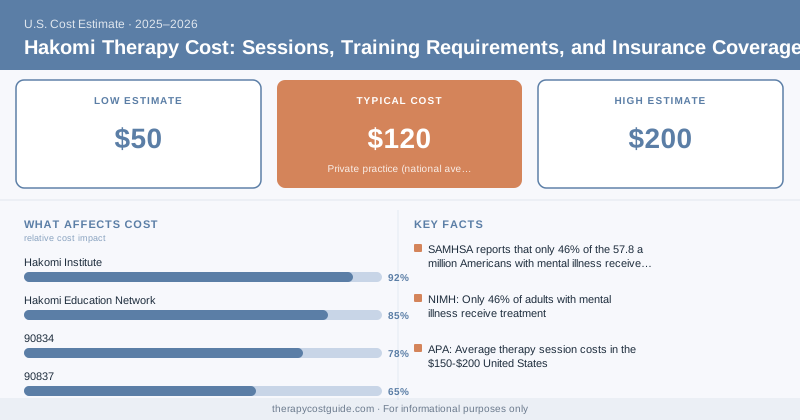
| Private practice (national average) | $120 – $200 | 50–60 minutes |
| Major metro (NYC, LA, SF, Seattle) | $175 – $300 | 50–90 minutes |
| Smaller cities / rural | $90 – $150 | 50 minutes |
| Extended sessions (deeper somatic work) | $200 – $350 | 90 minutes |
| Sliding scale (many Hakomi practitioners) | $60 – $110 | 50 minutes |
Rates are comparable to other specialized somatic and trauma-focused therapies. Hakomi practitioners tend to work in private practice settings rather than community mental health, which skews rates upward — but sliding scale is genuinely common in this community, more so than in some other specialized modalities.
How Hakomi Is Different from Other Somatic Therapies
Somatic therapy is a broad category. Hakomi occupies a specific place within it: it’s not primarily about breathwork, movement, or touch (though mindful touch may sometimes be used with consent). The core method uses what Kurtz called experiments and probes.
A probe is a carefully worded statement or touch offered by the therapist while you’re in a mindful, slightly slowed-down state of awareness — for example, “Notice what happens in your body when I say, ‘It’s okay to take up space.’” Your spontaneous reaction (tension, a shift in breathing, an emotion, a memory) becomes the material for exploration.
An experiment takes that a step further — actually trying something new in the session, in a contained way, to discover what the body already knows about a pattern.
What Hakomi Treats
Hakomi is particularly well-suited for:
- Developmental and attachment trauma (early relational wounds that didn’t leave a single clear memory)
- Chronic somatic symptoms with psychological roots (persistent tension, digestive issues, fatigue that doesn’t have a purely medical explanation)
- Relationship and communication patterns that repeat despite intellectual insight
- Anxiety and depression where cognitive work has plateaued
- Personal growth and self-understanding, not just symptom reduction
A key principle distinguishing Hakomi from approaches like CBT or even standard EMDR is its nonviolence principle: the therapist doesn’t push or persuade the client toward change. Defenses and protective patterns are treated as wisdom, not obstacles. This makes it particularly useful for clients who’ve felt “managed” or pressured in previous therapy.
How It Compares to Other Somatic Approaches
| Approach | Session Cost | Core Method | Best For |
|---|---|---|---|
| Hakomi | $120 – $230 | Mindfulness + experiments/probes | Attachment, developmental patterns |
| Somatic Experiencing (SE) | $130 – $250 | Titrated trauma processing, “felt sense” | Shock trauma, PTSD |
| Sensorimotor Psychotherapy | $130 – $250 | Body movement + narrative | Complex trauma, attachment |
| EMDR | $100 – $250 | Bilateral processing of trauma memories | Single-incident + complex PTSD |
| Brainspotting | $120 – $250 | Eye position + deep brain processing | Trauma, performance anxiety |
Hakomi and Somatic Experiencing are often mentioned together, but they work differently. SE (developed by Peter Levine) is more specifically focused on resolving incomplete survival responses from shock trauma — the “freeze” that didn’t finish. Hakomi works more broadly with character and developmental patterns through mindful self-study. Some practitioners train in both.
Practitioner Training: What It Takes
Hakomi certification requires substantial training. The main bodies are:
- Hakomi Institute — the original organization founded by Kurtz; offers Level 1 and Level 2 trainings over 1–2 years
- Hakomi Education Network — affiliated training programs globally
Full Hakomi certification (not just attendance) typically requires:
- 150+ hours of training
- Personal therapy in the Hakomi method
- Supervised practice hours
- A clinical case presentation
This training investment is on top of any underlying mental health license (LCSW, LPC, MFT, PhD). The additional certification means Hakomi practitioners have invested significantly in learning the method — which is part of why session rates reflect slightly more than generic talk therapy.
That said, many therapists are trained in Hakomi as one method among several and don’t always list it prominently in their profiles. When searching, look for “Hakomi,” “mindfulness-centered somatic,” or “Ron Kurtz method” in provider bios.
Insurance Coverage
Hakomi sessions are billed as standard outpatient psychotherapy. The billing codes are the same regardless of modality:
- 90834 — Individual psychotherapy, 45 minutes
- 90837 — Individual psychotherapy, 60 minutes
Insurers reimburse based on those codes and the therapist’s license, not the specific approach. SAMHSA reports that only 46% of the 57.8 million Americans with a mental illness received treatment in the past year — cost and insurance coverage remain primary barriers. Hakomi, at least, doesn’t add a billing disadvantage.
Is Hakomi Right for You?
Hakomi tends to resonate with people who:
- Have done “enough” talk therapy and feel cognitively understand their patterns but can’t shift them
- Are curious rather than just crisis-driven — it’s an exploratory process
- Are comfortable slowing down and paying close attention to physical sensation
- Have enough sense of safety to sit with mild discomfort in a therapeutic setting
It’s generally not the first-line recommendation for acute crisis, active psychosis, or situations requiring very structured, protocol-driven treatment. But for developmental patterns, chronic somatic distress, and the kind of “I know why, but I can’t stop” experience that therapy veterans often describe — Hakomi has a specific and meaningful role.
The Hakomi Institute’s practitioner directory at hakomiinstitute.com is a good starting point. Expect to have a phone consultation before committing — that initial fit matters more in somatic work than in many other approaches.
{ if eq .Lang "zh" }Disclaimer: TherapyCostGuide provides cost information for educational purposes only. We are not a mental health provider and do not offer clinical advice or treatment. Cost ranges are based on national survey data and vary significantly by location, provider credentials, practice setting, and insurance plan. Always consult a licensed mental health professional for treatment decisions. If you are in crisis, call or text 988 (Suicide & Crisis Lifeline) or go to your nearest emergency room.