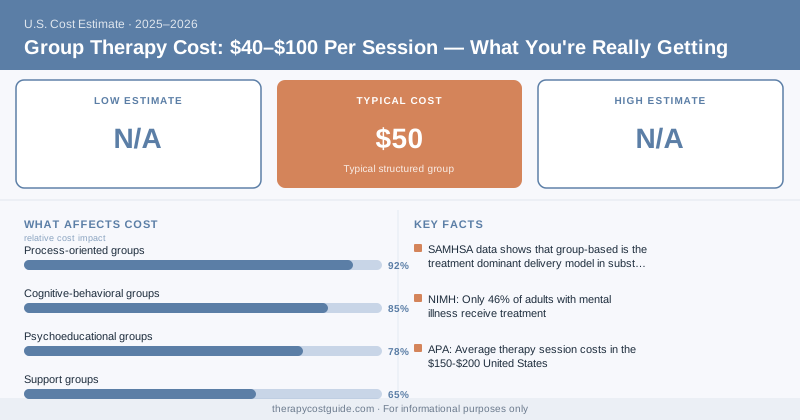
Group Therapy Cost: $40–$100 Per Session — What You're Really Getting
{ if eq .Lang "zh" }{ else }{ end }Most people picture group therapy as a circle of strangers sharing their worst moments. The reality is much more structured — and much more affordable. A typical group therapy session runs $40–$100, versus $120–$250 for an individual hour with the same therapist.
That price gap is real. But group therapy isn’t just cheaper individual therapy. It’s a different modality with different mechanisms — and for certain problems, it works better than one-on-one work.
Group Therapy vs. Individual Therapy: Cost Comparison
| Format | Typical Cost | Session Length | Frequency |
|---|---|---|---|
| Individual therapy | $120 – $250/session | 50 minutes | Weekly |
| Group therapy (outpatient) | $40 – $100/session | 60–90 minutes | Weekly |
| Psychoeducational group | $20 – $60/session | 60–90 minutes | Weekly |
| Support group (peer-led) | Free – $20 | 60–90 minutes | Weekly |
| Intensive Outpatient Program (IOP) | $100 – $300/day | 3–5 hrs/day | 3–5x/week |
| Typical structured group | $50 – $80/session | 75 minutes | Weekly |
The therapist-to-patient ratio is what drives the cost difference. A therapist running a 10-person group earns more per hour than doing individual sessions — and clients pay less per person. Everyone wins financially.
Types of Therapy Groups and Their Costs
Not all groups are created equal. The type of group determines the clinical approach, cost structure, and who runs it.
Process-oriented groups: Interpersonal dynamics within the group itself are the therapeutic tool. Members explore how they relate to each other in real time. Usually led by one or two licensed therapists. Cost: $60–$100/session.
Cognitive-behavioral groups: Structured skill-building sessions following CBT protocols. Often time-limited (8–20 sessions). Used for depression, anxiety, PTSD, substance use. Cost: $50–$90/session.
Psychoeducational groups: Focused on teaching about a condition and coping skills. Less therapy, more education. Often run in medical settings. Cost: $20–$60/session.
Support groups: Often peer-facilitated, may have a therapist for some sessions. AA, NAMI Connection, and cancer support groups fall here. Cost: free to $20.
Skills training groups (like DBT): Highly structured skill acquisition in areas like distress tolerance or emotion regulation. Often run alongside individual therapy. Cost: $50–$100/session.
What Does Research Say About Group Therapy Effectiveness?
The evidence is solid. A landmark meta-analysis published in the Journal of Consulting and Clinical Psychology found that group therapy produces outcomes equivalent to individual therapy for depression, anxiety, and several other conditions — with the added benefit of peer support and normalization.
SAMHSA data shows that group-based treatment is the dominant delivery model in substance use disorder programs, with more than 80% of addiction treatment providers using group formats as the primary treatment modality.
For specific conditions, group modalities actually outperform individual therapy. Interpersonal process groups, for example, are highly effective for social anxiety because exposure to the feared situation (other people) happens during the treatment itself.
The Therapeutic Factors Unique to Group
Yalom identified 11 “curative factors” specific to group therapy that individual therapy can’t replicate: universality (you’re not alone), altruism (helping others), instillation of hope (seeing others get better), imitative behavior, interpersonal learning, and cohesiveness, among others. These mechanisms are only available in group settings — meaning group isn’t just cheaper, it has capabilities individual therapy doesn’t.Insurance Coverage for Group Therapy
Group therapy billed by a licensed provider for a diagnosed condition is generally covered by insurance under mental health parity laws. The billing code (typically CPT 90853 for group psychotherapy) is a standard insurance code.
Typical in-network costs: $10–$40 copay per session after deductible. That’s genuinely affordable mental health treatment.
The coverage gap: many specialty groups — peer support, psychoeducational groups at community organizations, and some hospital-based programs — aren’t billable to insurance because they’re not conducted by licensed clinicians. You’ll pay out of pocket for those.
When Group Therapy Is the Better Choice
Group therapy isn’t for everyone or every situation. It’s typically the better choice when:
- Social anxiety, shyness, or interpersonal difficulties are core problems (the group is both treatment and laboratory)
- Substance use recovery — peer accountability and community are central to most evidence-based addiction treatment
- Grief or trauma with strong isolation component — universality reduces shame
- Cost is a real constraint — group at $60 versus individual at $200 means you can attend 3x more sessions for the same monthly spend
- You’re in concurrent individual therapy — many clinicians recommend combining both; group for skills/community, individual for deeper work
Group therapy isn’t a good fit when you have severe social anxiety that makes group participation impossible (individual work first), crisis-level presentations requiring intensive individual focus, or highly sensitive disclosures you’re not ready to share with peers.
Finding Group Therapy at Lower Cost
- NAMI (nami.org) runs free peer-led groups for people with mental illness and family members in most U.S. cities
- Psychology Today’s therapist directory has a group filter — search by condition and zip code
- Community mental health centers often run income-scaled groups for depression, anxiety, substance use
- Hospital system outpatient programs frequently offer psychoeducational groups at low cost for their patient populations
The bottom line: $60/week for group versus $160/week for individual means you can stay in active treatment twice as long for the same budget.
{ if eq .Lang "zh" }Disclaimer: TherapyCostGuide provides cost information for educational purposes only. We are not a mental health provider and do not offer clinical advice or treatment. Cost ranges are based on national survey data and vary significantly by location, provider credentials, practice setting, and insurance plan. Always consult a licensed mental health professional for treatment decisions. If you are in crisis, call or text 988 (Suicide & Crisis Lifeline) or go to your nearest emergency room.