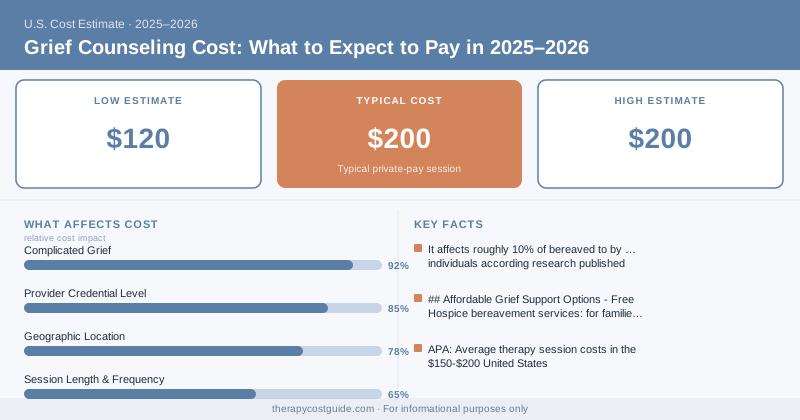
Grief Counseling Cost 2026: $100–$250 per Session (Individual, Group & Online)
{ if eq .Lang "zh" }{ else }{ end }Most grief doesn’t need a therapist. The natural process — however brutal — tends to move toward adaptation on its own over 6–18 months, supported by community, family, time, and the free resources that actually exist. Paid clinical grief counseling matters most when that process stalls.
Here’s where the money question actually lives.
Grief Counseling Costs at a Glance
| Setting / Provider | Cost Per Session | Notes |
|---|---|---|
| Licensed clinical counselor / LCSW | $100 – $200 | Most common individual grief counseling |
| PhD/PsyD psychologist | $150 – $300 | Recommended for complicated/prolonged grief |
| Hospice bereavement counselor | Often free | 12–13 months post-loss for hospice families |
| Community grief support group | Free – $30 | Hospital-based, community org, faith-based |
| Online grief counseling platform | $60 – $130/session | Flexible scheduling, often faster access |
| Typical private-pay session | $120 – $180 | Most U.S. metro areas |
Normal Grief vs. Complicated Grief
This distinction determines whether you need community support (often free) or clinical treatment (insurance-coverable, but more expensive).
Normal grief — however painful — tends to gradually soften over 6–18 months. Acute symptoms like crying, difficulty concentrating, sleep disruption, and social withdrawal are expected and don’t automatically warrant clinical intervention.
Prolonged Grief Disorder (PGD, also called complicated grief, listed in DSM-5-TR) is different. It affects roughly 10% of bereaved individuals, according to research from Columbia University’s Center for Complicated Grief and published by NIMH. Diagnostic criteria include intense longing that remains debilitating 12+ months after the loss, persistent difficulty accepting the death, bitterness or anger that stays acute, and withdrawal from ongoing life.
PGD requires specific evidence-based treatment — not general supportive counseling. The validated approach is Complicated Grief Treatment (CGT), developed by Dr. Katherine Shear at Columbia. It’s a structured 16-session protocol and costs the same as standard outpatient therapy: $100–$250/session, or $1,600–$4,000 total.
Does Grief Counseling Actually Work?
For normal, uncomplicated grief, the research is surprisingly mixed. A widely cited 2000 meta-analysis in the Journal of Consulting and Clinical Psychology found modest effects for grief counseling in people who were grieving normally — suggesting many would have adapted well without paid treatment. For complicated/prolonged grief, CGT shows strong results: roughly 70% of patients show significant improvement. The practical takeaway: if you’re within the range of normal grief, a support group and hospice services may serve you just as well as paid counseling. If you meet criteria for complicated grief, evidence-based clinical treatment is worth the cost.Types of Grief Support and What They Cost
Individual grief therapy ($100–$250/session): Most valuable for complicated grief, traumatic loss, or when personal circumstances make group settings difficult. Look for therapists with specific bereavement training, not just general mental health credentials.
Grief support groups (free–$30): Hospital-based programs, faith community groups, GriefShare (widespread, ~$20 for the participant workbook), NAMI grief programs. Peer support from others with lived loss experience provides something clinical therapy often can’t. Many people find group formats more helpful for normal grief than weekly individual therapy.
Online grief therapy ($60–$130/session): Platforms like Betterhelp, Talkspace, and dedicated grief-focused services. Faster access than in-person therapy, useful if you live in an area with few local grief specialists. Quality varies — look for licensed therapists with specific grief training.
Hospice bereavement services: Completely free for families of patients who died under hospice care. This is a chronically underutilized resource. Most hospice organizations provide 13 months of bereavement support (individual counseling, support groups, phone check-ins) to surviving family members — even people who weren’t the primary caregiver. If your loved one died under hospice care, you’re entitled to this service regardless of what you paid.
When Grief Becomes a Clinical Emergency
Immediate clinical referral — don’t wait — if:
- Suicidal thoughts: Grief dramatically increases suicide risk. Active ideation requires same-day intervention.
- Loss was traumatic, sudden, or violent: Suicide loss, overdose, accident, homicide. These losses carry significantly higher rates of both PTSD and complicated grief than expected deaths.
- Severe functional impairment persisting beyond 3 months: Can’t eat, can’t leave the house, can’t care for children.
NCHS data shows over 2.7 million Americans die each year, leaving 5–9 bereaved individuals per death — roughly 13–24 million newly bereaved people annually. That scale vastly exceeds available clinical grief resources, which is why the free community infrastructure matters so much.
Insurance and Diagnosis Codes for Grief Counseling
Standard grief counseling bills under these codes when provided by a licensed therapist:
- F43.21 / F43.22 — Adjustment disorder with depressed mood / with anxiety
- F43.8 — Other specified trauma- and stressor-related disorders (used for Prolonged Grief Disorder)
- F32.x — Major depressive disorder, when grief has progressed to clinical depression
Typical in-network copay: $20–$50/session for covered outpatient therapy.
One catch: many grief counselors in community organizations and hospice settings aren’t licensed to bill insurance. The care may be excellent and free — but it exists outside the insurance system.
Affordable Grief Support
- Hospice bereavement programs: Free 13-month support if your loved one was in hospice
- Hospital-based bereavement groups: Most major hospitals run free or low-cost groups, often condition-specific
- GriefShare: Faith-based, widely available, ~$20 participant workbook
- Open Path Collective: $30–$80 sessions from licensed grief counselors for qualifying incomes
- SAMHSA National Helpline: 1-800-662-4357 — free referrals to local mental health and grief resources
Disclaimer: TherapyCostGuide provides cost information for educational purposes only. We are not a mental health provider and do not offer clinical advice or treatment. Cost ranges are based on national survey data and vary significantly by location, provider credentials, practice setting, and insurance plan. Always consult a licensed mental health professional for treatment decisions. If you are in crisis, call or text 988 (Suicide & Crisis Lifeline) or go to your nearest emergency room.