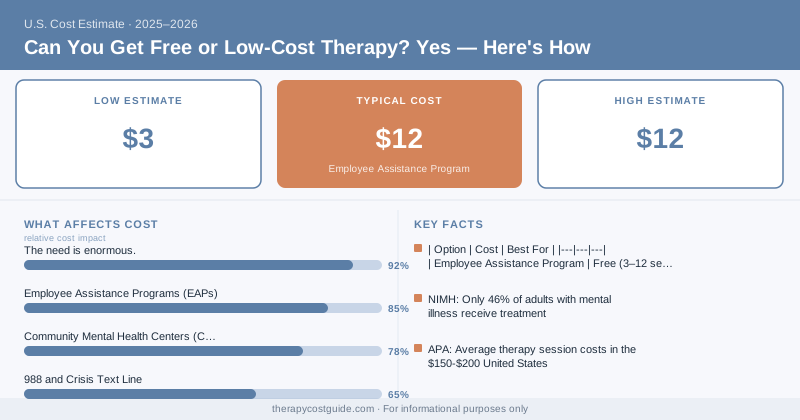
Can You Get Free or Low-Cost Therapy? Yes — Here's How
{ if eq .Lang "zh" }{ else }{ end }“I can’t afford therapy” is one of the most common — and most fixable — reasons people stay stuck. You probably can afford it. You just haven’t been shown the door marked free or low-cost, because the $200-an-hour private practices are the ones that show up in search results.
So let’s walk through the actual options, cheapest first, and how to qualify for each.
The need is enormous. Per NIMH, more than one in five US adults lives with a mental illness in any given year, yet SAMHSA’s 2023 data shows cost is the top barrier to care. The programs below exist precisely to close that gap.
Start With What’s Genuinely Free
Employee Assistance Programs (EAPs) — If you have a job, check this today. Many employers quietly offer 3–12 free therapy sessions a year through an EAP. It’s confidential from your boss, and it’s the single most underused benefit in American workplaces. Ask HR or look for “EAP” on your benefits portal.
Community Mental Health Centers (CMHCs) — Federally funded, legally required to serve everyone regardless of ability to pay. Fees slide all the way to $0. Find one at SAMHSA’s findtreatment.gov or by dialing 211.
988 and Crisis Text Line — Free, 24/7. Call or text 988 for the Suicide and Crisis Lifeline, or text HOME to 741741. Crisis support, not ongoing therapy — but a real resource when things get sharp.
| Option | Cost | Best For |
|---|---|---|
| Employee Assistance Program | Free (3–12 sessions) | Anyone employed, short-term needs |
| Community mental health center | $0 – $40 | Low income, ongoing care |
| University training clinic | $20 – $60 | Anyone, evidence-based therapy |
| Open Path Collective | $30 – $80 (+ $65 one-time) | Middle-income, no insurance |
| Sliding-scale private therapist | $40 – $90 | Some flexibility on fee |
| Group therapy | $30 – $80 | Shared concerns, lower cost |
| NAMI support groups | Free | Peer support (not clinical) |
The Low-Cost Middle Ground
If you earn too much for a CMHC but full private rates would wreck your budget, this is your lane.
Open Path Collective (openpathcollective.org) is a nonprofit network. Pay a one-time $65 membership and you book fully licensed therapists at $30–$80 a session — versus the usual $150–$250. The network topped 20,000 therapists as of 2024.
University training clinics staff advanced doctoral students closely supervised by licensed faculty, usually $20–$60 a session. The care is structured and evidence-based, and frankly your trainee therapist may be more current on the research than someone twenty years out of school.
How to Ask for a Sliding Scale Without Feeling Awkward
Plenty of private therapists keep a few reduced-fee slots and never advertise them. Just ask: “Do you offer a sliding scale based on income? Here’s roughly what I can manage per session.” That’s it. The worst answer is “not right now.” Most therapists who offer it genuinely want to help people who can’t pay full rate — see sliding-scale therapy for how the income tiers usually work.Don’t Forget Insurance and Public Programs
If you have any coverage, check it before assuming you’ll pay cash. Many people are surprised to learn their plan covers therapy at a $20–$40 copay. Walk through it with our does insurance cover therapy guide.
And if you’re on a public program, therapy is covered — see Medicaid therapy coverage and Medicare therapy coverage.
Frequently Asked Questions
Is free therapy actually any good? Yes. Community centers and training clinics use the same evidence-based methods as private practices, and trainees are supervised by licensed pros. Fit and consistency matter more than price tag.
How do I find a community mental health center near me? Use findtreatment.gov, or dial 211 from any phone. The 211 operators can also point you to local nonprofits and faith-based counseling, some of which is free.
Can I get free therapy without insurance? Absolutely. CMHCs, EAPs, training clinics, 988, and NAMI groups don’t require insurance at all. Open Path and sliding-scale therapists are built specifically for the uninsured.
Are there free options for students? Yes. Most colleges include a counseling center in tuition — free sessions for enrolled students. We cover this in student therapy.
What about veterans? The VA provides mental health care to enrolled veterans, often at no cost. Our veterans mental health guide has the details.
Is online therapy a cheap option? It can be. Subscription apps spread costs across a monthly fee, which can beat per-session private rates. Compare the trade-offs in online vs. in-person therapy cost.
How long will I wait for a free or low-cost spot? It varies. CMHCs and training clinics can have waitlists, while Open Path and EAPs are often faster. Get on more than one list at once — you can always cancel the others.
{ if eq .Lang "zh" }Disclaimer: TherapyCostGuide provides cost information for educational purposes only. We are not a mental health provider and do not offer clinical advice or treatment. Cost ranges are based on national survey data and vary significantly by location, provider credentials, practice setting, and insurance plan. Always consult a licensed mental health professional for treatment decisions. If you are in crisis, call or text 988 (Suicide & Crisis Lifeline) or go to your nearest emergency room.