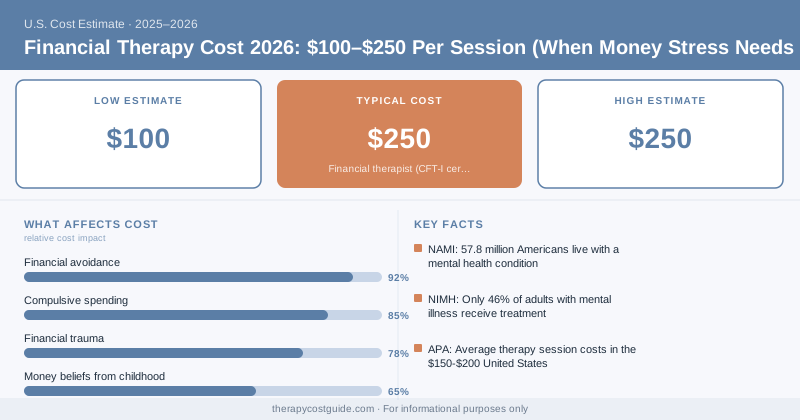
Financial Therapy Cost 2026: $100–$250 Per Session (When Money Stress Needs More Than a Budget)
{ if eq .Lang "zh" }{ else }{ end }You’ve read the books. You’ve made the budget. You know exactly what you’re supposed to do with money. And you still can’t do it.
If that sounds familiar, you’re not alone — and you might not have a budgeting problem. You might have a money psychology problem. The American Psychological Association’s annual Stress in America survey has consistently ranked finances as the #1 source of stress for American adults, with roughly 72% citing money as a significant stressor. That’s not a spreadsheet issue. That’s a deeper relationship with money that a budget app won’t fix.
That’s what financial therapy exists to address.
What Financial Therapy Actually Costs
| Provider Type | Per Session | Notes |
|---|---|---|
| Financial therapist (CFT-I certified) | $100–$250 | Addresses behavior + psychology |
| Financial planner (CFP) | $150–$300+ | Focuses on numbers, not psychology |
| Financial coach | $75–$200 | Goal-oriented, not clinically licensed |
| Hybrid financial therapist + planner | $175–$350 | Both clinical and planning expertise |
Financial therapy typically involves 6–16 sessions depending on what you’re working on. Acute issues — like understanding why you and your partner fight about money constantly — might resolve in 6–8 sessions. Deeper work around financial trauma, chronic self-sabotage, or compulsive financial behaviors often takes longer.
Some financial therapists charge per session. Others offer packages. Unlike traditional therapy, financial therapy sessions sometimes run 75–90 minutes rather than the standard 50, since there’s often substantive content to cover alongside the emotional exploration.
What Financial Therapists Actually Do
Financial therapy is the intersection of psychology and financial planning, but it sits closer to the psychology end for most practitioners.
Common issues that bring people to financial therapists:
- Financial avoidance — ignoring bills, not opening bank statements, refusing to look at account balances, extreme anxiety around financial decisions
- Compulsive spending — shopping as emotional regulation, spending triggers tied to specific feelings
- Financial trauma — experiences of poverty, bankruptcy, financial abuse in a relationship, or witnessing parental financial chaos that created lasting patterns
- Money beliefs from childhood — “we don’t talk about money,” “rich people are greedy,” “we can’t afford that” as internalized scripts that drive adult behavior
- Couples financial conflict — mismatched spending styles, financial infidelity (secret accounts or spending), power imbalances around income
- Financial success anxiety — high earners who can’t spend on themselves, who sabotage raises, or who live in chronic scarcity despite objective abundance
Financial therapists don’t just hand you a budget. They help you understand why you do what you do with money, which is the prerequisite to actually changing it.
The CFT-I Credential
The Certified Financial Therapist-I (CFT-I) is the primary credential in this field, issued by the Financial Therapy Association (FTA). It requires completing training in both financial planning concepts and therapeutic methods. The FTA was founded in 2010 and maintains a directory of CFT-I practitioners searchable by state. When searching for a financial therapist, this is the credential to look for — it signals someone who genuinely bridges both disciplines rather than just adding a financial module to a therapy practice.When Financial Therapy Makes Sense (vs. When It Doesn’t)
Financial therapy is not the right tool when you primarily need practical financial guidance — investment allocation, tax optimization, retirement planning, or debt payoff strategy. For that, a certified financial planner (CFP) or a fee-only financial advisor is what you need.
Financial therapy is the right tool when:
- You understand what you should do financially but can’t execute it consistently
- Money triggers intense emotional responses (panic, shame, rage, despair)
- Your financial behaviors are damaging relationships or your wellbeing
- You’ve made the same financial “mistakes” repeatedly despite previous attempts to change
- You experienced financial trauma or grew up in financial chaos and suspect it’s affecting you now
A practical test: if a knowledgeable friend gave you a specific financial plan and you’d follow it, you need a financial planner. If you’d agree with the plan, understand it completely, and still not follow it — you need a financial therapist.
Financial Therapy for Couples
Couples financial therapy addresses money as a relationship issue, not just an individual one. Financial conflict is one of the strongest predictors of divorce — and it’s rarely about math. It’s about different money histories, different values, different levels of financial anxiety, and different power dynamics. Couples sessions typically run $150–$300 and can be transformative for pairs who fight about money despite both being financially competent individually.Insurance Coverage Reality
Most financial therapy is not reimbursed by health insurance. The reason: insurance reimburses treatment for specific DSM-5 diagnoses, and “financial avoidance” or “spending compulsion” doesn’t map neatly onto a covered billing code.
The exception: if your financial therapist is also a licensed clinician (LMFT, LCSW, LPC, or psychologist) and they identify a co-occurring condition — say, anxiety disorder or depression that’s clearly affecting your financial functioning — they may be able to bill for those clinical conditions. The financial-specific work is bundled into a broader treatment plan. This works for some clients and doesn’t for others. Ask directly during a consultation.
HSA/FSA funds also can’t typically be used for financial therapy, since it’s not a qualified medical expense.
Finding a Financial Therapist
The Financial Therapy Association (FTA) maintains a searchable directory at financialtherapyassociation.org. You can filter by state, specialty, and credentials.
Expect waitlists, especially in smaller markets. Financial therapy is a small field — there are roughly 2,000 CFT-I credentialed practitioners in the US as of 2024. Telehealth has expanded access significantly; many financial therapists work with clients nationwide via video session.
The typical starting point is a 30-minute consultation ($0–$75 depending on the therapist) to discuss what you’re working on and whether there’s a fit. Come prepared to talk about what specifically isn’t working — not just “I’m bad with money,” but the specific patterns, behaviors, or emotional responses you want to change.
For most people who need it, $100–$250 per session over 8–12 weeks is a small investment compared to the financial cost of the behaviors they’re trying to change.
{ if eq .Lang "zh" }Disclaimer: TherapyCostGuide provides cost information for educational purposes only. We are not a mental health provider and do not offer clinical advice or treatment. Cost ranges are based on national survey data and vary significantly by location, provider credentials, practice setting, and insurance plan. Always consult a licensed mental health professional for treatment decisions. If you are in crisis, call or text 988 (Suicide & Crisis Lifeline) or go to your nearest emergency room.