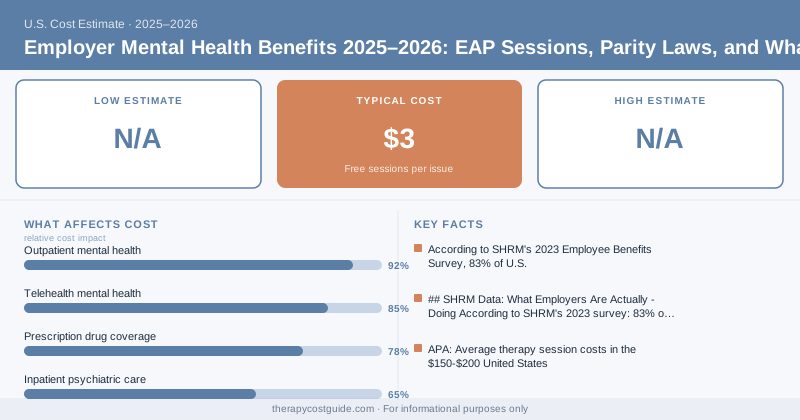
Employer Mental Health Benefits 2025–2026: EAP Sessions, Parity Laws, and What to Actually Use
{ if eq .Lang "zh" }{ else }{ end }There’s a good chance your employer offers free therapy sessions right now and you don’t know about it. According to SHRM’s 2023 Employee Benefits Survey, 83% of U.S. employers offer an Employee Assistance Program (EAP) — and most employees never use it.
That means you might be paying out of pocket for therapy you’re already entitled to for free. Here’s how to find out what you have.
Employee Assistance Programs (EAPs): The Free Therapy Most People Skip
An EAP is an employer-sponsored program that provides confidential short-term counseling and referral services to employees. The employer pays for it as a benefit — you use it at no cost.
| EAP Feature | Typical Range |
|---|---|
| Free sessions per issue | 3 – 12 sessions |
| Who’s covered | Employee + household members |
| Confidentiality | Yes — employer doesn’t know who uses it |
| Wait time | Often 2–5 business days |
| Session format | In-person, phone, or video |
| Cost to employee | $0 |
The “per issue” framing matters. Most EAPs provide 3–8 sessions per presenting problem per year. If you have a new issue (work stress, relationship problem, grief, anxiety), you may qualify for another cycle of free sessions. Some large employers offer more generous EAPs — 10–12 sessions is not uncommon at Fortune 500 companies.
How to Find Your EAP
Most employees don’t know their EAP exists because it’s buried in benefits materials. Here’s how to find it:
- Look on your pay stub. Some employers list the EAP number there.
- Check your benefits portal. Sign in to whatever system your company uses for benefits enrollment — the EAP is usually listed under “Wellbeing” or “Mental Health.”
- Call HR directly. Ask: “What’s our EAP, and what number do I call?”
- Check your insurance card’s back. Some carriers integrate EAP contact info.
Common EAP vendors include Cigna EAP, Aetna EAP, Optum EAP, Lyra Health, Spring Health, ComPsych, and Magellan Health. The vendor’s name and phone number is what you need to start.
Confidentiality: What the Employer Sees
A common reason people don’t use EAPs is fear that their employer will find out. Under EAP design, your employer pays a flat annual fee for the service — they don’t see who uses it, what issues are discussed, or how many sessions anyone takes. HIPAA protects your clinical information.
The only exceptions are the same as all mental health confidentiality exceptions: imminent threat to yourself or others, and mandated reporting for child abuse. Your personal anxiety, depression, relationship issues, and mental health concerns remain private.
Mental Health Parity: What the Law Requires
The Mental Health Parity and Addiction Equity Act (MHPAEA) of 2008, strengthened in 2024, requires health insurance plans to cover mental health and substance use disorder care at parity with medical/surgical care.
In plain language: if your insurance covers 20 physical therapy visits per year, it can’t limit you to 10 therapy sessions per year. If you have a $30 copay for a primary care visit, the mental health copay must be comparable. Prior authorization requirements for mental health can’t be more burdensome than for medical care.
What Else Your Employer Benefits Likely Cover
Beyond EAPs, most employer health plans include:
Outpatient mental health: Therapy sessions with in-network therapists, typically at your standard specialist copay ($30–$60). No limit on sessions for most plans (parity law).
Telehealth mental health: Many plans include Teladoc, MDLive, or similar services with $0–$50/session copays for video therapy or psychiatry.
Prescription drug coverage: Psychiatric medications are typically covered at Tier 1–2 (generic) copays of $5–$30/month.
Inpatient psychiatric care: Covered as inpatient hospitalization, subject to deductible and coinsurance.
Intensive Outpatient Programs (IOP) and Partial Hospitalization Programs (PHP): Covered by most plans with prior authorization.
What to Ask HR About Your Benefits
- What’s our EAP vendor and phone number?
- How many EAP sessions am I entitled to per year?
- Does our health plan have separate mental health benefits, or are they integrated with medical?
- What’s the copay for outpatient therapy sessions in-network?
- Do we have a Lyra Health, Spring Health, or similar enhanced mental health benefit (some employers are adding these separately from traditional EAPs)?
Enhanced Employer Mental Health Benefits: Lyra, Spring Health, and Others
In response to rising demand and employee needs, many mid-to-large employers have added enhanced mental health benefits beyond a basic EAP. Common vendors include:
Lyra Health: Offers covered therapy sessions with vetted licensed therapists, often 12–25 sessions/year fully covered. Matches employees to therapists using a clinical algorithm. Available at Starbucks, Morgan Stanley, and hundreds of other large employers.
Spring Health: Similar model — employer-sponsored therapy at no cost to the employee, with a broader provider network than a typical EAP.
Headspace for Work / Calm for Business: Meditation and mental wellness apps, sometimes offered as an add-on. Lower-level support compared to actual therapy.
If your company offers Lyra or Spring Health, use it — these programs typically provide more sessions and better therapist quality than traditional EAPs, still at no cost to you.
SHRM Data: What Employers Are Actually Doing
According to SHRM’s 2023 survey:
- 83% of employers offer EAPs
- 42% increased mental health benefits after the COVID-19 pandemic
- Large employers (500+) are significantly more likely to offer enhanced mental health benefits beyond basic EAPs
Despite the prevalence of these benefits, utilization rates for EAPs are typically only 3–6% of the eligible workforce. The gap between “benefit exists” and “benefit used” is enormous — and that gap costs employees real money.
Bottom Line
If your employer has an EAP (83% do), you have 3–12 free therapy sessions available right now. Call HR or look in your benefits portal for the EAP vendor number. Mental health parity law requires your insurance to cover therapy and psychiatric care comparably to medical care. Enhanced programs like Lyra or Spring Health, available at many large employers, provide substantially more coverage. Use these benefits before paying cash — they exist specifically for this.
{ if eq .Lang "zh" }Disclaimer: TherapyCostGuide provides cost information for educational purposes only. We are not a mental health provider and do not offer clinical advice or treatment. Cost ranges are based on national survey data and vary significantly by location, provider credentials, practice setting, and insurance plan. Always consult a licensed mental health professional for treatment decisions. If you are in crisis, call or text 988 (Suicide & Crisis Lifeline) or go to your nearest emergency room.