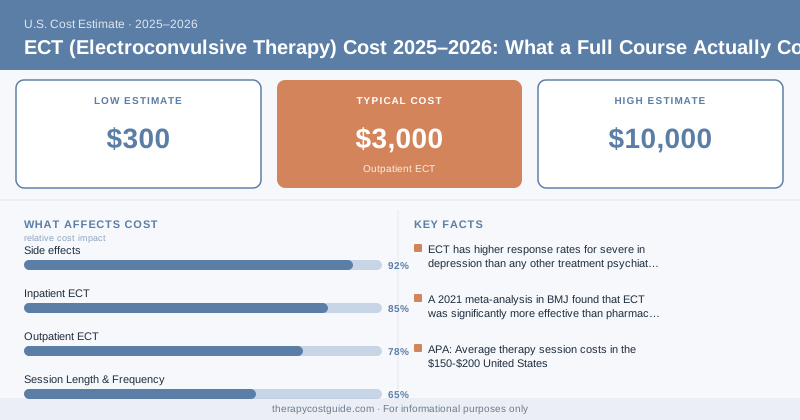
ECT (Electroconvulsive Therapy) Cost 2025–2026: What a Full Course Actually Costs
{ if eq .Lang "zh" }{ else }{ end }ECT has higher response rates for severe depression than any other treatment in psychiatry — not a marginal difference, but response rates of 65–85% in treatment-resistant cases, according to data cited in the American Journal of Psychiatry. That’s a stronger outcome than antidepressants, TMS, or Spravato. And yet it remains the most stigmatized psychiatric treatment in existence.
The stigma comes from its 1940s history: unmodified ECT without anesthesia, used as a broad institutional tool. Modern ECT bears no meaningful resemblance to that history. Here’s what it actually involves, what it costs, and when it’s indicated.
ECT Cost: Per Session and Full Course
ECT is almost never a single session — it’s administered in a course of treatments, typically 6–12 sessions (acute phase), sometimes with maintenance treatment afterward.
| Setting | Per Session Cost | Acute Course (6–12 sessions) | Annual Maintenance |
|---|---|---|---|
| Outpatient ECT | $300 – $800 (per session) | $2,500 – $8,000 | $3,000 – $10,000/year |
| Inpatient ECT (hospital stay included) | $2,000 – $5,000/day | $20,000 – $50,000+ | Outpatient after acute phase |
| Hospital facility fee (outpatient) | $1,500 – $3,000/session | Variable | — |
The wide range reflects the biggest variable: inpatient vs. outpatient. ECT itself (the procedure) is relatively straightforward to deliver. The expensive part, for inpatient cases, is the hospital stay — which runs $2,000–$5,000 per day in most U.S. hospitals.
Most ECT is delivered in outpatient or day hospital settings. Inpatient ECT is reserved for patients too ill to safely be outpatient (severe suicidal risk, inability to care for themselves, catatonia).
What Each ECT Session Involves
This is worth describing, because misconceptions about ECT are widespread.
Modern ECT is performed under general anesthesia (typically propofol or methohexital) and muscle relaxant (succinylcholine). The patient is unconscious during the entire procedure. A precisely calibrated electrical stimulus is applied through electrodes placed on the scalp — either both sides (bilateral) or one side (unilateral). The stimulus induces a brief, controlled seizure, which lasts 25–60 seconds and manifests as minimal movement due to the muscle relaxant. The patient wakes up within minutes, with no memory of the procedure itself.
The whole session takes approximately 30–60 minutes including preparation and recovery room monitoring.
Side effects:
- Memory impairment is the most clinically significant side effect. Most patients experience some degree of retrograde amnesia (difficulty recalling events from around the time of treatment) and anterograde amnesia (learning new information during the course). Most memory effects resolve within weeks to months after the course ends, but some patients report lasting subjective memory difficulties.
- Post-ictal headache and muscle aches (common, manageable)
- Nausea from anesthesia (common, managed with anti-nausea medications)
The Evidence Base: Separating ECT from Its Reputation
The evidence for ECT in severe depression is, bluntly, stronger than for almost any other psychiatric treatment.
A 2021 meta-analysis in BMJ found that ECT was significantly more effective than pharmacotherapy for severe depression, with remission rates of 60–80% in acute-phase treatment. For treatment-resistant depression specifically (patients who’ve failed multiple antidepressant trials), remission rates remain in the 50–70% range.
NIMH acknowledges ECT as the most effective acute treatment for severe, treatment-resistant depression, as well as the treatment of choice for:
- Catatonia
- Severe suicidal depression where rapid response is necessary
- MDD during pregnancy (when medication carries fetal risk)
- Certain cases of bipolar disorder and psychotic depression
The “One Flew Over the Cuckoo’s Nest” framing has caused genuine harm — people who would benefit from ECT refuse it due to cultural fear, while less effective treatments are tried first. The modern clinical reality is that ECT is, for the right patients, both safer than many alternatives and dramatically more effective.
Inpatient vs. Outpatient ECT
Inpatient ECT is indicated when:
- The patient is acutely suicidal and needs close monitoring between treatments
- The condition is severe enough that independent functioning isn’t safe (severe depression with inability to eat or care for self, catatonia)
- Medical complexity requires close monitoring
Cost: hospital stay + procedure = $10,000–$50,000+ for a full acute course with insurance. Without insurance, costs can be much higher.
Outpatient ECT is more common for patients who:
- Can be safely managed outside the hospital between treatments
- Have a support system (can be driven home after each session — anesthesia prevents self-driving)
- Are receiving ECT as maintenance treatment (monthly or as-needed after achieving remission)
Cost: $2,500–$8,000 for a standard acute course, outpatient only. Maintenance ECT adds $300–$800/session ongoing.
Insurance Coverage
ECT is covered by most major insurance plans when medically indicated — typically for severe, treatment-resistant depression or catatonia with documented prior treatment failures.
Prior authorization is required. Key documentation:
- Diagnosis with severity documentation
- Prior treatment history (medications tried, TMS if applicable)
- Clinical rationale from the treating psychiatrist
With insurance, the out-of-pocket cost for an acute ECT course is typically the patient’s deductible plus coinsurance — often $1,500–$5,000 depending on the plan. For inpatient ECT, hospitalization cost-sharing also applies.
Medicare Part B covers ECT as a Part B service (outpatient). Medicare Part A covers inpatient ECT hospitalization.
ECT Summary
Highest response rates of any depression treatment (60–85% in severe cases). Full course costs $2,500–$8,000 outpatient, $20,000–$50,000+ inpatient. Covered by insurance with prior auth for appropriate indications. Memory side effects are real but generally temporary. Indicated for severe treatment-resistant depression, catatonia, and select other conditions. Modern ECT is nothing like its historical depiction.Bottom Line
ECT costs $2,500–$8,000 for a full outpatient course and significantly more for inpatient treatment. Insurance covers it for appropriate indications with prior authorization. The stigma surrounding ECT is not matched by the evidence — for severe, treatment-resistant depression, it’s the most effective treatment available. Memory side effects are real but generally temporary. If you’ve exhausted other options for severe depression, ECT deserves a genuine, evidence-based conversation with your psychiatrist — not a reflexive rejection based on its cultural reputation.
{ if eq .Lang "zh" }Disclaimer: TherapyCostGuide provides cost information for educational purposes only. We are not a mental health provider and do not offer clinical advice or treatment. Cost ranges are based on national survey data and vary significantly by location, provider credentials, practice setting, and insurance plan. Always consult a licensed mental health professional for treatment decisions. If you are in crisis, call or text 988 (Suicide & Crisis Lifeline) or go to your nearest emergency room.