DBT Cost: Individual Sessions, Skills Groups, and the Real Weekly Price
{ if eq .Lang "zh" }{ else }{ end }Most people look up “DBT cost” expecting a session fee. What they find instead is a surprise: standard DBT isn’t one appointment a week. It’s two. And both are required for the full model.
Here’s what DBT actually costs — and what you give up when you opt for the cheaper versions.
Standard DBT: Two Components, Two Bills
Dialectical Behavior Therapy (DBT), developed by psychologist Marsha Linehan at the University of Washington, was designed as a comprehensive system. The standard model has three elements:
- Individual DBT therapy — weekly 45–60 minute session with your DBT therapist
- DBT skills training group — weekly 90–120 minute group session teaching the four skills modules (mindfulness, distress tolerance, emotional regulation, interpersonal effectiveness)
- Between-session phone coaching — access to your therapist for skills coaching between sessions (often included in the fee, sometimes not)
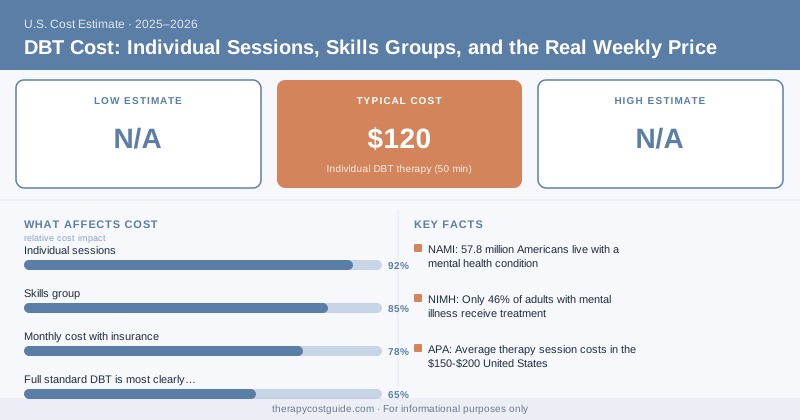
The individual sessions cost $100–$250. The skills group adds $50–$150 per group session. Weekly, that’s $150–$400 for both components combined — or $600–$1,600 per month at a moderate cost area.
| DBT Component | Typical Weekly Cost | Notes |
|---|---|---|
| Individual DBT therapy (50 min) | $120 – $250 | With a DBT-trained therapist |
| DBT skills training group (90 min) | $50 – $150 | Usually weekly for 24 weeks |
| Full standard DBT (both) | $170 – $400/week | $680 – $1,600/month |
| DBT-informed individual therapy only | $100 – $200/session | Missing the group component |
| Online DBT group programs | $100 – $250/month | Condensed, app-or-video-based |
How Long Is DBT Treatment?
Standard DBT skills training runs 6 months (two modules of 12 weeks each, covering all four skill areas). Many clients cycle through twice — so 12 months total for the skills group.
Individual therapy typically continues for 1–2 years alongside the group. The full standard model, at moderate U.S. costs, runs approximately $10,000–$25,000 over 12 months if you’re paying privately without insurance.
That’s a significant number. It’s also the reason DBT is often covered more broadly than some other modalities.
Insurance Coverage for DBT
DBT is usually covered when it’s been prescribed for an appropriate diagnosis — most commonly borderline personality disorder (BPD), but also severe depression, PTSD, eating disorders, and self-harm or suicidal behavior. SAMHSA lists DBT as one of the evidence-based treatments with strong empirical support for borderline personality disorder and related presentations.
The insurance complication: the skills group is billed as group psychotherapy, and some plans have separate copays or coverage rules for group vs. individual. Your individual DBT therapist can walk you through how to bill both components.
With in-network insurance, expect:
- Individual sessions: $20–$60 copay
- Skills group: $15–$40 copay per session
- Monthly cost with insurance: $140–$400 (copays only)
What 'DBT-Informed' Actually Means vs. Standard DBT
Many therapists describe their approach as “DBT-informed” or say they “use DBT skills.” This is not standard DBT. It typically means they teach some DBT skills in individual sessions without the group component, the phone coaching, and the full structured protocol.
DBT-informed therapy costs the same as regular individual therapy ($100–$250/session) and may still be helpful. But for the conditions DBT was specifically designed for — particularly BPD and chronic self-harm — the research evidence is for the full standard model, not the components-only version.
Who Should Do Full DBT vs. DBT Skills Only?
This is a clinical question, not just a cost question. That said, a useful rough guide:
Full standard DBT is most clearly indicated for:
- Borderline personality disorder (BPD)
- Chronic suicidal ideation or repeated self-harm
- Severe emotional dysregulation that hasn’t responded to other treatments
- Co-occurring complex trauma with significant impulsivity
DBT skills training or DBT-informed therapy may be appropriate for:
- Anxiety and depression with some emotional regulation difficulties
- Eating disorder recovery support
- Adolescents with emotion dysregulation
- People who’ve completed a DBT program and want maintenance skills reinforcement
Lower-Cost DBT Options
University training clinics with DBT programs — Many APA-accredited clinical psychology programs run full DBT programs. Doctoral students are supervised closely by licensed DBT-trained clinicians. Fees: $30–$80 per component. Wait lists can be long.
Community mental health centers — Federally funded centers increasingly offer DBT programs on a sliding-scale basis. Call your county behavioral health authority to ask what’s available.
Online DBT skills groups — Programs like Grouport and others offer DBT skills training groups via video, often at $100–$150/month. These are not a replacement for individual DBT therapy but can supplement it or work for lower-acuity presentations.
Disclaimer: TherapyCostGuide provides cost information for educational purposes only. We are not a mental health provider and do not offer clinical advice or treatment. Cost ranges are based on national survey data and vary significantly by location, provider credentials, practice setting, and insurance plan. Always consult a licensed mental health professional for treatment decisions. If you are in crisis, call or text 988 (Suicide & Crisis Lifeline) or go to your nearest emergency room.