CBT Cost: How Much Cognitive Behavioral Therapy Costs in 2025–2026
{ if eq .Lang "zh" }{ else }{ end }42% of Americans who sought therapy in the last five years received some form of CBT. It’s the most studied, most recommended, and most commonly practiced form of psychotherapy in the United States. It’s also, reassuringly, one of the shorter-term and more affordable approaches — if you know what you’re looking for.
Here’s the full cost picture for cognitive behavioral therapy.
What CBT Sessions Cost
CBT is a structured approach, not a specific credential — so you can receive it from a psychologist, licensed counselor, social worker, or psychiatrist. That credential gap creates the main price variation.
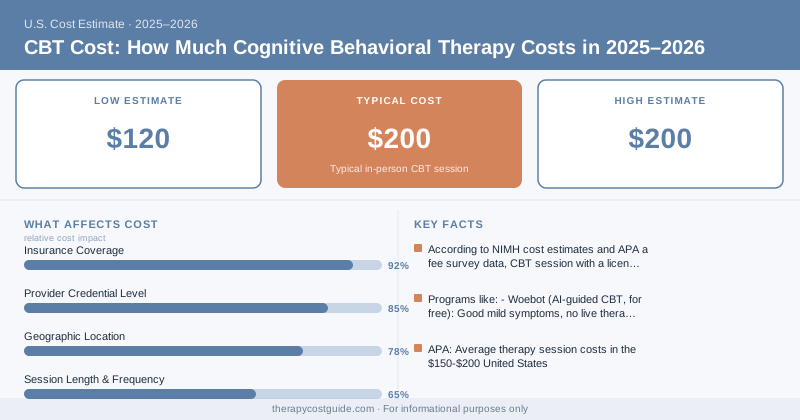
According to NIMH cost estimates and APA fee survey data, a CBT session with a licensed therapist runs $100–$250 in most U.S. markets.
| Provider Type | CBT Session Cost | Typical Range |
|---|---|---|
| PhD/PsyD Psychologist | $175 – $300 | Licensed doctoral level |
| Licensed Counselor (LPC) | $100 – $180 | Master’s level, trained in CBT |
| Licensed Clinical Social Worker (LCSW) | $90 – $160 | Master’s level, community settings |
| Psychiatrist (therapy-focused) | $200 – $350 | Rare; most focus on medication |
| Online CBT platform (async) | $40 – $100/wk | App-based, limited live sessions |
| Typical in-person CBT session | $120 – $200 | Most U.S. markets |
How Many Sessions Does CBT Take?
This is one of CBT’s real advantages: it’s time-limited by design. Standard CBT protocols are structured courses, not open-ended therapy.
- Specific phobias: 4–8 sessions
- Panic disorder: 10–15 sessions
- Generalized anxiety disorder (GAD): 12–20 sessions
- Major depression (mild to moderate): 16–20 sessions
- OCD (ERP-CBT): 14–20+ sessions (more intensive)
- PTSD (trauma-focused CBT): 12–20 sessions
At $150/session for 16 sessions, a full course of CBT for depression runs about $2,400. Compare that to years of open-ended supportive therapy, and the math starts to look different.
Why CBT’s Session Count Matters for Cost Planning
Most insurance plans cover mental health sessions with a defined number per year — often 20 to 52, depending on the plan. If your CBT course is 16 sessions, you’ll almost certainly stay within that limit. That’s not always true for longer-term therapy approaches.
If you’re paying out of pocket, knowing that CBT is typically 12–20 sessions lets you actually budget for it. It’s one of the few areas of mental health care where you can set a realistic number.
CBT Homework Is Part of the Treatment — Which Means Fewer Sessions
CBT works through assigned exercises between sessions: thought records, exposure hierarchies, behavioral activation logs. Patients who complete CBT homework consistently tend to need fewer total sessions than those who don’t engage between appointments. The homework isn’t busywork — it’s where most of the learning happens. This is one reason CBT is more cost-efficient than many alternatives.Insurance Coverage for CBT
CBT is covered by insurance when delivered by an in-network licensed provider for a diagnosed condition. There’s no special billing code for “CBT” specifically — it’s billed as standard outpatient psychotherapy. Your copay with in-network insurance typically runs $20–$60 per session after your deductible is met.
The complication: many CBT-specialized therapists are out of network. CBT training beyond graduate school requires additional certification programs (like ADAA or ABCT-affiliated training), and therapists with that specialization often operate in private pay practices.
NIMH notes that CBT is among the most evidence-supported treatments available, with dozens of randomized controlled trials showing efficacy for anxiety disorders and depression comparable or superior to medication for mild-to-moderate severity.
Online CBT: Is the Cheaper Version Actually Effective?
It can be. The evidence is solid for digital CBT (iCBT) for mild-to-moderate anxiety and depression. Programs like:
- Woebot (AI-guided CBT, free): Good for mild symptoms, no live therapist contact
- BetterHelp / Talkspace: Live CBT-oriented therapy, $60–$100/week for messaging + video access
- Breakthrough or specialized CBT apps: $40–$80/month for structured programs
A 2021 meta-analysis in Lancet Psychiatry found that internet-delivered CBT produced effect sizes comparable to face-to-face CBT for depression and generalized anxiety — but with important caveats. Complex trauma, severe depression, OCD with significant functional impairment, and conditions with significant psychosocial complexity still benefit more from in-person treatment with a skilled clinician.
Online CBT makes sense as a first step, for mild presentations, or when in-person treatment is inaccessible. It’s not a substitute for complex or severe presentations.
Finding a CBT Therapist at a Lower Cost
- University training clinics: Graduate students in CBT-focused programs supervised by licensed psychologists. Fees: $20–$60/session.
- Community mental health centers: Income-based sliding scale, often $5–$50/session.
- The Association for Behavioral and Cognitive Therapies (ABCT) maintains a therapist directory at abct.org where you can filter by specialty and insurance.
- Open Path Collective: $30–$80 sessions from credentialed CBT therapists.
The bottom line: a full course of CBT, even at $150/session, is an investment of roughly $2,000–$3,000. For most anxiety and depression presentations, that’s the most cost-effective evidence-based treatment available.
{ if eq .Lang "zh" }Disclaimer: TherapyCostGuide provides cost information for educational purposes only. We are not a mental health provider and do not offer clinical advice or treatment. Cost ranges are based on national survey data and vary significantly by location, provider credentials, practice setting, and insurance plan. Always consult a licensed mental health professional for treatment decisions. If you are in crisis, call or text 988 (Suicide & Crisis Lifeline) or go to your nearest emergency room.