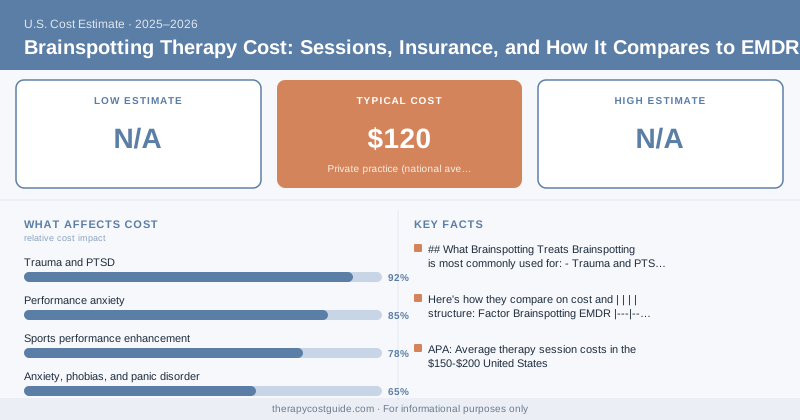
Brainspotting Therapy Cost: Sessions, Insurance, and How It Compares to EMDR
{ if eq .Lang "zh" }{ else }{ end }Brainspotting sounds like pseudoscience. It isn’t.
Developed in 2003 by therapist David Grand during an EMDR session, brainspotting emerged when Grand noticed that a figure skater’s traumatic block seemed to shift when her eyes moved to a specific position. The observation led to a systematic approach: that where you look affects how you feel, and that specific eye positions correlate with subcortical brain regions holding trauma and emotional distress.
It’s now used by thousands of licensed therapists across the U.S., and the cost — $120–$250 per session — is in the same range as other specialized trauma therapies.
Session Costs at a Glance
| Location / Setting | Typical Session Cost | Session Length |
|---|---|---|
| Private practice (national average) | $120 – $200 | 50–60 minutes |
| Major metro areas (NYC, LA, Chicago) | $175 – $350 | 50–90 minutes |
| Rural or smaller markets | $90 – $150 | 50 minutes |
| Intensive brainspotting sessions | $200 – $400 | 90–120 minutes |
| Group brainspotting (less common) | $40 – $80/person | 90 minutes |
The slightly higher rates compared to standard CBT or talk therapy reflect training investment: certified brainspotting practitioners complete Phase 1 and Phase 2 trainings (typically two 3-day intensives), plus often additional advanced training in specialized applications like sports performance or addiction.
What Brainspotting Treats
Brainspotting is most commonly used for:
- Trauma and PTSD — particularly trauma that hasn’t responded fully to talk-based approaches
- Performance anxiety — it’s widely used with athletes, musicians, and performers
- Sports performance enhancement — addressing the neurological component of performance blocks
- Anxiety, phobias, and panic disorder
- Attachment and developmental trauma — childhood experiences that feel “stuck” rather than resolved
- Chronic pain with psychological components
The VA estimates that 11–20% of veterans who served in Operation Iraqi Freedom or Enduring Freedom have PTSD in a given year. Brainspotting is increasingly used as a complement or alternative to trauma-focused CBT for this population, particularly for clients who struggle with verbal processing of traumatic memories.
How a Brainspotting Session Works
Your therapist will have you focus on a troubling issue or feeling, then use a pointer (or their hand) to slowly move it across your visual field while you track your internal experience. When you and the therapist identify an “activated” eye position — one that seems to correlate with a felt sense of distress or resonance — you hold your gaze there while processing. Sessions often involve bilateral sound (audio pulsing) through headphones to support bilateral brain engagement. The therapist stays largely quiet, trusting your brain’s natural processing capacity.Insurance Coverage: The Good News
Unlike some newer therapies, brainspotting doesn’t need its own billing code. Therapists bill it using standard psychotherapy CPT codes:
- 90834 — Individual psychotherapy, 45 minutes
- 90837 — Individual psychotherapy, 60 minutes
- 90847 — Family psychotherapy with client present
Because billing is identical to standard talk therapy, your insurance treats it the same way. If your plan covers outpatient psychotherapy, you should be able to see a brainspotting-trained therapist at your normal in-network or out-of-network rate.
The practical caveat: not all brainspotting therapists are in-network with insurance panels. Many specialized trauma therapists work out-of-network. If your plan has out-of-network benefits (typically 50–80% after deductible), you can still get partial reimbursement by submitting a superbill.
Brainspotting vs. EMDR: What’s the Cost Difference?
EMDR (Eye Movement Desensitization and Reprocessing) is the better-known bilateral processing approach and has a stronger research base. Here’s how they compare on cost and structure:
| Factor | Brainspotting | EMDR |
|---|---|---|
| Session cost | $120 – $250 | $100 – $250 |
| Protocol structure | Less structured; therapist-guided | More standardized 8-phase protocol |
| Number of sessions (typical) | 6 – 20+ | 6 – 12 for single-incident trauma |
| Research base | Growing; less RCT data than EMDR | Strong; over 30+ RCTs, WHO endorsed |
| Verbal processing required | Minimal | Some |
| Therapist training | 2 Phase trainings (~6 days total) | EMDR Institute or similar; more extensive |
Cost-wise, brainspotting and EMDR are nearly identical. The choice between them often comes down to therapist availability, client preference, and how well initial sessions feel.
A 2022 review in the Journal of Traumatic Stress noted that body-based and eye position-based interventions like brainspotting show promising results for trauma processing in clients who find purely verbal or cognitive approaches insufficient. However, EMDR remains the gold standard for evidence-based trauma treatment.
How Many Sessions Will You Need?
Most brainspotting therapists work without a fixed session number — the approach is client-led by design. That said, here’s what’s typical:
- Single-incident trauma (car accident, surgical trauma, one-time assault): 4–8 sessions
- Complex trauma or PTSD: 12–30+ sessions
- Performance anxiety (athletes, performers): 4–10 sessions focused on specific blocks
- Ongoing anxiety or attachment issues: Often indefinite, monthly maintenance sessions after initial work
Finding a Brainspotting Therapist
The Brainspotting International directory at brainspotting.com lists trained practitioners by location. When searching, ask:
- Which phase of training have they completed? (Phase 1 and 2 is standard; advanced training is a plus)
- Do they have experience with your specific issue (trauma, sports performance, etc.)?
- What’s their sliding scale range, if any?
Rates at community mental health centers will be lower — often $50–$100 per session on a sliding scale — but brainspotting-trained therapists at those settings are less common. Private practice remains the primary setting for this modality.
For trauma with a strong somatic component, some clients also find somatic therapy a useful complement to brainspotting — both work below the level of verbal narrative and engage the body’s trauma responses.
{ if eq .Lang "zh" }Disclaimer: TherapyCostGuide provides cost information for educational purposes only. We are not a mental health provider and do not offer clinical advice or treatment. Cost ranges are based on national survey data and vary significantly by location, provider credentials, practice setting, and insurance plan. Always consult a licensed mental health professional for treatment decisions. If you are in crisis, call or text 988 (Suicide & Crisis Lifeline) or go to your nearest emergency room.