Borderline Personality Disorder Treatment Cost: DBT, Therapy, and What's Covered
{ if eq .Lang "zh" }{ else }{ end }Here’s the number that surprises most people: full DBT for BPD doesn’t cost what a single therapy session costs. It costs what two therapy sessions per week cost — because that’s what the gold-standard treatment actually is. Understanding BPD treatment costs starts with understanding what the treatment actually involves.
According to NAMI, approximately 1.4% of U.S. adults live with borderline personality disorder — about 4 million people. BPD has historically been considered difficult to treat, but that changed with the development of Dialectical Behavior Therapy (DBT). DBT produces meaningful clinical improvement in the majority of people who complete it. The challenge is mostly one of access and cost.
Standard DBT: What It Includes and What It Costs
Full standard DBT — the model with the strongest evidence for BPD — has three required components:
- Individual DBT therapy: Weekly 50-minute session with a DBT-trained therapist — $120–$300/session
- DBT skills training group: Weekly 90–120 minute group — $50–$150/session
- Phone coaching: Between-session access to your therapist for skills coaching during crises (sometimes included in the individual fee, sometimes billed separately)
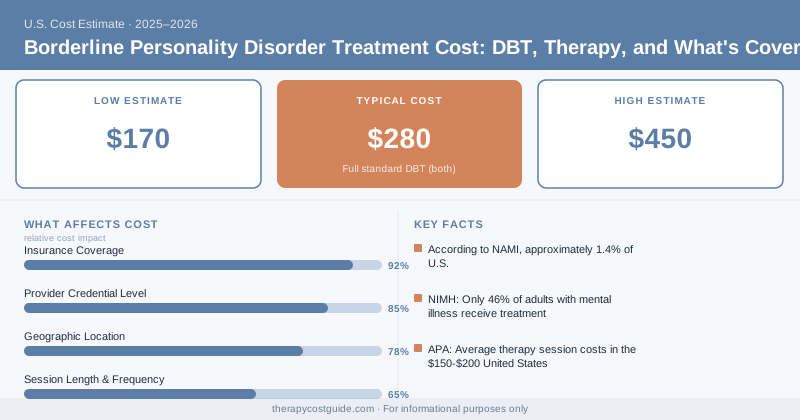
Weekly, that’s $170–$450 for both components — or $680–$1,800 per month. Add it up over a year, and standard DBT at moderate U.S. prices runs $8,000–$22,000 annually.
| DBT Treatment Component | Weekly Low | Weekly Typical | Weekly High |
|---|---|---|---|
| Individual DBT therapy (50 min) | $120 | $180 | $300 |
| DBT skills training group (90 min) | $50 | $100 | $150 |
| Full standard DBT (both) | $170 | $280 | $450 |
| Monthly cost (full model) | $680 | $1,120 | $1,800 |
| Annual cost (full model) | $8,160 | $13,440 | $21,600 |
| With in-network insurance | $140/wk | $200/wk | $400/wk |
Why DBT Is the Standard of Care for BPD
DBT was specifically developed by psychologist Marsha Linehan for chronically suicidal patients, many of whom had BPD diagnoses. The research base is now substantial: multiple randomized controlled trials show DBT reduces:
- Suicidal behavior and self-harm
- Psychiatric hospitalizations
- Dropout from treatment
- BPD symptom severity
SAMHSA lists DBT as an evidence-based practice with the highest level of research support for BPD and chronic self-harm.
What the Skills Training Group Teaches
DBT skills are organized into four modules — each typically taught over a 6-week period:
- Mindfulness — observing and describing experience without judgment
- Distress Tolerance — surviving crises without making them worse
- Emotional Regulation — understanding and managing intense emotions
- Interpersonal Effectiveness — navigating relationships and assertiveness
A full DBT skills curriculum covers all four modules in 6 months. Many programs repeat it once, so a full 12-month course is common.
DBT-Informed Therapy vs. Standard DBT — Why the Difference Matters for Cost
Many therapists advertise “DBT” but deliver “DBT-informed” therapy — which means they teach some DBT skills in individual sessions without the group, phone coaching, or structured protocol. DBT-informed therapy costs the same as any individual therapy ($100–$250/session) and is not the same thing.
For mild-to-moderate presentations, DBT-informed therapy may help. For BPD — particularly with significant self-harm history, suicidal behavior, or significant emotional dysregulation — the full standard model is what the research supports. If you’re paying for DBT treatment of BPD, ask specifically: “Do you offer the full model with individual therapy, a skills group, and phone coaching?”
Alternative BPD Treatments and Their Costs
DBT isn’t the only evidence-based treatment for BPD, though it has the most research:
- Mentalization-Based Therapy (MBT): Developed by Peter Fonagy; typically offered in group and individual format. Costs are comparable to DBT in programs that offer it.
- Schema-Focused Therapy: Longer-term approach targeting early maladaptive schemas; individual sessions at $150–$300/session, often 2–3 years duration.
- Transference-Focused Psychotherapy (TFP): Psychodynamic model, 2 sessions/week. Cost: $200–$400/week.
Insurance Coverage for BPD Treatment
BPD is a covered mental health diagnosis under insurance. DBT is generally reimbursable when billed appropriately. The key billing nuances:
- Individual DBT therapy: Billed as individual psychotherapy (CPT 90837, 90834)
- DBT skills group: Billed as group psychotherapy (CPT 90853)
Some insurers have separate copays for group vs. individual therapy. Typical in-network copays:
- Individual sessions: $25–$60
- Group sessions: $15–$40
Lower-Cost DBT Options
University training clinics — Programs at APA-accredited clinical psychology departments often run full DBT programs with closely supervised doctoral students. Fees: $30–$80 per component. Wait lists are common.
Community mental health centers — Federal community mental health centers increasingly offer DBT programs on sliding-scale fees. Call your county behavioral health authority.
Online DBT skills groups — Platforms like Grouport offer DBT skills training groups via video at $100–$150/month, which is significantly cheaper than in-person groups. These work best as a supplement to individual therapy.
{ if eq .Lang "zh" }Disclaimer: TherapyCostGuide provides cost information for educational purposes only. We are not a mental health provider and do not offer clinical advice or treatment. Cost ranges are based on national survey data and vary significantly by location, provider credentials, practice setting, and insurance plan. Always consult a licensed mental health professional for treatment decisions. If you are in crisis, call or text 988 (Suicide & Crisis Lifeline) or go to your nearest emergency room.