Affordable Therapy in Phoenix: Sliding Scale Options for 2026
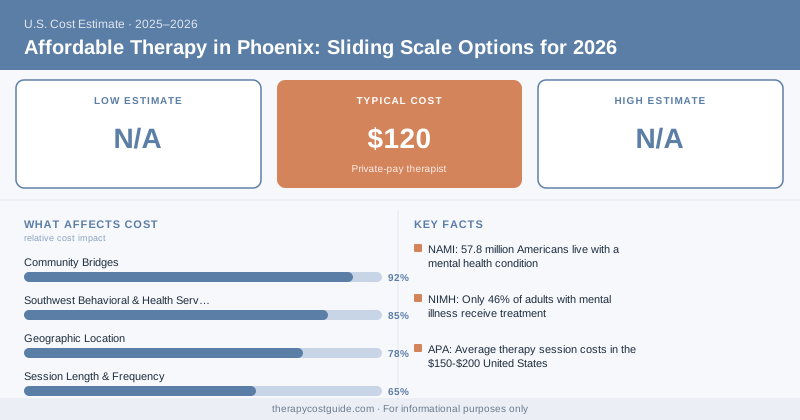
{ if eq .Lang "zh" }{ else }{ end }Direct question: if you’re uninsured in Phoenix right now, where do you actually go? Most people default to Googling “therapist near me” and hitting a wall of $150+ private-pay listings. The better first calls are Community Bridges, Southwest Behavioral & Health Services, and AHCCCS enrollment — and most Phoenix residents have never heard of any of them.
Phoenix Therapy Cost by Option
| Option | Typical Cost | Notes |
|---|---|---|
| Private-pay therapist | $120 – $200/session | Higher in Scottsdale, Paradise Valley |
| Community Bridges | $0 – $50/session | Sliding scale, multiple Valley locations |
| Southwest Behavioral & Health Services | $0 – $60/session | Sliding scale, serves Maricopa County |
| Federally Qualified Health Center (Adelante Healthcare, etc.) | $0 – $50/session | Legally required sliding scale, bilingual staff |
| University training clinic (ASU) | $20 – $50/session | Supervised graduate students |
| AHCCCS (Arizona Medicaid) | $0 – $5 copay | Must be Medicaid-eligible |
| Open Path Collective member therapist | $40 – $80/session | $65 one-time membership |
AHCCCS: Arizona’s Medicaid Program
AHCCCS covers outpatient mental health therapy for eligible low-income Phoenix residents with minimal copays through a network of contracted community providers. Arizona expanded Medicaid under the ACA, which meaningfully broadens eligibility for low-income adults compared to non-expansion states like neighboring… well, compared to Texas, for instance. If you’re uninsured and unsure of eligibility, applying costs nothing and processing typically takes a few weeks.
Community Bridges and Southwest Behavioral
Community Bridges operates multiple locations across the greater Phoenix area offering sliding-scale behavioral health services, including crisis services alongside ongoing outpatient therapy.
Southwest Behavioral & Health Services serves Maricopa County with a similar sliding-scale model and a strong focus on serious mental illness alongside general outpatient therapy needs.
Ask About Extreme Heat Season Scheduling Flexibility
Phoenix’s brutal summer heat (regularly exceeding 110°F) genuinely affects appointment attendance and scheduling for residents without reliable air-conditioned transportation. Ask any clinic you’re considering whether they offer telehealth options during peak summer months specifically — many Phoenix-area providers have expanded telehealth precisely because in-person attendance drops during extreme heat events.Bilingual and Culturally Specific Options
Given Phoenix’s significant Spanish-speaking population, several FQHCs — including locations affiliated with Adelante Healthcare — specifically staff bilingual clinicians. Ask directly about language match when scheduling your intake rather than assuming general bilingual capacity extends to therapy specifically.
Free Support Resources
NAMI Phoenix Metro offers free peer support groups and a warmline for residents who need support while navigating the intake process at a sliding-scale clinic. Arizona State University students also have access to free or low-cost counseling through the campus counseling center, which is worth checking before searching off-campus options if you’re currently enrolled.
Bottom Line
Phoenix’s AHCCCS Medicaid expansion, combined with Community Bridges, Southwest Behavioral & Health Services, and area FQHCs, creates real low-cost pathways well below the $120-$200 private-pay range. Ask about telehealth flexibility during summer heat months, and confirm bilingual clinician availability directly if language match matters for your care.
{ if eq .Lang "zh" }Disclaimer: TherapyCostGuide provides cost information for educational purposes only. We are not a mental health provider and do not offer clinical advice or treatment. Cost ranges are based on national survey data and vary significantly by location, provider credentials, practice setting, and insurance plan. Always consult a licensed mental health professional for treatment decisions. If you are in crisis, call or text 988 (Suicide & Crisis Lifeline) or go to your nearest emergency room.