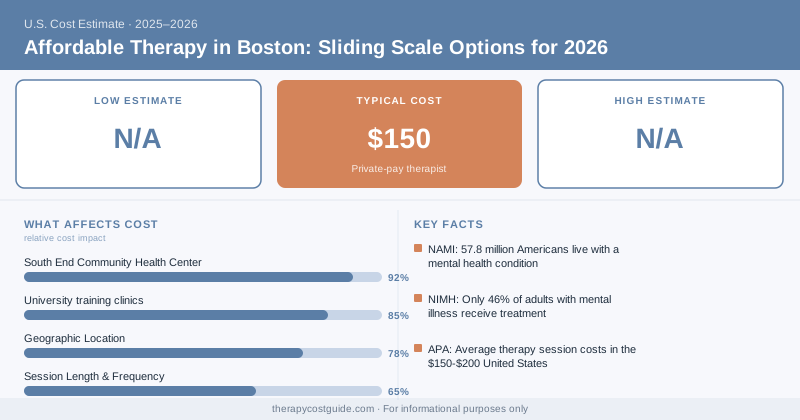
Affordable Therapy in Boston: Sliding Scale Options for 2026
{ if eq .Lang "zh" }{ else }{ end }Massachusetts has one of the lowest uninsured rates of any U.S. state, a direct legacy of its landmark 2006 health reform law that later became the blueprint for the ACA. That single fact reshapes the entire affordable therapy conversation in Boston compared to cities in non-expansion states — most residents have some insurance, but that doesn’t mean their mental health costs are automatically low.
Boston Therapy Cost by Option
| Option | Typical Cost | Notes |
|---|---|---|
| Private-pay therapist | $150 – $250/session | Higher in Back Bay, Beacon Hill |
| South End Community Health Center (FQHC) | $0 – $50/session | Sliding scale |
| Other Boston-area FQHCs | $0 – $60/session | Legally required sliding scale |
| University training clinic (BU, Northeastern, Simmons) | $20 – $50/session | Supervised graduate students |
| MassHealth (Massachusetts Medicaid) | $0 – $5 copay | Broad eligibility, must enroll |
| Open Path Collective member therapist | $40 – $80/session | $65 one-time membership |
MassHealth: Broader Eligibility Than Most States
MassHealth covers outpatient mental health therapy with minimal copays for a broader income range than Medicaid programs in most states, a direct result of Massachusetts’s early and aggressive health reform push. If you’re uninsured in Boston, checking MassHealth eligibility should be your first step, since the state’s income thresholds are more generous than many other states’ Medicaid programs.
FQHCs and Community Health Centers
South End Community Health Center and similar Federally Qualified Health Centers across Boston are legally required to offer sliding-scale fees regardless of insurance status, integrating behavioral health into broader primary care services.
University training clinics at Boston University, Northeastern, and Simmons University all provide reduced-rate therapy with supervised graduate students — Boston’s density of graduate psychology and counseling programs makes this an unusually deep option compared to many mid-sized cities.
Even With Insurance, Ask About Your Specific Behavioral Health Copay
Because most Boston residents have some form of insurance thanks to the state’s coverage requirements, the more common cost question isn’t “how do I get insurance” but “what will my specific plan actually charge me per session.” Massachusetts enforces mental health parity strongly, but copay amounts still vary by plan tier — call your insurer and ask for your exact outpatient mental health copay before assuming it matches your primary care copay.The High-Deductible Gap
Even in a high-insurance-coverage state like Massachusetts, residents on high-deductible health plans can still face significant out-of-pocket costs before their deductible is met, particularly for a first evaluation session. If you’re in that situation, sliding-scale FQHCs or Open Path Collective can be genuinely cheaper than your own insurance until you’ve met your deductible for the year.
Bottom Line
Massachusetts’s health reform legacy means more Boston residents have baseline insurance than in most U.S. cities, but private-pay rates ($150-$250) and high-deductible gaps still create real affordability barriers. Check MassHealth eligibility first if uninsured, lean on FQHCs and university training clinics for low-cost options, and always confirm your specific plan’s mental health copay rather than assuming parity is automatic.
{ if eq .Lang "zh" }Disclaimer: TherapyCostGuide provides cost information for educational purposes only. We are not a mental health provider and do not offer clinical advice or treatment. Cost ranges are based on national survey data and vary significantly by location, provider credentials, practice setting, and insurance plan. Always consult a licensed mental health professional for treatment decisions. If you are in crisis, call or text 988 (Suicide & Crisis Lifeline) or go to your nearest emergency room.