Addiction Counseling Cost: What Treatment Actually Costs in 2025–2026
{ if eq .Lang "zh" }{ else }{ end }Only 18% of people with a substance use disorder receive any treatment in a given year. Cost is the barrier most commonly cited. Understanding what treatment actually costs — and what’s available at every price point — is the first step toward actually getting it.
Here’s the honest breakdown.
Addiction Treatment Levels of Care and Costs
Addiction treatment isn’t one thing. The ASAM (American Society of Addiction Medicine) framework defines five levels of care with dramatically different price points.
| Level of Care | Setting | Cost |
|---|---|---|
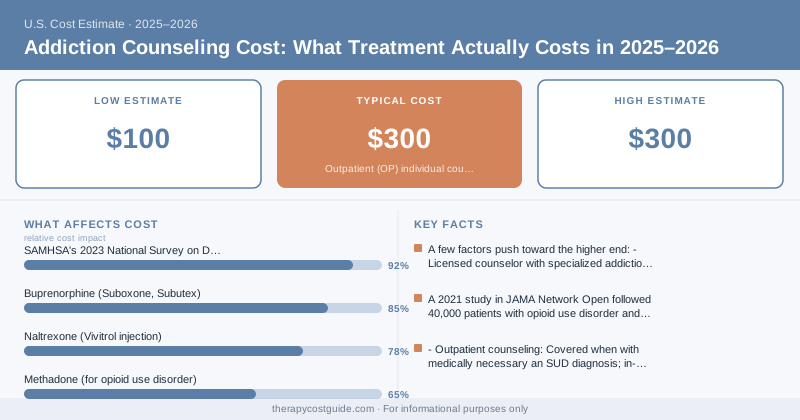
| Outpatient (OP) individual counseling | Private practice, community center | $100 – $300/session |
| Intensive Outpatient Program (IOP) | Outpatient clinic, 9–12 hrs/week | $100 – $300/day, or $3,000–$10,000/program |
| Partial Hospitalization Program (PHP) | Hospital outpatient, 20–30 hrs/week | $300 – $800/day, $6,000–$20,000/month |
| Residential treatment (30-day) | Inpatient facility | $5,000 – $80,000/month (enormous variation) |
| Medical detox | Inpatient hospital/detox center | $1,500 – $10,000 (3–10 days) |
| Medication-assisted treatment (MAT) only | Primary care or addiction clinic | $150 – $400/month |
For most people with alcohol or opioid use disorder, Intensive Outpatient + MAT is both the most accessible and most evidence-supported starting point — and it’s far less expensive than residential treatment.
What Individual Addiction Counseling Costs
Individual outpatient counseling with a licensed addiction specialist (LCAS, CADC, LPC-MHSP, or LCSW specializing in addiction) runs $100–$300 per session. A few factors push toward the higher end:
- Licensed counselor with specialized addiction certifications (CADC-II, LCDC)
- Dual-diagnosis (co-occurring mental health + substance use) specialization
- Urban private practice setting
- Evidence-based modalities like Motivational Interviewing (MI) or Contingency Management
SAMHSA’s 2023 National Survey on Drug Use and Health found that approximately 48.7 million Americans aged 12 or older had a substance use disorder in 2023 — 17.3% of the U.S. population. Treatment capacity significantly lags demand, which is why community-based and telehealth options matter.
Medication-Assisted Treatment (MAT): A Separate Cost Layer
For opioid use disorder and alcohol use disorder, MAT is the standard of care. It means adding FDA-approved medications to behavioral counseling — not substituting medication for therapy.
Buprenorphine (Suboxone, Subutex):
- Office visit to prescribing provider: $150–$350 initial, $100–$200 monthly follow-up
- Medication cost: $80–$300/month (generic buprenorphine is significantly cheaper than brand-name Suboxone)
- With insurance: often $20–$50/month copay for the medication
Naltrexone (Vivitrol injection):
- Injection cost without insurance: $1,200–$1,500/month
- With insurance/prior authorization: often $0–$50/month copay after deductible
- Oral naltrexone (Revia): $30–$90/month generic
Methadone (for opioid use disorder):
- Opioid Treatment Programs (OTPs): $70–$150/week
- Medicaid often covers methadone maintenance; Medicare Part D does not cover methadone for addiction (only for pain)
MAT Works — the Research Is Unambiguous
Buprenorphine and naltrexone for opioid use disorder reduce mortality by 50% or more in clinical trials. A 2021 study in JAMA Network Open followed 40,000 patients with opioid use disorder and found those on MAT had a 59% lower overdose death rate compared to those receiving behavioral treatment alone. For alcohol use disorder, naltrexone reduces drinking days by 4–5 per month versus placebo. Skipping MAT to avoid the cost is a life-and-death false economy.Insurance Coverage for Addiction Treatment
The ACA and Mental Health Parity Act require insurance plans to cover substance use disorder treatment at the same level as physical health treatment. In practice, coverage varies significantly.
- Outpatient counseling: Covered when medically necessary with an SUD diagnosis; in-network copays $20–$60/session
- IOP programs: Usually covered; may require prior authorization
- Residential treatment: Most insurers will approve shorter stays (7–14 days) more easily than 30-day programs; often requires failed lower levels of care first (“step therapy”)
- MAT medications: Covered under pharmacy benefit; Medicaid has strong MAT coverage in most states
- Methadone for addiction: Medicaid covers; commercial insurance coverage varies by state and plan
SAMHSA estimates that untreated substance use disorder costs the U.S. $442 billion annually in healthcare, lost productivity, and criminal justice costs. Insurers have strong actuarial incentives to cover treatment.
Finding Affordable Addiction Treatment
SAMHSA’s National Helpline: 1-800-662-4357 (free, confidential, 24/7). Referrals to local treatment facilities, support groups, and community-based organizations. Also at findtreatment.gov.
SAMHSA’s opioid treatment locator: Treatment locator at samhsa.gov/medication-assisted-treatment/find-treatment includes all certified OTPs.
Federally Qualified Health Centers (FQHCs): Sliding-scale community health centers with integrated behavioral health. Many now offer MAT. Search at findahealthcenter.hrsa.gov.
State-funded treatment programs: Every state has publicly funded addiction treatment slots for people without insurance or who can’t afford commercial programs. Contact your state’s substance abuse agency or use SAMHSA’s locator.
County behavioral health departments: Often offer free or sliding-scale IOP and outpatient services.
What Treatment Course Actually Costs
Most addiction specialists recommend continuing care far beyond the initial treatment phase:
- Initial stabilization (1–3 months of IOP): $3,000–$10,000
- Ongoing outpatient counseling (weekly for 6 months, then biweekly): $4,000–$8,000
- MAT continuation (12+ months recommended): $1,800–$4,800/year depending on medication
That’s roughly $8,000–$22,000 for a full first year of evidence-based treatment — before insurance. With in-network coverage and reasonable cost-sharing, the out-of-pocket figure for many people is $1,500–$5,000 for the year.
Expensive, yes. Compare it to the financial cost of active addiction — job loss, DUIs, medical complications, and the rest — and the math is straightforward.
{ if eq .Lang "zh" }Disclaimer: TherapyCostGuide provides cost information for educational purposes only. We are not a mental health provider and do not offer clinical advice or treatment. Cost ranges are based on national survey data and vary significantly by location, provider credentials, practice setting, and insurance plan. Always consult a licensed mental health professional for treatment decisions. If you are in crisis, call or text 988 (Suicide & Crisis Lifeline) or go to your nearest emergency room.