Acceptance and Commitment Therapy (ACT) Cost in 2025–2026
{ if eq .Lang "zh" }{ else }{ end }What if trying harder to control your thoughts is making everything worse? That’s the central challenge ACT poses — and for many people, it’s genuinely disorienting. Acceptance and Commitment Therapy doesn’t try to change or eliminate negative thoughts; it changes your relationship to them.
It’s also one of the most practically flexible therapy approaches available, with strong evidence across a wide range of conditions and a growing ecosystem of apps and self-help resources that can reduce the total cost.
ACT Therapy Session Costs
| Provider Type | Cost Per Session | Notes |
|---|---|---|
| Licensed counselor (ACT-trained) | $100 – $200 | Most common setting for ACT |
| PhD/PsyD Psychologist | $150 – $280 | Often protocol-research-informed |
| LCSW with ACT training | $100 – $185 | Strong fit for ACT’s contextual model |
| Online ACT therapist | $60 – $150 | Platform-based or telehealth |
| ACT group therapy | $40 – $90/session | Groups organized by condition |
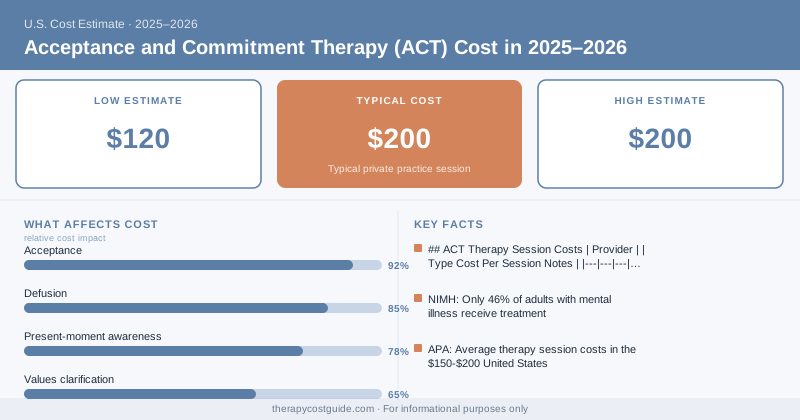
| Typical private practice session | $120 – $200 | Mid-size U.S. markets |
ACT session costs are in the same range as CBT — because the therapist credentials are the same. The difference is the training the therapist brings, not the license type.
What Is ACT and How Is It Different from CBT?
ACT (Acceptance and Commitment Therapy) is part of what researchers call the “third wave” of cognitive-behavioral therapies. It was developed by Steven Hayes at the University of Nevada and is grounded in Relational Frame Theory (RFT) — a behavioral science of language and cognition.
Where classic CBT focuses on identifying and challenging distorted thoughts (“cognitive restructuring”), ACT takes a different approach:
- Acceptance: Allowing difficult thoughts and feelings to exist without fighting them
- Defusion: Learning to observe thoughts as “just thoughts” rather than literal truths
- Present-moment awareness: Mindfulness as a foundation for flexible responding
- Values clarification: Identifying what genuinely matters to you
- Committed action: Taking values-driven action even in the presence of discomfort
The research comparison is interesting: A 2018 meta-analysis published in JAMA Psychiatry found ACT and CBT produce comparable outcomes for anxiety and depression, with ACT showing some advantages for chronic pain, stigmatized conditions, and situations where cognitive restructuring is difficult (e.g., many psychotic symptoms, deeply held beliefs).
ACT Session Count and Total Cost
ACT is generally delivered as a time-limited treatment — shorter than open-ended therapy, though often longer than some strict CBT protocols.
- Anxiety or depression: 8–20 sessions, most commonly 12–16
- Chronic pain: 8–16 sessions; ACT has particularly strong evidence for pain
- Obsessive-compulsive symptoms: 12–20 sessions (often combined with ERP)
- Substance use: 8–16 sessions as part of a broader program
- Eating disorders: 12–24 sessions
At $150/session for 16 sessions: $2,400 total out of pocket. With in-network insurance: $320–$960 (copay of $20–$60 for 16 sessions).
The RFT Basis: Why ACT Works Differently
Relational Frame Theory (RFT) explains why humans can suffer in ways other animals can’t: our language capacity means we can relate events symbolically, anticipate future suffering, and create evaluative hierarchies (comparing ourselves to how we “should” be). ACT doesn’t fight this capacity — it works with it by teaching psychological flexibility. The research on RFT as a model of cognition and the ACT clinical data have been developed in parallel, giving ACT an unusually solid theoretical foundation compared to some other newer therapy approaches.ACT Apps: Can You Reduce Costs With a Digital Supplement?
This is a legitimate question with an honest answer: yes, for mild-to-moderate symptoms, and as a between-session complement to live therapy.
ACT apps worth knowing about:
- ACT Companion: Designed by an ACT therapist, structured exercises across the six ACT processes. $5–$10/month.
- Woebot: AI-driven CBT/ACT hybrid, free. Decent evidence for mild depression/anxiety.
- Acceptance (app by Steven Hayes’ lab): Free; values clarification and defusion exercises directly from ACT’s developer.
- Mindfulness-based apps (Headspace, Calm): Target one ACT component (present-moment awareness) without the full model.
APA clinical practice guidelines caution that apps are appropriate adjuncts for mild-to-moderate presentations but should not substitute for clinical care in moderate-to-severe depression, trauma, or presentations requiring safety monitoring.
The cost-efficient approach for many people: 8–12 sessions with an ACT therapist to learn the model and work the primary target, followed by ongoing app-based practice for maintenance and skill-building.
Insurance Coverage for ACT
ACT sessions are billed as standard outpatient psychotherapy — same codes as any individual therapy session. There’s no separate “ACT code.” As long as your therapist is licensed and in-network, your standard mental health benefits apply.
NIMH research funding has supported multiple large ACT trials, reflecting its status as an evidence-based treatment recognized by the American Psychological Association and included in clinical practice guidelines for several conditions.
Finding an ACT-trained therapist: the Association for Contextual Behavioral Science (ACBS) maintains a therapist directory at contextualscience.org/civicrm/therapist-directory. Filter by location and condition.
Finding Affordable ACT Treatment
- ACBS therapist directory: contextualscience.org — find ACT-trained therapists by location
- Open Path Collective: Some ACT-trained therapists offer $30–$80 sessions for eligible clients
- University psychology departments: Graduate student therapists supervised by ACT-trained faculty
- Group ACT programs: Many conditions (chronic pain, anxiety) have group ACT protocols that cost $40–$80/session per person
- Self-help books: Steven Hayes’ A Liberated Mind and Russ Harris’ The Happiness Trap are widely used as ACT self-help resources — not a replacement for therapy, but valuable for understanding the model and beginning the work
ACT is one of the more transferable skill sets in therapy — the exercises, metaphors, and frameworks translate well to real life outside sessions, which means you often need fewer maintenance sessions after the initial treatment course.
{ if eq .Lang "zh" }Disclaimer: TherapyCostGuide provides cost information for educational purposes only. We are not a mental health provider and do not offer clinical advice or treatment. Cost ranges are based on national survey data and vary significantly by location, provider credentials, practice setting, and insurance plan. Always consult a licensed mental health professional for treatment decisions. If you are in crisis, call or text 988 (Suicide & Crisis Lifeline) or go to your nearest emergency room.